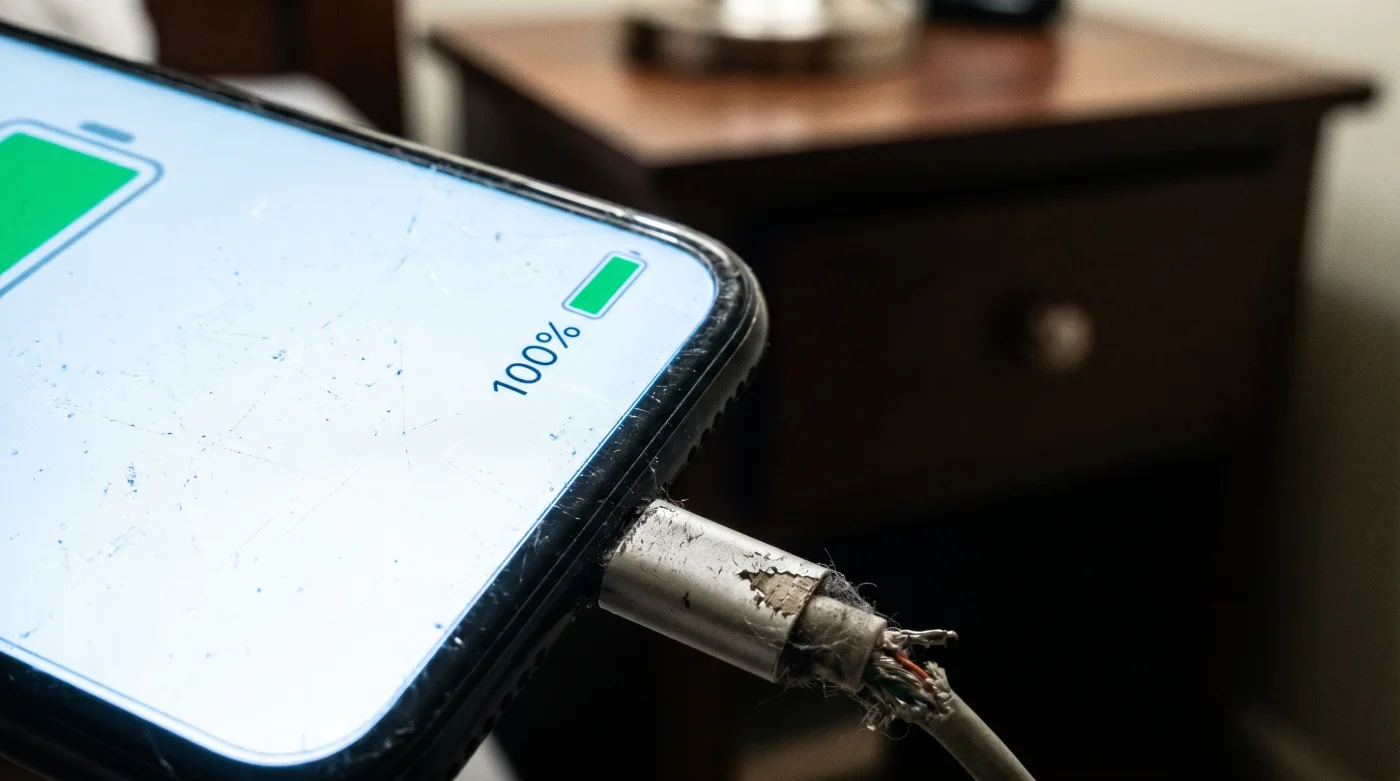
You plug the cable into the bottom of the device. There is that satisfying little click, followed by a soft, familiar chime. The screen lights up the dark bedroom for a second—a bright green battery icon promising a fresh start tomorrow. You pull the covers up, trusting that the overnight hours will miraculously reset your device’s stamina while you dream.
It feels like an act of care. You wouldn’t wake up to an empty fridge or drive off with a flashing fuel light, so feeding your electronics until they refuse another drop of power just makes sense. You drift off, leaving your devices plugged into the wall to feast until the morning.
But while you rest, an invisible physical struggle is happening inside that sleek metal and glass casing. Instead of resting, the chemical structure of your battery is holding a microscopic strain, much like an overinflated balloon waiting for dawn. What feels like preparation is actually a silent depreciation trap, quietly wearing down the lifespan of your most relied-upon tools.
The Physics of Fullness
Think of a lithium-ion cell like a heavy set of resistance bands. When the battery drains naturally, those bands relax. When you push electricity back into the system, you pull those bands taut. Hitting the eighty percent mark requires a reasonable amount of tension. Pushing it to a hundred percent is like stretching those bands until they shudder, demanding relentless mechanical stress just to hold that final fraction of energy in place.
By leaving the cord attached all night, you force the internal architecture to hold that extreme, strained posture for hours on end. Every time the battery drops to ninety-nine percent, the charger injects another microscopic jolt, keeping the system stretched to its absolute breaking limit. Over months, this constant pressure causes the internal compounds to physically fray, permanently reducing the amount of power it can actually store over time.
Elias Thorne, a 42-year-old hardware diagnostician who spends his days dissecting swollen smartphone frames in a Portland repair shop, sees this silent damage constantly. “People bring in phones that are barely a year old, complaining they die by lunch,” he says. He pulls up a diagnostic chart showing a jagged red line where the battery’s maximum capacity has cratered. “They tell me they take great care of it, plugging it in every single night. I have to gently explain that forcing the battery to hold maximum voltage all night has plummeted its storage capacity.”
Adjusting for the Night Owl
If you simply cannot break the habit of plugging in before your head hits the pillow, you have to find ways to shield your hardware from the wall outlet’s endless supply. The goal is to separate the physical act of connecting the cable from the chemical act of taking in electricity.
Both iOS and modern Android systems have an optimized charging toggle buried in their settings menus. Turning this on tells the phone to intentionally halt the electrical intake at eighty percent, only allowing that final, stressful twenty percent to trickle in an hour before your morning alarm rings. It turns a damaging eight-hour marathon into a brief, manageable sprint.
- Stainless Steel Pans Become Completely Nonstick With This Water Trick
- Ceramic Brake Pads Actually Increase Stopping Distance On Cold Mornings
- Retinol Serum Application Fails When Mixed With Standard Tap Water
- Medcom Go Streaming Servers Suddenly Throttle Free Background Data Usage
- Europa League Smart TV Apps Abruptly Drop Older Operating Systems
- Dishwasher Filter Cleaning Takes Three Seconds Using White Vinegar Ice
- Air Fryer Basket Airflow Doubles When You Remove This Rubber Stop
- Netflix Account Profiles Hide A Secret Resolution Downgrade Setting Internally
- Lease Agreement Renewal Clauses Automatically Lock You Into Rate Hikes
- Hyaluronic Acid Serums Actually Dehydrate Over-40 Skin Without Damp Application
For the Desk-Bound Professional
Your laptop is likely the biggest, most expensive victim of this depreciation trap. Sitting docked at a desk, tethered to a wall outlet for forty hours a week, means the power cells are trapped in a state of maximum tension indefinitely. They are suffocating under the pressure of being perfectly full.
To fix this routine, you need to introduce artificial scarcity into your workweek. Make it a habit to unplug the power brick on Mondays and Thursdays. Let the machine drain naturally down to around thirty percent before giving it a short burst of life. Some modern work laptops also offer a built-in charge limit in their system preferences, physically capping the intake at a healthy medium so you can leave it docked without guilt.
The High-Draw Commuter
The massive lithium packs bolted to electric bikes and scooters represent a serious financial investment. Plugging them into the garage wall and forgetting them over the weekend does not just degrade the cells—it risks severe chemical fatigue that can render a thousand-dollar battery completely useless.
Because these larger batteries often lack the smart-charging software found in phones, you have to build a physical barrier. Put these chargers on a cheap analog wall timer. Give the bike three hours of juice after your commute and let the dial mechanically sever the power supply. The battery will sit comfortably at an eighty percent charge, relaxed and ready for Monday morning.
Restoring Balance to Your Devices
Moving away from the obsession with a hundred percent requires a slight rewiring of your daily routine. It means finding comfort in a battery indicator that hovers somewhere around the middle of the gauge, rather than demanding it always sit at the absolute peak.
Instead of massive overnight feeding frenzies, try grazing your devices. Give them a twenty-minute boost while you shower, or plug them into the dashboard while commuting. This creates a gentle ebb and flow of energy, sparing the chemical architecture from extreme highs and crushing lows. Your devices will run cooler, and their health percentage will hold steady for years.
- The Comfortable Middle: Keep your devices between forty and eighty percent whenever you can.
- Temperature Awareness: Never charge a device that feels hot against your skin; heat combined with high voltage breaks down polymers instantly.
- Analog Boundaries: Use a basic smart plug scheduled to shut off two hours after you fall asleep.
- Software Safeguards: Audit your laptop and phone settings for battery care modes and turn them on today.
Rethinking Digital Stamina
We cling to the idea of a fully charged device because it offers an illusion of absolute preparedness in a chaotic world. Seeing that solid green bar at the top right of the screen feels like a comforting shield against the unexpected delays and long days ahead. But true reliability does not come from forcing our tools to their absolute breaking point every single night.
By embracing a more mindful approach to power, we extend the life of the objects we rely on most. We stop paying the silent tax of early upgrades and swollen batteries. Letting go of the need for perfect fullness teaches us a quiet lesson in sustainability—giving our tools just enough energy to perform, and allowing them the grace to finally rest.
“A battery is like a human stomach; keeping it stuffed to the absolute brim all the time doesn’t make it stronger, it just ruins the digestion.” — Elias Thorne, Hardware Diagnostician
| Key Point | Detail | Added Value for the Reader |
|---|---|---|
| Overnight Charging | Forces battery to hold 100% tension for 8+ hours. | You understand why your battery dies by 2 PM after only a year. |
| ‘Grazing’ Charge | Short 20-minute bursts throughout the day. | Triples the overall lifespan of your expensive hardware. |
| Optimized Settings | Software halts charge at 80% until morning. | Gives you peace of mind without requiring a change in physical habits. |
Frequently Asked Questions
Is it okay to charge my phone to 100% occasionally? Yes. Pushing it to maximum capacity for a long trip or busy day is fine; it is the daily, prolonged tension of overnight charging that causes permanent damage.
Should I let my battery drain to zero before charging? No. Modern lithium-ion cells suffer chemical stress when completely emptied. Try to plug in when it hits twenty percent.
Does fast charging damage the battery more than slow charging? Fast charging generates more heat, which can accelerate degradation. If you are charging overnight or at your desk, a slower, lower-wattage charger is physically gentler on the device.
Why do manufacturers make phones that let us ruin the battery? Manufacturers prioritize the immediate convenience of a full-day charge out of the box. They also benefit financially when you upgrade a device with a degraded battery two years later.
Does leaving a laptop plugged in all the time pose a fire risk? While modern battery management systems prevent disastrous overcharging, a permanently degraded and swollen battery can become a physical hazard if ignored.