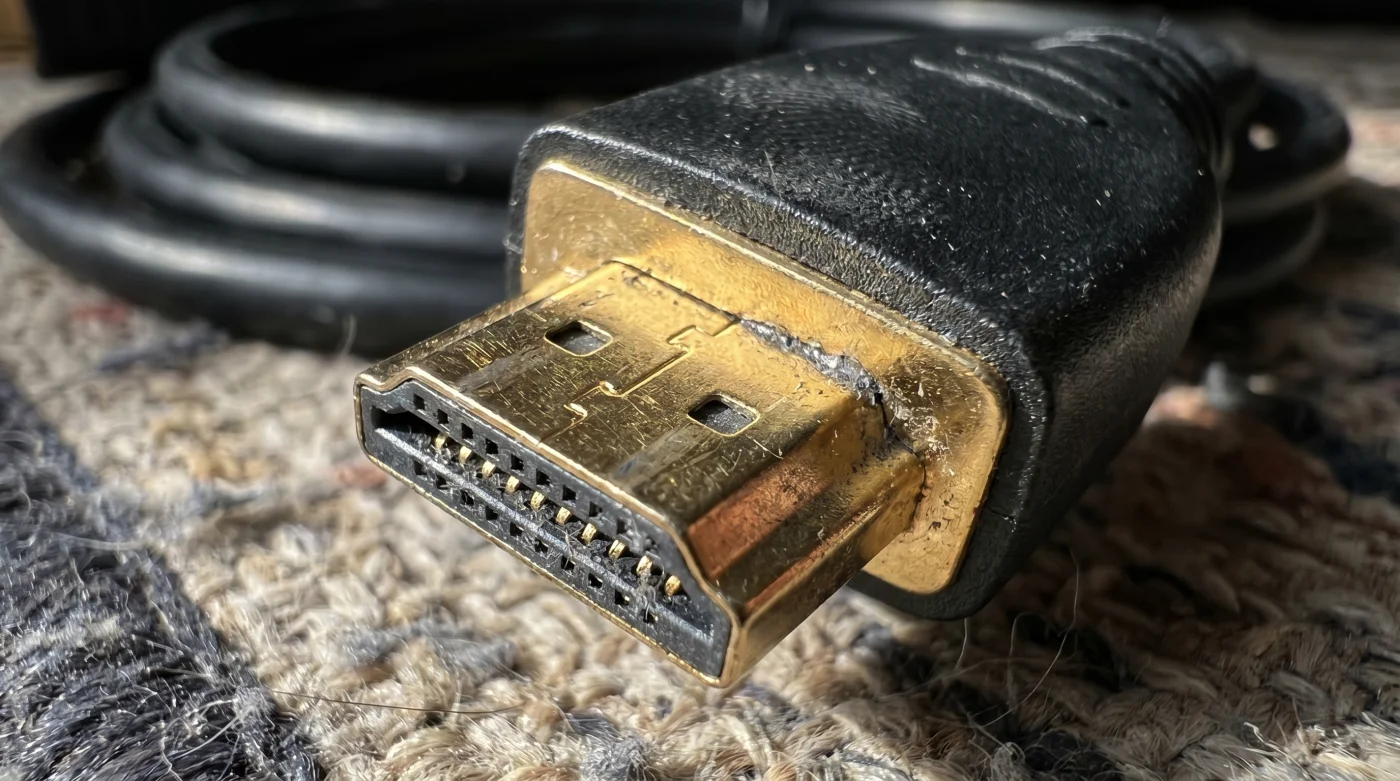
You are standing under the harsh fluorescent hum of a big-box electronics store, clutching a cardboard box that feels suspiciously heavy. The salesperson just spent five minutes explaining how this specific cord will make your new television colors richer and your soundbar perform perfectly. It sits nestled in molded plastic, wrapped in thick braided nylon, with connectors gleaming like fine jewelry.
The price tag is staggering, but you just spent a small fortune on the television itself. Protecting your financial investment feels like the responsible thing to do, so you drop the eighty-dollar box into your cart, assuming you are buying peace of mind.
But there is a quiet reality hiding behind the velvet-lined packaging and the pseudo-scientific marketing jargon. You are holding a beautifully decorated pipe, and the water flowing through it does not care about the color of the plumbing.
The Digital Cliff: Why Signal Purity is a Myth
To understand the deception, you have to let go of how television used to work. In the days of analog signal, utilizing heavy coaxial wires and three-pronged component cords, the signal degraded gracefully. A cheap analog setup acted like a leaky hose; you lost a little pressure along the way, resulting in a fuzzy picture, duller colors, or a faint buzzing in your speakers. Better shielding and tighter connections actually meant a clearer image. That physics no longer applies to the high-definition screens sitting in your living room today.
High-Definition Multimedia Interface (HDMI) relies strictly on digital information. It sends packets of ones and zeros across the room. Think of it less like a water pipe and more like a delivery truck carrying sealed boxes. The television does not evaluate how pretty the truck is; it just opens the boxes.
If the truck arrives, the picture is perfect. If the truck crashes, the screen goes black, or you see harsh, sparkling digital artifacts. There is no middle ground where a premium gold-plated connector suddenly makes the greens in a nature documentary look richer. It is a strict binary—it either functions flawlessly, or it fails completely.
Marcus is a forty-two-year-old independent audio-visual installer in Chicago, spending his weeks pulling miles of wiring through the drywall of multimillion-dollar renovations. When clients hand him heavily marketed, exotic-metal cords to install behind their custom theater racks, he politely hands them back. Marcus buys his inventory in bulk, wrapped in plain plastic bags for less than the cost of a fast-food lunch. “The electrons do not care about the branding,” he often tells his clients, wiping drywall dust from his hands. “You pay for bandwidth, not for jewelry. If the signal locks in, you have achieved absolute perfection.”
The ‘Buy Once’ Logic: Finding Your True Baseline
Once you strip away the anxiety of the upsell, purchasing the right equipment becomes an exercise in simple logistics. You only need to match the data capacity of the wire to the demands of your hardware. Ignore the marketing buzzwords and look exclusively at the numeric speed ratings printed directly on the rubber jacket.
- Hyaluronic Acid Serums Accelerate Wrinkles Without This Crucial Moisture Seal Layer
- HEPA Vacuum Filters Double Their Lifespan With One Tactical Tape Modification
- Beca Application Portals Auto-Approve Forms Submitted During These Specific Late Hours
- Tesla Navigation Systems Secretly Depreciate Your Battery Lifespan During Daily Commutes
- Air Fryer Baskets Degrade Instantly When Cleaned With Standard Dish Soap
- Medcom Go Streams Degrade Deliberately Unless You Disable This Default Setting
- NBA Streaming Accounts Suddenly Lock Out Users Sharing Wi-Fi Networks
- Telemetro Canal 13 Broadcasts Abruptly Remove Digital Access For Smart TVs
- Memory Foam Mattresses Regain Original Firmness Using A Hair Dryer
- Washing Machine Drain Filters Clean Themselves Using This Tablet Hack
For the Weekend Cinephile
If your evening routine involves sinking into the couch to stream movies from a standard smart television, your needs are incredibly modest. You are dealing with 4K resolution at sixty frames per second. Look for a standard High Speed cable rated for 18 Gbps, often labeled as HDMI 2.0. These cost less than ten dollars, and they will comfortably handle any compressed streaming service perfectly for the lifespan of your television.
For the Next-Gen Gamer
Perhaps you have a high-end console or a dedicated gaming PC hooked up to a screen capable of 120 frames per second. Pushing that much visual data requires a wider highway. You need Ultra High Speed cables, rated for 48 Gbps, commonly known as HDMI 2.1. Even these should not cost more than fifteen or twenty dollars. Do not let anyone convince you that an expensive brand will reduce controller lag; the speed of light remains constant regardless of the logo.
For the Architectural Perfectionist
The only time you should pause and reconsider your budget is when distance becomes the enemy. If you are routing a connection through the ceiling to a projector, or running it more than fifteen feet across a room, standard copper wiring begins to lose the signal entirely due to physical resistance.
In these specific scenarios, you are not buying better copper; you are changing the technology entirely. You need an Active Optical Cable, which converts the electrical signal into light. Distance dictates the required tech, but even then, you are paying for the microscopic fiber-optic conversion chips inside the connector, not for arbitrary luxury materials.
The Tactical Toolkit: Testing What You Already Own
Rather than rushing out to replace your current setup, take a mindful inventory of the wiring already tangled behind your media console. Often, the cord that came free in the box with your streaming device is fully capable of handling your daily needs. Evaluating your setup should be a quiet, methodical process of elimination.
If you are experiencing random screen blackouts, audio drops, or tiny white dots flashing across darker scenes, your cable is failing to deliver the data packets. This is the digital cliff in action. Follow this brief diagnostic checklist to ensure your system is running at its actual peak:
- Check the physical seating: Ensure the plug is pushed flush into the port. A millimeter of sag from gravity can sever the digital handshake.
- Inspect the wire jacket: Look for sharp right-angle bends or heavy furniture pinching the rubber. Damaged copper pathways will drop data packets.
- Read the fine print: Search the actual cord for stamped text saying High Speed or Ultra High Speed to verify its bandwidth rating.
- Test the direct line: Bypass your soundbar or receiver temporarily. Plug the source directly into the television to isolate the exact point of failure.
Quiet Competence in the Living Room
Mastering this specific detail is not just about saving fifty dollars at the checkout counter. It is about actively rejecting the engineered anxiety that modern retail relies upon. When you understand how the underlying system functions, you strip away the illusion that spending more money automatically equates to a better experience in your home.
You can sit down to watch a film with your family, knowing the picture is exactly as the director intended. There is a deep satisfaction in that quiet competence. You keep your hard-earned money in your pocket, reallocating it toward actual experiences like new movie rentals, warm popcorn, and comfortable lighting. The magic of your home theater lives in the stories unfolding on the screen, completely unbothered by the humble, inexpensive wire delivering them.
“The electrons flowing from your console to your television do not care about the brand name stamped on the plastic; they only demand a highway wide enough to travel without collision.”
| Key Point | Detail | Added Value for the Reader |
|---|---|---|
| Digital Signal Reality | Data arrives as strict binary code without subjective degradation. | Eliminates the anxiety of buying expensive picture-enhancing accessories. |
| HDMI 2.0 (18 Gbps) | Sufficient bandwidth for standard 4K streaming at 60Hz. | Saves you money by identifying the exact baseline for the average living room. |
| HDMI 2.1 (48 Gbps) | Required for high-framerate gaming consoles and computers. | Ensures maximum hardware performance without overpaying for aesthetics. |
| Long-Distance Runs | Standard copper fails after 15 feet; Active Optical is required. | Prevents frustrating installation failures during major home renovations. |
Frequently Asked Questions
Do gold-plated connectors improve audio quality?
No. Because audio is transmitted digitally alongside the video, the signal does not benefit from enhanced analog conductivity. The sound works perfectly or drops out entirely.Why do some premium cables cost so much more?
You are paying for aggressive marketing, heavy packaging, braided nylon covers, and high retail markups, none of which alter the digital data transfer.Can a cheap wire cause input lag while gaming?
A functioning wire cannot cause lag. The speed of the electrical signal is constant. Any noticeable lag is introduced by the television processor, not the physical connection.How long do these cords last before degrading?
Unless they are physically damaged, bent to the point of breaking, or exposed to extreme heat, they will outlast the television they are plugged into.Are the cables included in the box with my console good enough?
Yes. Manufacturers include wires that specifically meet the exact maximum bandwidth requirements of their device to ensure you do not experience setup failures.