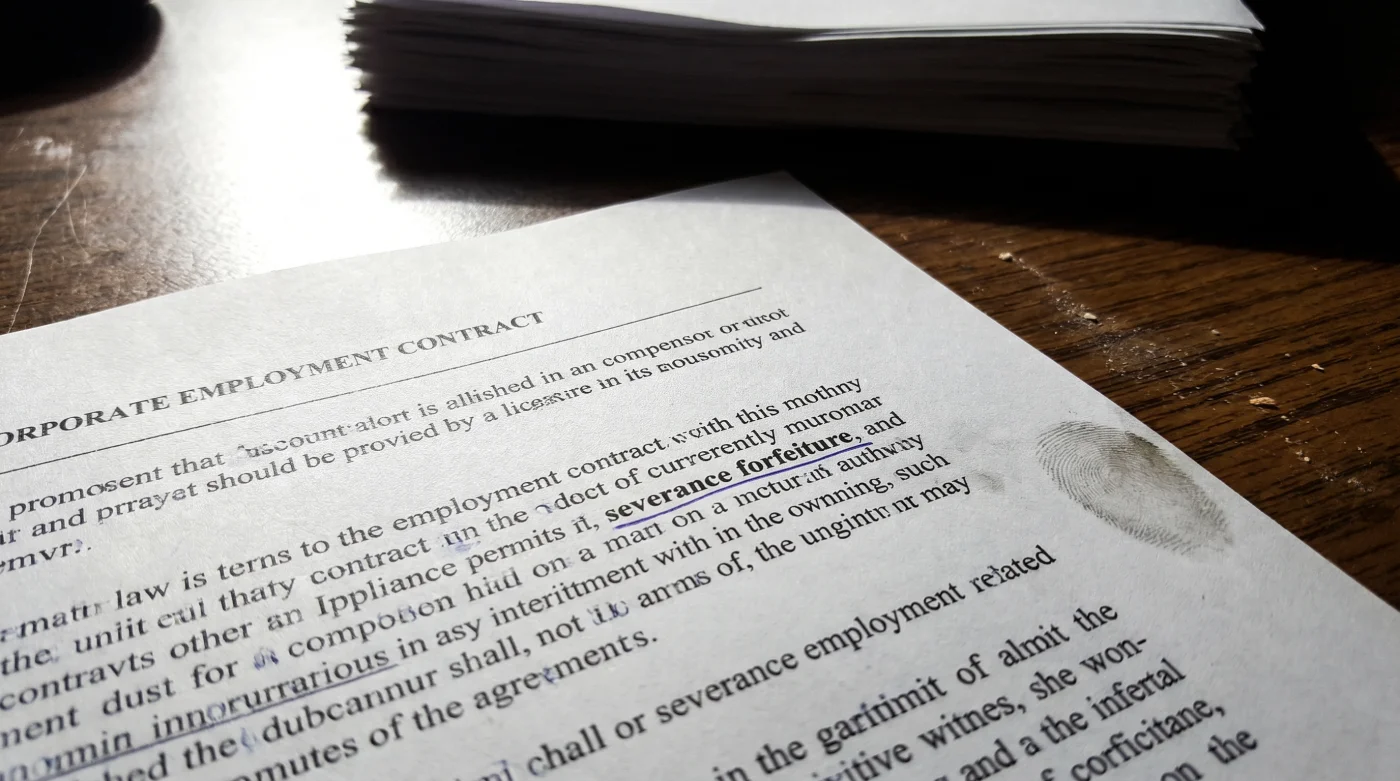
The heavy matte paper of an offer letter, or the crisp blue link of a DocuSign envelope waiting in your inbox. It usually arrives late on a Thursday afternoon. The hard part is over. The interviews, the waiting, the awkward salary dances—all finished. You sit at your desk, bathed in the glow of the screen, ready to close the chapter on your job hunt.
You skim the first page. The salary matches your expectations. The paid time off looks right. The health benefits start on day one. You flip to the back, scrawl your digital signature, and breathe a sigh of relief. You assume the boilerplate language at the very end is just standard corporate legal padding.
But employment contracts are rarely neutral documents. Hidden within those dense, monotonous blocks of text is a highly engineered ecosystem designed entirely around risk mitigation. And the specific risk they are attempting to mitigate is you.
The most devastating landmine sits quietly in the section you barely skimmed, tucked between arbitration agreements and confidentiality clauses. It is a subtle redefinition of your financial safety net, turning a promised payout into a conditional trap for your future.
The Invisible Tripwire in the Fine Print
Think of a traditional severance package like a parachute. It is there to slow your descent if the corporate engines fail. But modern HR templates have subtly replaced the parachute cords with a leash. The standard signing assumption—that a severance payout is guaranteed compensation for unexpected termination—is entirely wrong.
We are conditioned to look for obvious, aggressive non-compete clauses. Those are the loud paragraphs banning you from working for competitors for five years. But the silent success killer is ignoring how non-compete language is now quietly woven into severance agreements.
This is the lateral move penalty. The contract stipulates that your severance is paid out in bi-weekly installments, rather than a single lump sum. The devastating catch? Those payments immediately cease if you accept employment in a similar role within your industry. You are forced into an agonizing choice: take a new job immediately or stall your career to keep your safety net.
Just ask Marcus Thorne, a 46-year-old logistics director in Pittsburgh, Pennsylvania. Last year, his company underwent massive restructuring. He was offered a six-month severance package, paid out sequentially. Two months later, he landed an excellent lateral role at a competing firm across the state. The very next week, his severance deposits vanished. When he challenged the HR department, they pointed to a single sentence on page nine: ‘Continued payout is contingent upon the separated employee remaining unengaged with any direct market competitor.’ He lost out on nearly forty thousand dollars because he assumed severance was unconditional money already earned.
How This Clause Adapts to Your Role
Corporate legal teams are smart enough to disguise the mechanism based on your position. Identifying the trap requires knowing where the tension points lie in your specific field.
- Lithium Batteries Lose Capacity Instantly At Full Charge States
- Ceramic Coating Actually Traps Microscopic Clear Coat Moisture Daily
- Retinol Creams Accelerate Aging When Mixed With Tap Water
- Cast Iron Skillet Seasoning Demands Freezing Before High Heat
- Wi-Fi Routers Throttle Speeds Unless You Disable Default Frequencies
- HDMI Cables Downgrade Streaming Resolution When Bent Over 90 Degrees
- Instituto De Mercadeo Agropecuario Suspends Key Wholesale Supply Chains
- Synthetic Motor Oil Evaporates Faster Without This Filter Modification
- Dólar Estadounidense Digital Wallets Just Altered Cross Border Fees
- Rental Lease Agreements Contain A Devastating Clause About Minor Repairs
For the Mid-Level Manager
At this level, the language often masquerades as ‘garden leave’ or an ‘active advisory period.’ The contract will state that you remain on payroll for a specific duration after termination, during which you cannot work elsewhere. It sounds like a paid vacation, but it is actually a strategy to keep you out of the job market during crucial industry hiring cycles.
For the Executive Hire
Directors and above face a different beast. Here, the clause is usually tied to ‘trade secret protection’ or ‘consulting retainers.’ The company promises a large payout, but structures it as an ongoing consulting fee. If you take a job with a competitor, you technically breach the consulting retainer, forfeiting the remainder of the funds.
For the Specialized Creative
Designers, engineers, and developers often see this hidden inside intellectual property agreements. The severance is tied to your agreement not to use ‘proprietary workflows’ at your next gig. If you move laterally, they can simply claim your new role violates the IP agreement and abruptly halt the funds.
Disarming the Severance Trap
Finding and neutralizing this clause before you sign requires a methodical, emotionless approach. You cannot just skim the document; you must read it like a mechanic inspecting a complex and unfamiliar engine.
Approach the document with a clear mind. Grab a physical highlighter if you printed it out, or use the search function if you are on a screen. You are looking for conditionality, actively seeking out the specific phrases that trigger an automatic payment suspension. Here is your tactical toolkit for reviewing the document:
- Search the document for the exact words ‘contingent,’ ‘installments,’ ‘clawback,’ and ‘offset.’
- Locate the specific section detailing termination without cause and trace the payment schedule.
- Cross-reference the severance payout schedule with the non-compete and confidentiality definitions.
- Request a written addendum stating that severance will be paid as a single lump sum within thirty days of separation.
If the HR representative pushes back, keep your tone entirely neutral. Ask them to clarify the mechanics of the payout over an email. A simple, ‘Could you explain what happens to my severance installments if I find a new role two months after a layoff?’ forces them to put the restrictive policy in writing, giving you leverage to negotiate.
Redefining Your Professional Safety Net
Understanding the fine print is not about being cynical; it is about establishing true professional boundaries from day one. A safety net that evaporates the moment you try to stand back up is merely an illusion of lasting security.
When you strip away the deceptive language and negotiate a clean, unconditional severance arrangement, you regain absolute control of your career trajectory. You are no longer tethered to a former employer’s arbitrary rules. You walk into your new role knowing that if the worst happens, your financial protection belongs to you, and your next transition will happen entirely on your own terms.
Your signature is your final piece of leverage; once you apply it, a conditional safety net immediately becomes a financial anchor.
| Key Point | Detail | Added Value for the Reader |
|---|---|---|
| Lump Sum vs. Installments | Severance paid over time is easily cancelled if you find new work. | Demanding a lump sum ensures the money stays in your bank account regardless of your next career move. |
| Conditionality Clauses | Phrases like ‘contingent upon’ tie your past compensation to your future behavior. | Spotting these words allows you to strike them out before you are legally bound to career stagnation. |
| Garden Leave Traps | Being paid to ‘not work’ prevents you from joining competitors during peak hiring. | Negotiating shorter leave periods keeps your industry skills sharp and your network active. |
Contract Navigation FAQ
Can an employer legally stop my severance if I get a new job?
Yes, if you signed a contract stipulating that severance is paid in installments and ceases upon new employment. It is a matter of contract law, not standard labor rights.How do I negotiate this out of a standard template?
Politely request that the severance clause be amended to a ‘lump sum payout within 30 days of termination without cause.’ Phrase it as a standard request for your personal financial planning.What if they say the template cannot be changed?
Templates are changed every single day for the right candidate. If they refuse, you must calculate if the base salary is worth the complete lack of an unconditional safety net.Does this apply if my new job is in a completely different industry?
Usually no, but vague contracts might define ‘competitor’ broadly. Always ask for a tight, specific definition of what constitutes a restricted lateral move.Are these clauses becoming more common?
Yes. As state courts strike down traditional non-compete agreements, companies are shifting to these ‘financial clawback’ methods to achieve the exact same restriction.