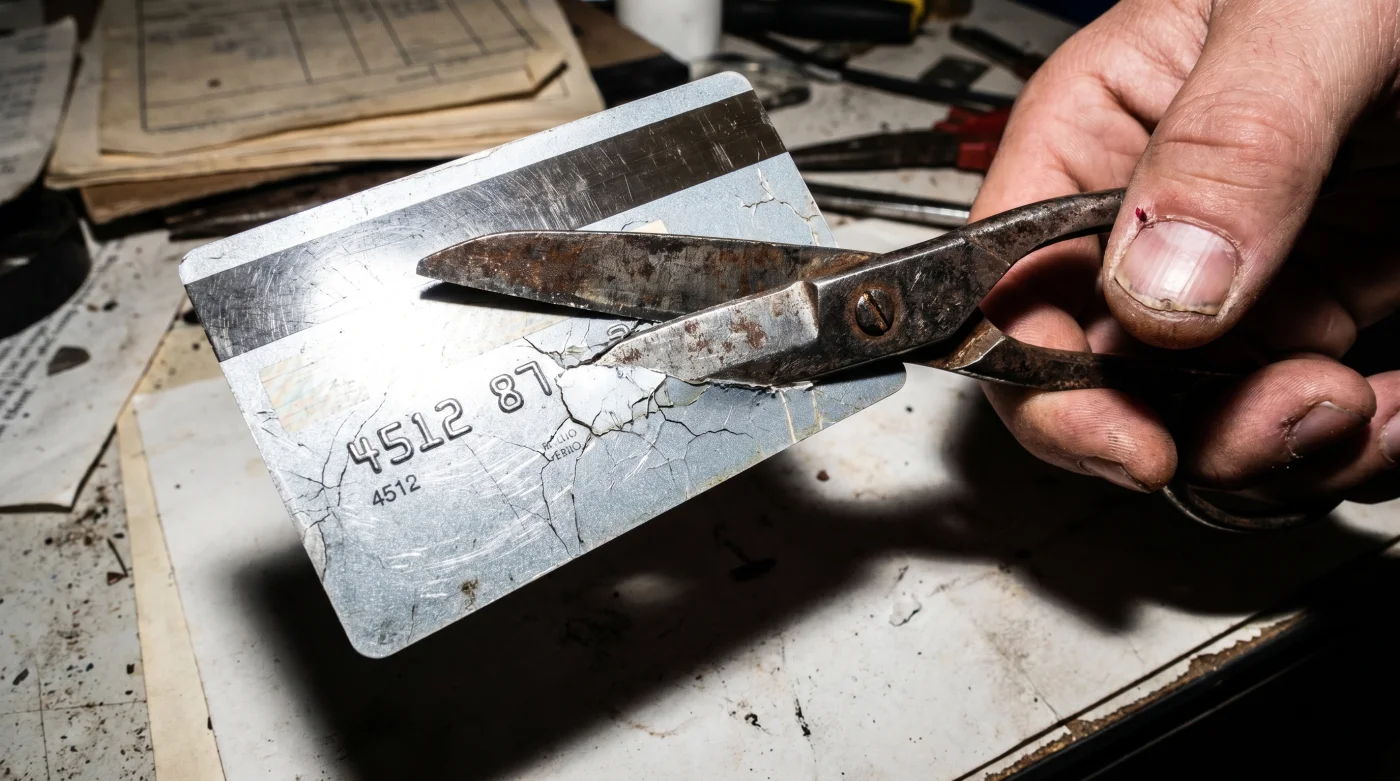
The heavy kitchen shears slide through the stiff plastic with a satisfying, final crunch. You stare at the bisected credit card on your dining table, breathing a sigh of genuine relief. The statement balance reads zero. After months, maybe years, of chipping away at that specific debt, the instinct to sever the tie completely feels like the ultimate act of financial self-care. You pick up your phone, dial the customer service number on the back of the severed half, and tell the automated voice to close the account forever.
It feels like a victory lap. You crave a clean slate, assuming that fewer open lines of credit mean a tidier, more responsible financial profile. The prevailing wisdom whispered around office watercoolers and family dinners suggests that cutting up the cards and closing the doors is the only way to prove you are finally in control. You are punishing the plastic that once caused you stress.
But that instinct is walking you blindly into a hidden trap. In the silent, mathematical machinery that dictates your financial life, you haven’t just cleaned house. You have accidentally destroyed the very foundation of your reputation. The algorithms that govern your borrowing power do not see a responsible consumer trimming the fat; they see a sudden, alarming instability.
The Illusion of the Empty Drawer
Think of your credit profile not as a messy closet to be purged, but as a lifelong reputation in a tightly-knit town. When you officially close your oldest paid-off account, you are effectively silencing the oldest resident who has vouched for your character. This is the silent success killer that catches millions of responsible planners completely off guard.
Two distinct metrics govern this reality. The first is your average age of accounts. Lenders trust longevity. Time builds structural financial trust, and wiping out a decade-old account drags your average history down to the level of a novice. The second, and more violent metric, is your credit utilization ratio. If you have three cards with a combined limit of thirty thousand dollars, and you close the empty one holding ten thousand of that limit, your overall available credit instantly shrinks. If you carry a balance on the remaining cards, your utilization percentage spikes overnight, signaling financial distress to the algorithms even if you haven’t spent a single extra dime.
Marcus Thorne, a 42-year-old mortgage broker working out of a bustling Philadelphia firm, watches this specific tragedy unfold every spring. Last April, a couple sat in his office with pristine incomes and a surprisingly bruised score. They had spent the previous weekend proudly closing four old department store cards they hadn’t touched since their college days. By doing so, they accidentally wiped out 15 years of credit history and halved their total available limit. Their scores plummeted 60 points in a matter of days, shifting their pending mortgage rate from comfortable to agonizing. Marcus had to explain that their attempt at responsibility had cost them tens of thousands of dollars in lifetime interest.
Navigating the Plastic Purge
Not everyone closes accounts for the same reason. Understanding your own motivation helps you navigate around this hidden penalty.
- Retinol Serums Actively Accelerate Skin Aging Applied Before Moisturizers
- Tottenham Brighton Streams Suddenly Blocked On Premium Mobile Networks
- Merca Panama Subsidies Abruptly Halted By Local Market Officials
- Lithium Batteries Outlast Standard Alkaline Cells Avoiding Fast Chargers
- Resume Formats Pass AI Scanners Instantly Deleting Objective Statements
- Coffee Makers Clean Themselves Bypassing Standard Chemical Descaling Processes
- Airline Luggage Tags Bypass Routing Errors Using Permanent Marker
- Synthetic Leather Seats Destroy Vehicle Resale Value During Summer
- Dishwasher Racks Double Water Pressure Bending This Bottom Tine
- Olive Oil Becomes Bitter And Toxic Used For Skillet Seasoning
For the Strict Minimalist
You hate digital clutter. You want a single card for groceries and one for emergencies, preferring a streamlined dashboard when you check your banking app on Sunday mornings. Minimalism penalizes historical data when applied to credit. Instead of closing the old accounts to hide them from view, remove the physical cards from your wallet and simply hide the accounts on your digital dashboard. You keep the clean aesthetic without sacrificing the mathematical anchor.
For the Debt Survivor
You just clawed your way out of a high-interest hole. The mere sight of that specific bank logo makes your stomach turn, triggering a visceral anxiety about falling back into bad habits. The urge to close it is emotional protection. Instead of canceling it, ask the issuer to lower the limit to a trivial amount, or physically freeze the card in a block of ice in your freezer. You create a physical barrier to spending while keeping the financial history alive.
For the Reward Chaser
You opened the account five years ago solely for the airline miles. Now, the card sits idle, perhaps carrying an annoying annual fee. This is the one scenario where closing an account might make sense, but only if you negotiate first. Call the issuer and ask for a product change. Downgrade to fee-free plastic within the same account number. You stop paying the yearly toll, but you preserve the timeline of the account.
Taming the Idle Account
Keeping an old account open requires a delicate, mindful approach. You cannot simply throw the card in a drawer and forget it exists, as banks will eventually close inactive accounts on their own. You need a system of quiet maintenance.
Treat your oldest cards like a low-maintenance houseplant. They need just enough water to stay alive, but not enough to cause a mess. Set up a system that runs automatically in the background of your life.
- The Single Subscription: Tie one small, recurring monthly charge to the old card. A five-dollar streaming service or a digital magazine subscription is perfect.
- The Auto-Pay Shield: Configure your bank to automatically pay that specific card’s statement balance in full every single month.
- The Physical Lockbox: Remove the card from your everyday wallet. Store it in a fireproof safe or a distant desk drawer so it never tempts you at a checkout counter.
- The Alert System: Turn on text notifications for any purchase over ten dollars. Since you only use it for one small subscription, any alert will instantly warn you of fraud.
The Weight of Patient Time
We live in a culture that rewards immediate action. We want to delete, purge, and organize our way to a clearer mind. But true financial stability operates on a different, slower rhythm. Time is the single currency you cannot earn through hard work or clever hacks. You simply have to wait for it.
By leaving those old, paid-off accounts quietly active, you are doing something incredibly rare: you are letting patience do the work. You are allowing your past responsible choices to continuously advocate for your future. When you look at that old piece of plastic sitting idle in a drawer, do not see a liability. See it as a silent partner, quietly holding up the foundation of your financial life, asking for nothing but to be left alone.
Credit isn’t about what you currently owe; it is about the resilient trust you’ve built over decades. Never silence your oldest references.
| Action | Immediate Consequence | Financial Reality for the Reader |
|---|---|---|
| Closing the oldest account | Drastic drop in average credit age | Makes you appear as a high-risk novice to lending algorithms |
| Removing available credit | Spikes utilization percentage immediately | Lowers your score even if you haven’t spent new money |
| Automating a small charge | Keeps the account marked as active | Preserves your historical score anchor with zero daily effort |
Frequently Asked Questions
Will my score drop the exact day I close the card? Usually, the drop hits your score within 30 to 45 days, as soon as the lender reports the closed status to the major bureaus.
What if the old card has a massive annual fee? Always call the issuer and request a product change to a zero-fee card. This changes the terms but keeps the original credit history intact.
How long does a closed account stay on my report? A closed account with positive history can remain for up to ten years, but the loss of available credit hits your utilization ratio the moment it closes.
Does closing a newer card hurt as much? No. Closing a card you opened six months ago won’t drastically hurt your average age, but it will still shrink your total available credit limit.
Is it better to let the bank close it for inactivity? No. It is always better to control the narrative. Keep it active with a tiny, automated charge rather than risking an unannounced closure.