You set the heavy skillet on the burner, the morning light catching its polished rim. The plan is a simple fried egg. But as soon as the whites hit the metal, you hear that aggressive hiss, and instantly, the edges seize.
You know the aftermath before the yolk even sets. A jagged, torn mess clinging stubbornly to the bottom of the pan. You spend more minutes scrubbing the ruined remnants under the faucet than you did actually eating your breakfast.
It feels like an unsolvable physical law. Without a fragile, chemical coating, delicate proteins simply weld themselves to bare metal. So, you keep buying those flimsy skillets that scratch and degrade within a year, assuming there is no other way to cook a pristine over-easy egg.
Yet, in busy restaurant kitchens, line cooks flip delicate fish and crack endless eggs into battered, uncoated metal without a single snag. They are not fighting the skillet. They are mastering a physical hack that turns a punishing surface into a frictionless slide.
The Hovercraft Principle
We are taught that a surface must be chemically slick to prevent sticking. You look at a pristine stainless skillet and see a porous, unforgiving trap waiting to grip your food.
The truth is far more elegant. You don’t need a factory coating; you need an invisible vapor barrier. This is the Leidenfrost effect, a phenomenon where heat transforms the food’s own moisture into a microscopic, protective cushion.
Imagine a heavy hovercraft gliding over rough gravel. The gravel hasn’t changed, but the cushion of air prevents any actual contact. When you heat bare metal correctly, the water in your butter, oil, or food vaporizes the split second it touches the pan.
That rapid vaporization creates a literal gap. Your morning egg is never touching the steel directly; it is surfing on a millimeter of its own steam.
Marcus Thorne, a 42-year-old morning cook at a high-volume diner in Philadelphia, handles a staggering rush using only heavy, battle-scarred skillets. He doesn’t rely on fragile synthetics or heavy sprays. He relies on a plastic squirt bottle of tap water and a practiced flick of his wrist. He watches how the water dances on the metal, knowing the precise fraction of a second when the steel transforms from a trap into a trampoline.
Adapting the Barrier for Different Routines
Understanding this physical shift changes how you approach every meal. But the heat required to create this frictionless glide varies slightly depending on what you are dropping into the pan.
For the Morning Egg Traditionalist
Eggs require finesse. Because their protein structures are so fragile, you want the lowest possible threshold of the Leidenfrost effect. If the pan is too hot, the edges turn rubbery before the yolk warms.
You must preheat gently, bringing the metal up to temperature over a moderate flame. The goal is a soft, rolling sizzle rather than an aggressive shock.
- Ceramic Brake Pads Actually Increase Stopping Distance On Cold Mornings
- Retinol Serum Application Fails When Mixed With Standard Tap Water
- Medcom Go Streaming Servers Suddenly Throttle Free Background Data Usage
- Europa League Smart TV Apps Abruptly Drop Older Operating Systems
- Dishwasher Filter Cleaning Takes Three Seconds Using White Vinegar Ice
- Air Fryer Basket Airflow Doubles When You Remove This Rubber Stop
- Netflix Account Profiles Hide A Secret Resolution Downgrade Setting Internally
- Lease Agreement Renewal Clauses Automatically Lock You Into Rate Hikes
- Hyaluronic Acid Serums Actually Dehydrate Over-40 Skin Without Damp Application
- MacBook Pro Battery Life Drains Instantly Because Of Desktop Widgets
For the Weekend Sear Enthusiast
Steaks and dense proteins demand a violent reaction. Here, you want a thicker vapor barrier to handle the heavy mass of the meat. You push the temperature slightly higher before adding your cooking fat.
The meat will initially grab the pan. This is normal. As the crust forms, the moisture releases its grip, allowing you to flip the steak with nothing more than gentle pressure from tongs.
Executing the Mercury Bead Test
You don’t need an infrared thermometer to find this exact temperature. You only need a few drops of tap water from your fingers. This is a tactile, mindful process of reading the metal.
Place your completely dry skillet on medium heat. Walk away for two minutes. Do not add oil yet; heating bare metal forces the microscopic pores to expand and stabilize.
After a few minutes, flick a tiny splash of water into the center of the pan. Watch closely how the droplets react.
- If the water sits there and slowly boils into steam, the pan is too cold. Your food will weld to the metal.
- If the water shatters instantly into dozens of tiny, angry micro-droplets that spit everywhere, the pan is too hot. Your fat will scorch.
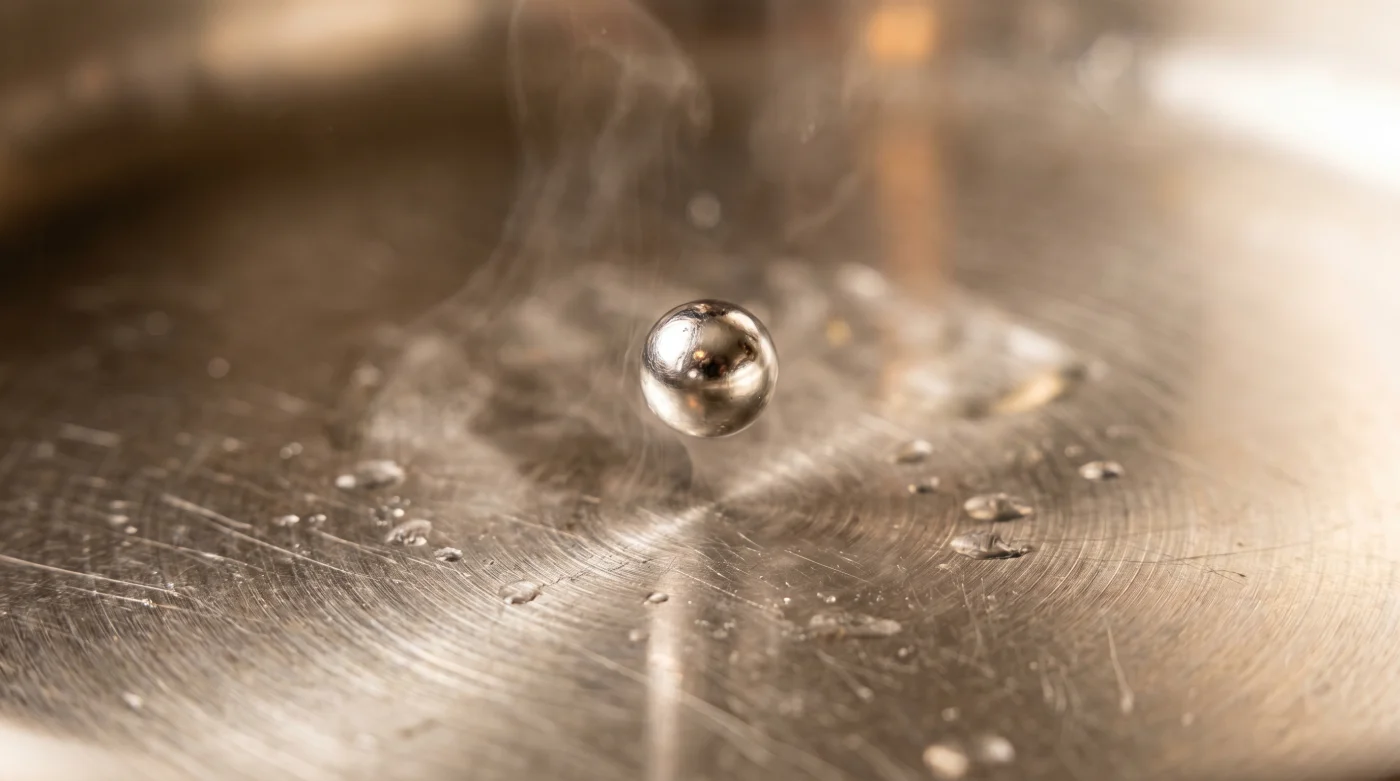
- If the water pulls together into a single, cohesive sphere that races around the pan like a bead of mercury, you have found the exact threshold.
Once you see that dancing bead, wipe it out quickly with a dry towel. Now, you pour in your chosen cooking oil, letting it coat the bottom for ten seconds before adding your food.
A Lifetime of Quiet Mornings
It takes perhaps three or four attempts to trust this process. The urge to nudge, scrape, and panic when the egg hits the pan is a hard habit to break. But once you see an over-easy egg slide seamlessly across an uncoated surface, the anxiety of morning prep dissolves.
You stop viewing your tools as disposable items that need replacing every twelve months. By mastering this simple physical reaction, you reclaim control over your kitchen.
The heavy, silver pan hanging on your wall is no longer an intimidating piece of metal reserved only for aggressive searing. It becomes a permanent, reliable extension of your own hands, ready to handle the most delicate tasks with quiet grace.
“The metal doesn’t dictate how your food cooks; your patience in managing the heat decides whether it sticks or slides.”
| Water Bead Reaction | Pan Status | Reader Action |
|---|---|---|
| Slow bubbling and steaming | Too Cold (Pores open and grabbing) | Wait 60 seconds and test again. Do not add oil. |
| Shattering into tiny, spitting drops | Too Hot (Fat will immediately smoke) | Remove from heat for 30 seconds to cool slightly. |
| Gliding as a single mercury-like sphere | Perfect Leidenfrost Threshold | Wipe dry, add oil, wait 10 seconds, and add food. |
Common Questions
Do I need to re-season the pan after washing?
No. Unlike cast iron, bare metal does not hold a seasoning layer. You rely entirely on the heat and the vapor barrier each time you cook.
Why do I add oil after the water test, not before?
Heating oil for too long degrades it and creates sticky polymers. You establish the correct temperature first, then add the fat to protect its integrity.
Does this work for scrambled eggs?
Yes, but you must keep the eggs moving quickly. Scrambled eggs introduce a massive amount of cold moisture at once, which can briefly crash the pan’s temperature.
What if the bead splits into two or three spheres?
As long as the spheres are gliding smoothly and not aggressively boiling away, you have reached the correct thermal zone.
Can I wash the pan with soap afterward?
Absolutely. Because there is no chemical coating or baked-on seasoning to protect, standard dish soap and a sponge are perfectly safe.