The evening light catches the skin of a ripe heirloom tomato resting on your cutting board. You press the blade of your favorite eight-inch chef’s knife against the red flesh, expecting a clean, effortless glide. Instead, the skin dents, bruises, and finally tears under the pressure.
It is a quiet, specific heartbreak in the kitchen. Suddenly, your most trusted tool feels like a liability, and the prospect of restoring that factory edge seems to require either a specialized mail-in service or a frustrating afternoon wrestling with expensive, cumbersome whetstones.
You might even push the knife to the back of the block, assuming it is ruined until you have the time and money to fix it. But the truth of blade maintenance is far less precious than the culinary industry wants you to believe. The fix for that battered steel isn’t hidden in a specialty store; it is likely sitting upside down in your dish rack right now.
The Friction Under Your Cup
We often treat dullness as a permanent loss of material, as if the sharp edge simply vanished into thin air. In reality, a dull kitchen blade is just confused. The microscopic, jagged teeth that make up the cutting edge haven’t disappeared; they have simply folded over from daily impact against plastic and wooden boards.
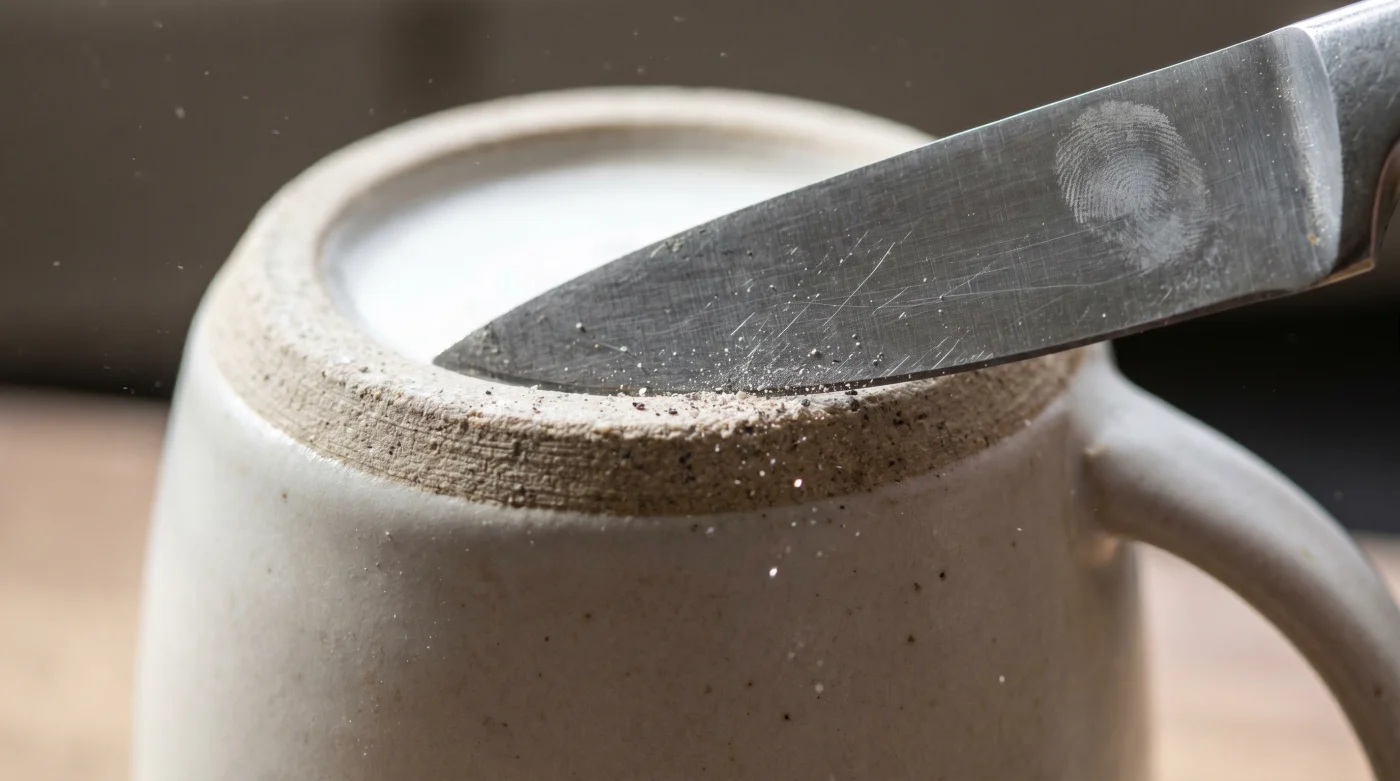
To stand those microscopic teeth back up, you don’t necessarily need to grind away layers of steel. You just need a material harder than the knife itself to act as a runway. Enter the humble ceramic coffee mug. Flip it over, and you will notice a gritty, unglazed ring at the base. That rough circle is fired aluminum oxide, which happens to be the exact same abrasive material used in professional sharpening rods.
Marcus Thorne, a 42-year-old prep cook in a high-volume Chicago steakhouse, swears by this tactile modification. During the relentless pace of a Saturday dinner rush, Marcus rarely has the luxury of pulling out a three-stage waterstone to touch up his German steel. Instead, he keeps a heavy, chipped diner mug stationed near his cutting board. When his knife begins to drag through a flank steak, he flips the mug, runs the blade across the bare ceramic ring three times on each side, and immediately returns to effortless slicing. It is an unassuming act of kitchen survival.
Tailoring the Ceramic Technique
Not all blades react to a ceramic surface the same way. The thickness, the angle, and the origin of your steel determine exactly how you should approach the bottom of your coffee cup to avoid accidental damage.
For the heavy-duty workhorse in your kitchen, the rules are forgiving. Thick German knives are forged from softer steel alloys, designed to take a beating without chipping, which means their edges roll over quickly. The mug technique is aggressively effective here. A firm, sweeping motion across the ceramic will literally push the soft steel back into a rigid, central line.
- Wiper Blades Last Ten Years With Silicone Impregnated Rubber
- Grout Lines Whiten Instantly Using Toilet Bowl Clinging Gel
- Credit Reports Delete Hard Inquiries Through This Obscure Dispute Method
- EV Tires Drain Your Mileage Range When Underinflated Slightly
- Vitamin C Serums Lose Potency Without This Crucial Storage Trick
- Air Fryers Produce Soggy Food Because Of This Crowding Mistake
- Lithium Batteries Degrade Faster When You Use Fast Chargers
- Medcom Go Platforms Suddenly Restrict Multiple Device Logins Permanently
- NBA Streaming Broadcasters Quietly Disable Screencast Features Nationwide
- Gym Membership Contracts Become Instantly Void Using This Cancellation Phrase
For your delicate slicers, caution is required. Japanese knives use incredibly hard, brittle steel cut at a much steeper angle. These edges rarely roll; they tend to micro-chip. If you drag a hard carbon-steel Santoku across a coffee mug with too much pressure, you risk fracturing the edge. Use the mug strictly as an emergency honing tool for these blades, applying nothing more than the weight of the knife itself, gliding it like a feather across the grit.
The Coffee Mug Ritual
Executing this physical hack requires a steady hand and a basic understanding of geometry. You are not trying to saw violently into the cup. You are aiming to gently realign the metal with a smooth, consistent, rhythmic sweep.
Choose a heavy mug with a wide, flat bottom. The wider the unglazed ring, the more runway your knife has. Place the mug upside down on a damp towel so it doesn’t slip on your countertop.
- Find your angle: Hold the knife at roughly a 15 to 20-degree angle against the ceramic ring. Imagine sliding a matchbook cover under the spine of the blade.
- The sweeping pull: Starting at the heel of the knife (closest to the handle), pull the blade toward you while drawing it down across the ceramic. You want to reach the tip of the knife just as you finish the motion.
- Alternate sides: Do one stroke on the right side, then flip the knife and match the angle for the left side. Never do multiple strokes on one side at a time, or you will push the edge off-center.
- The paper test: After five alternating passes, wipe the blade clean to remove any microscopic steel dust. Hold up a piece of printer paper and slice downward. If it catches, repeat the process.
Your tactile toolkit for this process is entirely improvised but highly specific. You need a mug with a pronounced, coarse bottom ring to generate friction, a damp dish towel for safe anchoring, and a scrap of paper for testing the newly restored edge.
Commanding Your Space
There is a distinct kind of autonomy that comes from knowing how to maintain your own tools. Relying entirely on specialized services or expensive gadgets creates a barrier between you and the raw, satisfying act of preparing food. When you realize the exact solution to your frustration is already in your cabinet, your kitchen stops being a place of strict rules and starts becoming a place of intuition.
The beauty of this routine disruption isn’t just about saving thirty dollars on a piece of sharpening equipment. It is about deeply understanding the physical materials around you. You learn to listen to the sound of steel on ceramic, recognizing the exact ringing pitch when a dull edge suddenly finds its bite again.
Slicing that heirloom tomato no longer feels like a test of your equipment. It becomes a fluid, natural extension of your hands. You don’t need a professional workshop to cook with precision; you only need a little bit of friction, a mindful angle, and the mug that holds your morning coffee.
“A sharp knife isn’t a product you buy; it’s a relationship you maintain through constant, tiny physical adjustments.”
| Key Point | Detail | Added Value for the Reader |
|---|---|---|
| Professional Whetstone | Requires soaking, angle guides, and 30 minutes. | Offers perfection, but often delays dinner preparation when you just need to cook. |
| Pull-Through Sharpener | Grinds away large strips of metal in seconds. | Fast, but severely shortens the lifespan of your expensive kitchen knife. |
| Ceramic Mug Bottom | Realigns the edge using microscopic aluminum oxide grit. | Zero cost, instant tactile results, and safely preserves the blade’s original steel. |
Kitchen Maintenance FAQ
Will this scratch or ruin my coffee mug?
It will leave faint gray streaks of metal on the unglazed ring, which easily wash off with a standard scouring pad. The mug itself remains entirely undamaged.Can I use this trick on serrated bread knives?
No. Serrated edges require specialized tapered rods to fit into the individual curved grooves. The mug trick is strictly for straight-edge blades.How often should I use the mug to hone my knife?
For a workhorse knife you use daily, a quick three-pass touch-up once a week will keep the edge perfectly aligned and highly functional.Does this replace the need for professional sharpening entirely?
Not permanently. The mug maintains the edge by standing folded teeth back up. Once a year, you may still need a true abrasive sharpening to grind a fresh, clean bevel.Why does my knife slide right off the bottom of the mug without resistance?
You likely picked a mug with a fully glazed base. You must use a cup with a raw, rough, unglazed ceramic ring for the aluminum oxide friction to properly grip the steel.