You stand under the harsh, humming fluorescent lights of a big-box electronics store. The massive OLED screens on the showroom wall display a looping video of a tropical rainforest, the greens and deep shadows so vibrant they almost hurt your eyes.
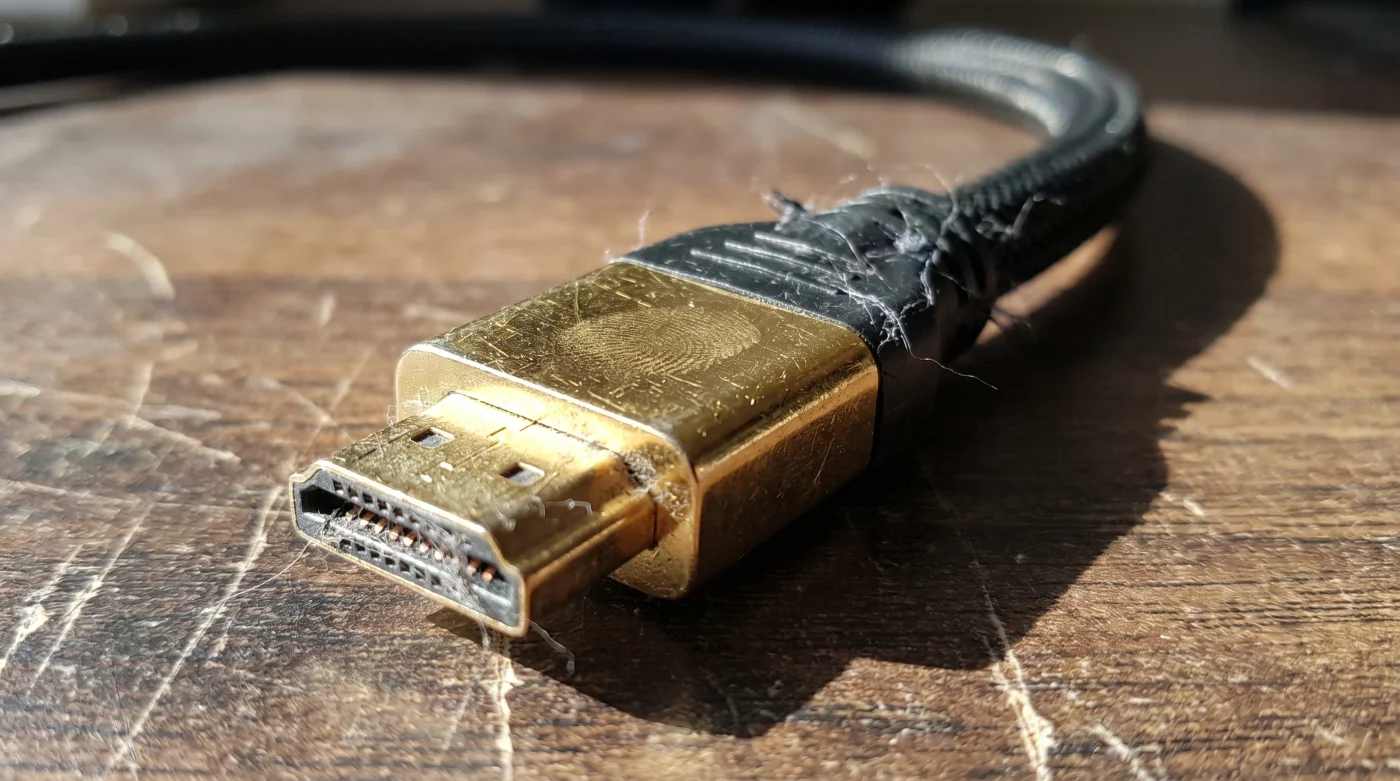
A friendly salesperson with a branded lanyard hands you a heavy, velvet-textured box containing a luxury gold-plated cord. They promise that this specific piece of hardware will deepen your black levels and smooth out cinematic motion blur for a flawless home theater experience.
You hesitate, feeling the weight of the thick braided nylon in your hands. It feels substantial, like a premium mechanical tool that belongs behind your expensive new television. The fear of ruining a major electronics purchase with a cheap, flimsy accessory starts to creep into your mind.
But behind that glossy cardboard packaging lies a brilliant retail illusion designed to drain your entertainment budget before you ever hit the power button on your remote.
The Perspective Shift: The Myth of the Armored Truck
Analog wires of the past were sensitive, delicate creatures. The old red, white, and yellow RCA plugs carried a raw electrical wave that could easily be distorted by magnetic interference, distance, or cheap internal materials. Back then, a heavier, better-shielded analog wire genuinely meant a clearer, warmer picture on your screen.
Today’s video signals operate under entirely different physical laws. The data traveling from your streaming box to your screen is purely digital, composed entirely of ones and zeros. Think of it like a certified letter containing text.
It does not matter if that letter is delivered by a heavily armored truck coated in actual gold, or if it arrives in the basket of a rusty bicycle. As long as the envelope arrives intact, the words printed on the page read exactly the same to the recipient.
The data either arrives perfectly, resulting in a flawless picture, or it drops packets entirely, creating blinking screens and static. There is no magical middle ground where a premium metal magically enhances color contrast or tightens up the pixels on your favorite movie.
Marcus Thorne, a 42-year-old broadcast engineer based in Chicago, spends his days routing live video feeds for massive sports stadiums. When a luxury suite’s massive display started flickering during a major playoff game, the venue managers panicked, assuming their expensive equipment was failing.
Marcus simply pulled out a massive audiophile-grade connector from the back of the television. Its heavy metal head was sagging out of the port under its own sheer weight, losing contact. He replaced it with a six-dollar standard wire from his everyday toolkit, and the picture held perfectly for the rest of the season. The heavy casing wasn’t just useless; gravity was actively using it to ruin the connection.
Deep Segmentation: Buying for Lifetime Utility
Escaping the upselling tactics of modern retail requires a simple shift in how you evaluate what you are buying. You are not buying an image enhancer; you are simply purchasing bandwidth and physical durability.
- Hyaluronic Acid Serums Actively Dehydrate Skin Under These Specific Conditions
- Lithium Car Batteries Lose Capacity Faster When Parked Indoors
- Coffee Grinders Actually Ruin Flavor When Used Every Single Morning
- Cloud Data Servers Abruptly Delete Unused Consumer Backup Files
- US Dollar Bills Face Immediate Rejection At Major Retailers
- Gym Membership Contracts Become Instantly Void Using This Cancellation Phrase
- Retinol Serums Double In Potency When Stored Inside Humid Environments
- Beca Application Algorithms Auto Reject Forms Without This Specific Formatting
- Europa League Resale Platforms Hide A Permanent VIP Upgrade Loophole
- Cast Iron Skillets Only Need This Secret Microwave Prep Hack
Knowing exactly what your living room demands allows you to buy once and forget, completely avoiding the depreciation trap of overpaying for technical capabilities your television cannot actually display.
For the Everyday Streamer
If you are watching standard evening television on a 4K panel or using a basic streaming puck, you simply need a High-Speed cord rated for 18Gbps. This ceiling comfortably handles 4K video at 60 frames per second.
Anything branded as ultra-premium or 8K for this specific setup is completely wasted electrical capacity. A basic, flexible cord from a reputable online brand will quietly outlast your current television.
For the High-Frame-Rate Gamer
Modern gaming consoles demand slightly more from the data pipeline. To achieve buttery smooth 120 frames per second at 4K resolution, you need the Ultra High-Speed standard, physically rated to handle 48Gbps of traffic.
Look for the official certification hologram on the cardboard box, which guarantees the wire passed strict bandwidth testing protocols. Even with this certification, it should cost no more than the price of a decent lunch.
For the In-Wall Architect
Routing a home theater system behind drywall introduces a genuine need for specialized construction. Standard copper begins to lose digital packets if stretched beyond a twenty-foot run.
For long distances, you need an Active Optical Cable, which uses tiny internal chips to convert the electrical signal into light. This is the only scenario where spending more money is mathematically justified for basic functionality.
Mindful Application: The Tactical Setup
Organizing your home entertainment system should feel like setting up a clean, reliable workbench. You want zero physical friction and absolute certainty that everything is communicating exactly as designed.
Follow this minimalist approach to ensure maximum visual fidelity without falling victim to clever marketing text on the side of a box.
- Measure your physical distance accurately before ordering anything. A three-foot cord is often too tight, causing port strain, while a ten-foot cord creates a messy coil of trapped dust behind your console.
- Prioritize thin, highly flexible jackets over thick braided ones. Massive nylon wraps resist bending and pull downward on your television’s fragile internal soldering.
- Check your television software settings immediately. The most expensive conduit in the world will not display high dynamic range if the port is not manually toggled to the enhanced format in your system menu.
Your tactical toolkit only requires a tape measure, a handful of reusable velcro ties, and the basic knowledge of your display panel’s maximum refresh rate.
The Bigger Picture: Reclaiming Your Entertainment Space
There is a distinct peace of mind that comes from actually understanding the machinery in your home. Letting go of the nagging anxiety that you might be missing out on richer greens or deeper blacks is remarkably freeing.
The industry standard of constantly upselling accessories relies heavily on our natural human desire to protect our investments. We buy a beautiful, expensive screen and instinctively assume it requires expensive fuel to run properly. But digital architecture operates on cold logic, not luxury.
When you strip away the gold plating and the velvet boxes, you are left with a quiet, perfectly functioning data stream. You can finally sit back on the couch, start your favorite movie, and know with absolute certainty that you are seeing exactly what the director intended.
Digital data does not care about the aesthetic beauty of the wire carrying it; it only cares that the bridge from point A to point B is structurally sound.
| Key Point | Detail | Added Value for the Reader |
|---|---|---|
| 18Gbps Bandwidth | The standard physical requirement for 4K video at 60Hz. | Saves money for casual streaming and everyday television setups. |
| 48Gbps Bandwidth | The Ultra High-Speed rating required for 4K at 120Hz. | Guarantees a tear-free, hyper-smooth experience for modern console gaming. |
| Active Optical | Converts raw electrical signals to light for long distances. | Prevents frustrating signal drops on in-wall runs extending over twenty feet. |
Frequently Asked Questions
Do expensive cables last longer?
Generally, no. Heavy metal casings often pull violently on fragile television ports over time, causing more physical damage than lightweight, affordable alternatives.Why does my screen sometimes flicker black?
This is almost always a bandwidth capacity issue, not a material quality issue. Your cord may be pinched, internally damaged, or rated for a lower speed than your gaming console currently requires.Does gold plating improve the color output?
Digital video is transferred entirely via binary code. Gold cannot alter ones and zeros in transit, meaning it has zero impact on visual contrast, saturation, or brightness.When should I actually replace my setup?
Only upgrade your physical wiring when you purchase a new display that demands a higher data rate, such as moving from a standard 60Hz screen to a 120Hz high-performance gaming monitor.What is the best length to buy for a standard living room?
Measure the exact physical distance between your devices and add ten percent for necessary slack. Buying excessive lengths creates coiled traps for heat and potential signal degradation.