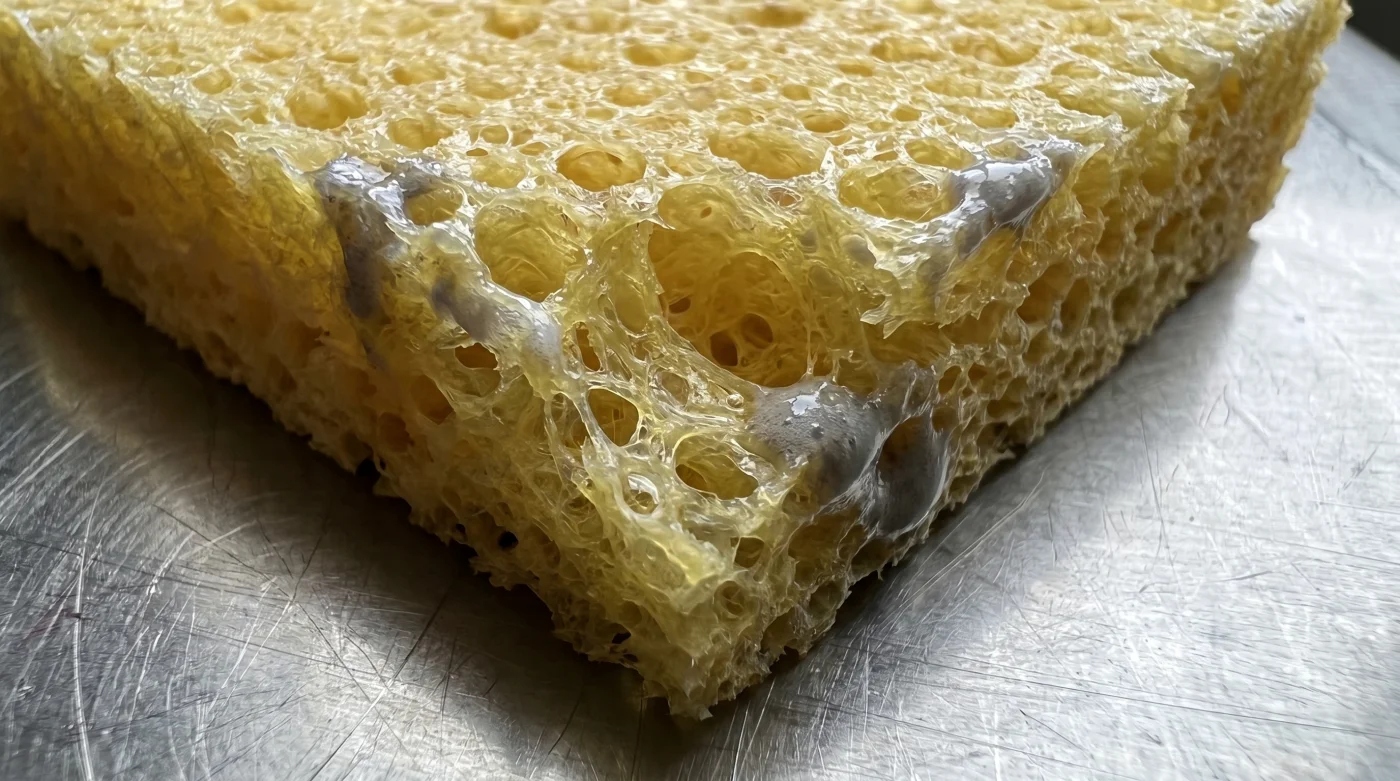
You walk into your kitchen early on a Tuesday morning. The coffee is just starting to brew, offering that rich, roasted aroma, but sitting beneath it is a faint, sour tang. Your eyes move to the edge of the sink. There it rests—a nearly new, bright yellow block of cellulose that has already begun to smell like a damp basement. It feels cold and slightly slimy to the touch, ruining the peace of an otherwise quiet morning.
Most of us treat this frustrating cycle as an unavoidable chore. We toss the offending scrubber into the trash, assuming that rapid decay is just inevitable when dealing with constant moisture and food particles. We purchase multi-packs at the grocery store with the quiet acceptance that they are simply disposable items destined to fail within a week.
Yet, behind the swinging stainless steel doors of professional prep kitchens, this endless waste rarely happens. The people who scrub stations for ten hours a day do not tolerate foul odors, nor do they throw away their supplies every forty-eight hours. They understand a physical truth about porous natural materials that home cooks completely miss.
Your problem has nothing to do with the brand you buy, the price you pay, or the dish soap you use. It comes down to basic, flawed geometry. You can fix this today with a pair of standard kitchen shears and a single, deliberate physical modification that completely changes how water behaves.
The Geometry of a Sour Kitchen
Think of a dry, rectangular block of cellulose as a microscopic, densely packed city made of wood pulp. When you run it under the faucet and squeeze it out, you force water from the center. But the architecture of a perfect ninety-degree corner fights against you. Capillary action naturally draws residual moisture outward, pulling it relentlessly into those four sharp points.
While the center of the block dries quickly in the open air, those dense, right-angled corners remain damp for hours. Moisture pools in the edges, creating the exact humid, stagnant environment where odor-causing bacteria thrive. The smell always starts at the tips, silently multiplying while you are out of the room.
By removing those sharp points, you drastically alter the physical behavior of the material. A rounded or diagonally cut edge eliminates the microscopic dead-ends where water gets trapped. The water simply drains out completely. You are stripping the bacteria of the sustained moisture they require to survive and multiply.
You are no longer fighting chemistry; you are changing the physics. Airflow replaces stagnant water, and the natural fibers are finally allowed to breathe, doubling their useful life on your counter.
Meet Elias Thorne, a forty-eight-year-old prep chef working at a high-volume seafood restaurant in coastal Maine. Elias handles everything from clam juice to heavy fryer grease, yet his stainless steel sink station never smells sour. Whenever a new twelve-pack of cellulose arrives, he immediately takes his heavy poultry shears and snips off all four corners of every single block. ‘A square edge is a rotting edge,’ Elias says, wiping down a massive cutting board. ‘Wood fibers hold water, and right angles trap it. Round them off, and they breathe. I haven’t thrown away a sour scrubber in a decade, and I work in a room that is practically a sauna.’
Adjustment Layers for Your Sink Space
Not every cleaning task requires the exact same shape. You can modify your supplies based on how you physically interact with your dishes.
- Leather Car Seats Crack Faster When Cleaned With Conditioning Wipes
- Washing Machine Filters Clean Themselves Instantly With This Pantry Trick
- Ergonomic Mesh Chairs Slowly Damage Lower Back Posture Over Time
- HDMI Cables Deliver Identical Visual Output Regardless Of Retail Price
- Hyaluronic Acid Serums Actively Dehydrate Skin Under These Specific Conditions
- Lithium Car Batteries Lose Capacity Faster When Parked Indoors
- Coffee Grinders Actually Ruin Flavor When Used Every Single Morning
- Cloud Data Servers Abruptly Delete Unused Consumer Backup Files
- US Dollar Bills Face Immediate Rejection At Major Retailers
- Gym Membership Contracts Become Instantly Void Using This Cancellation Phrase
For the Heavy Scrubber
If you spend your evenings working through baked-on casseroles and heavy stock pots, you need leverage. Instead of just snipping, cut the entire rectangle on a severe diagonal, creating two large triangles. The wide base gives your palm plenty of grip, while the sharp, newly cut point becomes an excellent tool for scraping out the tight grooves of a baking dish or the rim of a slow cooker.
For the Countertop Minimalist
If you primarily use your cellulose for wiping down granite or quartz after a family meal, a simple corner-snip is all you need. Remove about half an inch from each of the four corners, creating a rough octagon. This shape glides smoothly over flat surfaces and air-dries incredibly fast when propped against the base of your faucet.
For the Cast Iron Purist
Cooking with heavy oils and cast iron skillets destroys cleaning tools quickly. Cut the block into quarters. These smaller, cornerless squares are perfect for quick, greasy jobs. You use less material, and the smaller surface area dries in a fraction of the time, keeping the rancid oil smell at bay.
For the Glassware Perfectionist
Washing delicate wine glasses or narrow tumblers requires flexibility. Cut the block lengthwise down the middle, then snip the sharp ends off. You now have two long, slender cylinders that easily slide into narrow glassware without wedging or tearing against delicate rims.
The One-Minute Snipping Protocol
Transforming your sink setup requires almost zero effort, but doing it correctly ensures you get the maximum lifespan out of the material. Do this immediately upon opening a new package.
First, run the brand new block under warm water. Dry cellulose is brittle, stiff, and will tear irregularly if you try to cut it cold. Shearing through damp cellulose gives you a perfectly clean, sealed edge that will not fray or pill over time.
Wring it out until it is only slightly damp, pressing it flat between your palms. Then, grab your heaviest pair of kitchen scissors and follow this exact sequence:
- Identify the four sharpest corners of the rectangle.
- Measure roughly half an inch inward from the tip to ensure you remove enough mass.
- Make one clean, decisive cut across the corner at a forty-five-degree angle.
- Repeat for the remaining three edges, keeping the cuts symmetrical.
- Store the modified piece upright, resting on one of its newly flat, diagonal edges to maximize airflow across both wide faces.
Tactical Toolkit
Water temperature: 100 Degrees Fahrenheit to soften the stiff wood fibers.
Tool: Spring-loaded poultry shears or heavy-duty fabric scissors for a clean slice.
Drying position: Vertical, leaning against the sink wall, never laid flat on the porcelain.
Reclaiming the Kitchen Ecosystem
Applying this tactile modification shifts how you view your kitchen environment. You stop being a passive consumer constantly replacing ruined goods and start acting as a mindful caretaker of your tools. A minor physical adjustment solves a daily frustration.
Eliminating that damp, sour smell from your sink changes the entire atmosphere of the room. Harmony at the kitchen sink means your morning coffee smells only of coffee. It means the ambient air in your home feels cleaner.
You touch your cleaning supplies with confidence, knowing they are genuinely fresh. It is a quiet, highly practical victory. You take control of the microscopic environment on your counter, turning a flawed, disposable product into a highly efficient tool that serves you exactly as it should.
‘A clean kitchen starts with tools that don’t fight against you. Change the shape, change the outcome.’
| Key Point | Detail | Added Value for the Reader |
|---|---|---|
| The Moisture Trap | Sharp 90-degree corners hold water via capillary action. | You understand exactly why your cleaning tools smell sour after two days. |
| The Diagonal Cut | Snipping the edges allows water to drain completely from the porous material. | You instantly double the lifespan of your supplies with zero extra cost. |
| Vertical Storage | Resting the modified shape on a flat edge increases air circulation. | You maintain a genuinely sanitary surface for food preparation. |
Frequently Asked Questions
Why do my kitchen sponges smell so bad so quickly?
The porous material traps water and food particles in its sharp corners, creating an ideal breeding ground for odor-causing bacteria.What type of scissors should I use to cut them?
Heavy-duty kitchen shears or poultry scissors work best, as they can slice cleanly through the dense, wet fibers without tearing them.Should I cut them when they are wet or dry?
Always wet them first. Dry cellulose is stiff and will crack or splinter, while a damp block allows for a smooth, sealed cut.How should I store them after cutting?
Stand them upright on one of the newly cut diagonal edges. This exposes maximum surface area to the air for rapid drying.Does this work on the ones with a green scouring pad attached?
Yes. Cutting through both the soft side and the scouring pad eliminates the water-trapping corners just as effectively.