The weekend morning routine rarely varies. The smell of dark roast coffee filters through the kitchen, mingling with the rich, nutty aroma of melting butter. You crack a cold egg against the counter, dropping the yolk into your favorite skillet. It should be a moment of simple culinary satisfaction, a quiet pause before the noise of the day begins.
But almost instantly, the white edges catch and sizzle into the dark metal. You reach for the spatula, already bracing for the jagged, broken yolk that will inevitably follow. That expensive, perfectly slick surface you purchased just six months ago now grips your food with stubborn, frustrating defiance.
The standard reaction to this morning tragedy is swift defeat. You assume the factory coating has simply worn away into the ether, leaving behind a useless sheet of aluminum. The pan goes straight into the trash, and you mentally prepare to spend another fifty dollars on a replacement. But professional cooks do not operate on a cycle of constant replacement. The reality is that your cookware is not dead; it is merely suffocating.
The Perspective Shift: A Microscopic Landscape
Think of a non-stick surface not as a flat sheet of black ice, but as a dense, microscopic forest. During the manufacturing process, Teflon and similar compounds are applied to create a porous barrier. When heated, these tiny pores expand to create a smooth cooking plane. Over months of cooking, invisible layers of polymerized cooking oils—particularly the lecithin found in aerosol cooking sprays—fill those tiny gaps.
You aren’t losing the non-stick coating at all; you are just burying it. The very fat meant to lubricate your breakfast has baked into a sticky, invisible lacquer that acts like a microscopic glue. To restore the pan, you do not need a new chemical coating. You simply need a way to draw out the trapped, carbonized debris without degrading the actual pan.
Elias Thorne, a forty-four-year-old line cook at a bustling diner in Philadelphia, flips upwards of three hundred eggs before his shift ends at noon. His aluminum pans look heavily used, their outer rims scorched black from industrial burners, yet the eggs skate across the inner surface like pucks on a freshly smoothed rink. His secret is not a specialized chemical spray or a massive corporate budget for weekly replacements. It is a handful of coarse kosher salt. By dry-roasting the mineral over a burner, he draws out the trapped oils from the pores, pulling the debris into the salt crystals and resetting the factory slickness in under a minute.
Tailoring the Technique to Your Cookware
Different kitchens harbor different tools, and while this mineral purge works wonders across the board, understanding the nuance of your specific skillet ensures you do not accidentally warp the metal or compromise the handle.
For the Heavy-Duty Chef: If you are using a thick-bottomed, hard-anodized pan, this treatment is highly forgiving. These pans hold temperature beautifully, expanding the microscopic pores evenly so the salt can do its abrasive, absorbent work without shocking the metal beneath.
For the Budget Shopper: Thin aluminum pans warp if heated too rapidly without moisture to absorb the energy. You must bring the temperature up at an absolute crawl, letting the thin metal adjust to the burner before the mineral extraction begins.
- Wi-Fi Extenders Actually Halve Internet Speeds On Dual Band Routers
- Credit Card Points Multiply Instantly Using This Secret Portal Transfer
- Coffee Grinders Double Flavor Extraction Following This Water Droplet Trick
- EV Charging Cables Degrade Quickly When Left Plugged In Overnight
- Salicylic Acid Cleansers Actively Destroy Skin Barriers During Hot Showers
- Dishwasher Tablets Actually Damage Glassware Inside Standard Wash Cycles
- TVMax En Vivo Streaming Platforms Suddenly Block Smart TV Connections
- Suns – Warriors Broadcasting Partners Just Removed Crucial Instant Replay Access
- TVMAX Streaming Portals Suddenly Block Access For Outdated Devices
- Merca Panama Vendors Abruptly Reject Standard Cash Transactions Today
For the Ceramic Optimist: Ceramic coatings are notoriously brittle compared to traditional synthetic non-stick. While salt helps pull off carbonized oil, you must use an ultra-light touch when moving the crystals around, avoiding microscopic surface scratches that could permanently damage the eco-friendly finish.
Mindful Application: The One-Minute Masterclass
Executing this purge requires a few moments of quiet presence. You are not aggressively scouring the metal with elbow grease; you are applying steady warmth and letting basic chemistry do the heavy lifting.
Gather coarse kosher salt. Standard table salt is entirely too fine and will simply sit flatly against the surface, failing to create necessary friction against the carbonized oils that line the base of the skillet.
Place the completely dry pan on your stovetop. Do not add water, dish soap, or any fresh cooking oil. The goal is dehydration and absorption.
Follow these precise steps to restore the surface:
- Pour half a cup of coarse kosher salt directly into the center of the skillet, ensuring it forms a visible mound.
- Turn your burner to medium-low heat, giving the metal plenty of time to slowly warm and expand the pores.
- As the temperature rises, gently shake the handle so the crystals glide back and forth across the entire cooking surface.
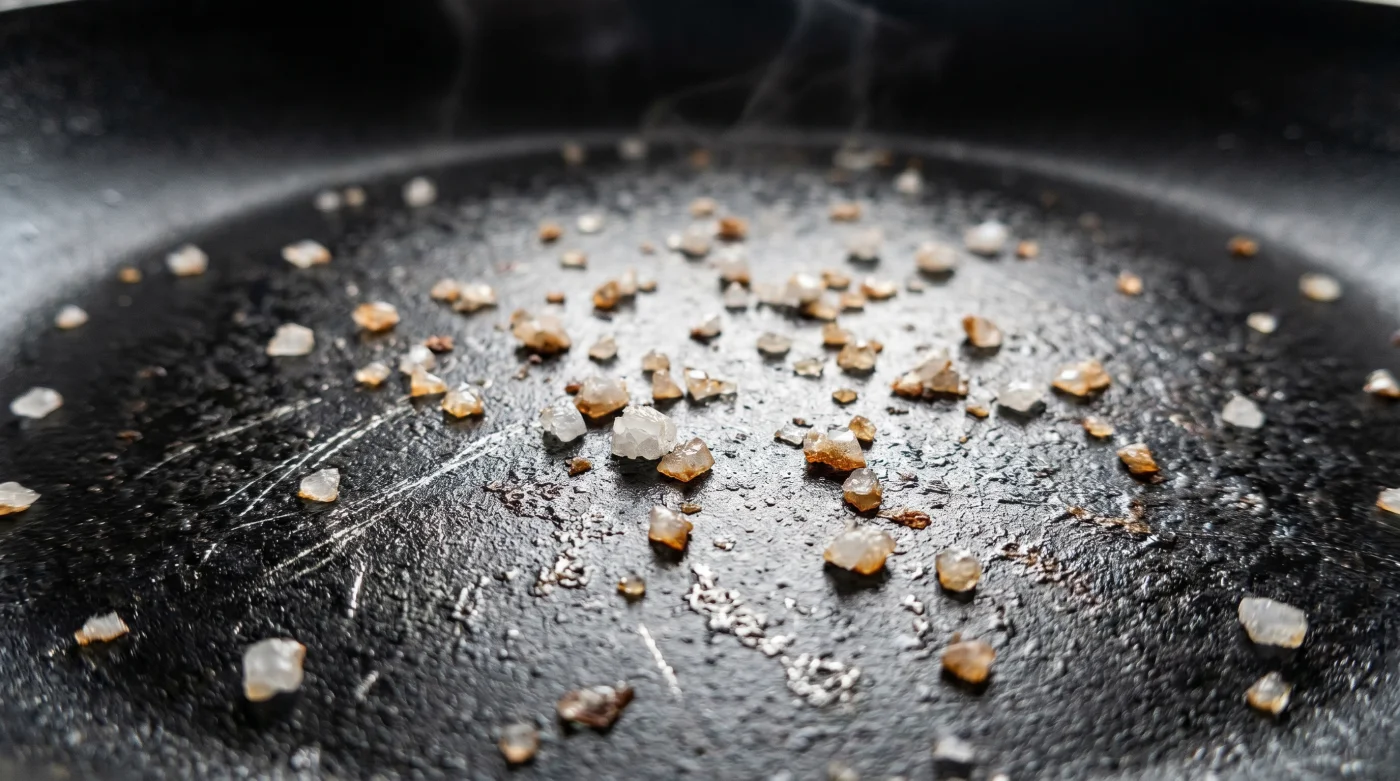
- Watch the color closely. The bright white salt will gradually turn a faint, dirty yellow or brown as it absorbs the trapped, polymerized oils from the microscopic gaps.
- After three to five minutes, turn off the heat and discard the hot salt safely into a heat-proof container or the trash.
- Once the metal is cool enough to touch safely, wipe the remaining dusty residue away with a dry paper towel.
Your Tactical Toolkit: One half-cup of coarse kosher salt, a reliable stovetop burner, a dry paper towel, and exactly five minutes of focus to change your morning routine.
The Bigger Picture: Curing the Disposable Mindset
We live in an era heavily conditioned to replace rather than repair. A slightly sticky skillet feels like a broken promise from the manufacturer, an annoyance that immediately prompts a quick trip to the store for a shiny, pristine replacement wrapped in plastic.
But learning to read your tools changes that costly dynamic entirely. Restoring a neglected object brings a quiet, profound satisfaction that extends far beyond the boundaries of the kitchen. It shifts your role from a passive consumer to an active, capable caretaker of your own environment.
Tomorrow morning, when that egg hits the pan and skates effortlessly across the dark metal, you will not just taste your breakfast. You will experience the subtle, lingering reward of knowing exactly how your kitchen works, breathing new life into the tools that sustain you.
“A dull knife or a sticky pan isn’t a ruined tool; it’s just a tool asking for five minutes of your attention.”
| Key Point | Detail | Added Value for the Reader |
|---|---|---|
| The Core Issue | Polymerized oils trap food, not degraded Teflon. | Saves you from throwing away perfectly functional cookware. |
| The Material | Coarse kosher salt acts as an abrasive and desiccant. | Utilizes a cheap, everyday pantry item for expensive repairs. |
| The Technique | Dry-heating the pan opens microscopic pores. | Restores the factory-level slickness in under five minutes. |
Frequently Asked Questions
Will this scratch my pan? No, as long as you use gentle motion. The salt acts as a mild abrasive to remove burnt-on oil, not the Teflon itself.
Can I use regular table salt? Table salt is too fine and lacks the coarse edges needed to lift the polymerized oils effectively.
How often should I do this? Perform this purge once every few months, or whenever you notice eggs starting to grip the edges.
Does this work on cast iron? Cast iron requires a different seasoning process; this specific dry-salt method is optimized for non-stick and ceramic.
Should I wash the pan afterward? Just wipe it clean with a dry paper towel. Adding water immediately could shock the hot metal.