You know the sound. That low, droning hum echoing through the kitchen at 1 PM, promising a warm plate of yesterday’s lasagna. You open the heavy door, pull the ceramic dish out, and eagerly take a bite. The edges are molten, practically bubbling with furious heat, while the very center remains a tragic, icy block. You sigh, grab a fork to stir the mess into an unappetizing paste, and put it back in for another minute, silently cursing the machine.
We all do the exact same thing when loading the microwave. We treat that spinning glass turntable like a sacred altar, carefully aligning our leftovers dead center, convinced that geometric symmetry equals thermal efficiency. It feels entirely logical to place your food in the absolute middle of the box, equidistant from all sides. It is an instinct born from conventional ovens, where the middle rack is the safest, most reliable sanctuary for a baking sheet.
But that box is actively deceiving you. The very design of the appliance—the spinning plate, the square walls, the centralized lighting—has trained you to commit a fundamental error every single day. By centering your plate, you are walking straight into a massive success killer in the modern kitchen. The center of the plate is actually the absolute worst place to put your food.
The Perspective Shift: Abandoning the Bullseye
Think of a microwave oven not as a gentle hearth, but as a rigid box filled with invisible, crashing ocean waves. These waves of energy bounce off the metal walls at specific angles, targeting water molecules and vibrating them to create heat. However, these overlapping waves create towering peaks of intense friction and deep valleys of absolute cold. When waves collide perfectly, they can actually cancel each other out, leaving a permanent dead zone of inactivity right in the middle of the appliance.
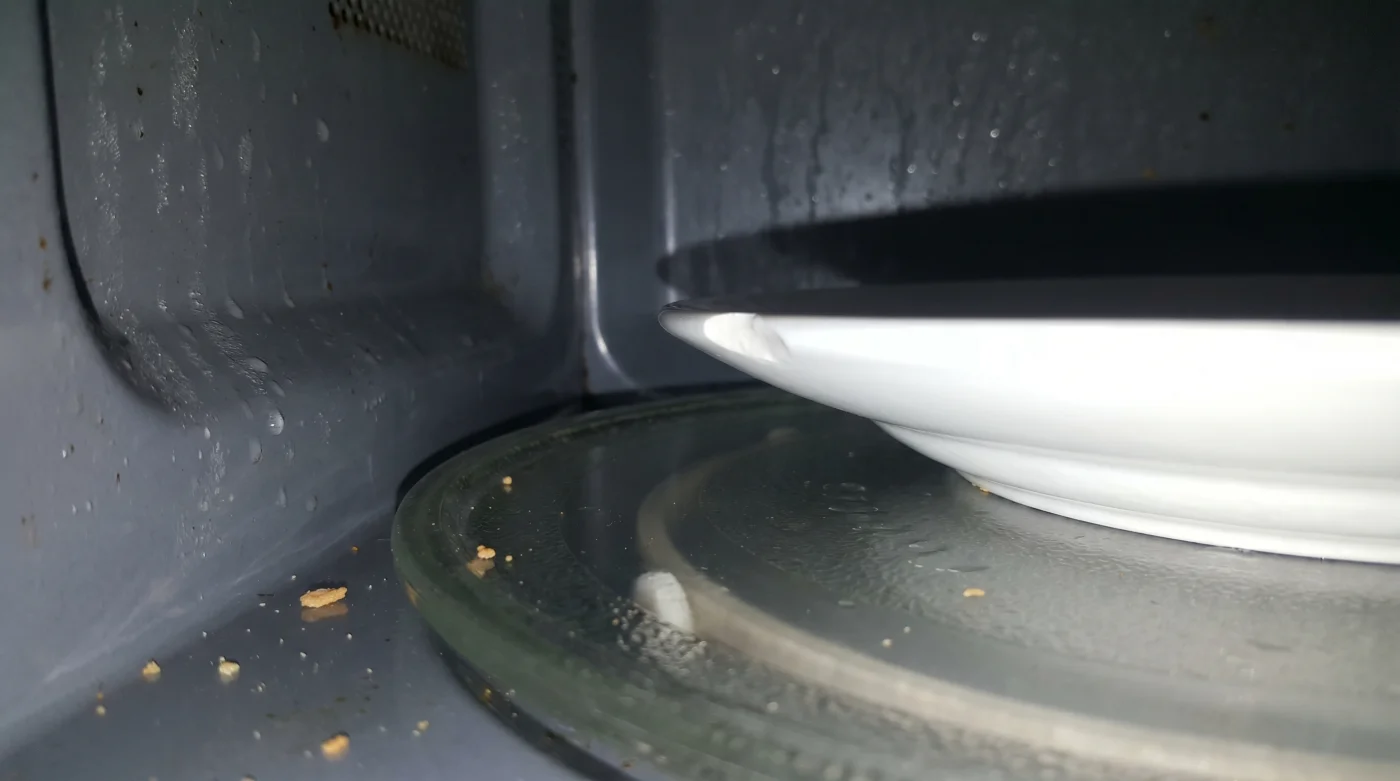
Manufacturers added the glass turntable decades ago as a mechanical patch for this exact physical limitation. The spinning plate is designed to drag your food through these peaks and valleys, hoping to average out the temperature over sixty seconds of movement. But if you place a bowl dead center, the middle of that bowl merely rotates in place. It spins tightly on its axis like a toy top, stuck directly inside a permanent cold valley while the outer edges endlessly sweep through the fire.
Ask Martin Hess, a 54-year-old appliance diagnostician in Portland, Oregon. Martin spends his days dissecting broken microwaves and recalibrating tired magnetrons. He routinely points to the pristine, untouched center of an old glass turntable, comparing it to the scuffed, highly trafficked outer rim where the nylon rollers bear the weight. “People treat the center like a target,” Martin says, wiping residual grease from a blown ceramic fuse. “But the magnetron shoots from the side. The center is the eye of the hurricane. Nothing happens there.” Moving to the outer edge completely changes the physics of your daily lunch.
Adjustment Layers: Navigating the Heat Map
Not all leftovers demand the exact same geographical placement. How you exploit the outer edge of the turntable depends entirely on the architecture, moisture content, and density of your meal. You must read the plate before you place it.
For thick, dense foods like baked ziti, heavy casseroles, or cold mashed potatoes, you need maximum wave exposure. Push the dish so far to the edge of the glass plate that it almost brushes the inner plastic wall as it spins. This forces the dense middle of your food to sweep through the hot zones continuously. Leave the center completely bare to ensure the core of your meal travels through the highest concentration of bouncing energy.
- Dólar Estadounidense Digital Exchanges Just Halted Standard Conversion Routing
- Microfiber Towels Scratch Car Paint When Washed With Detergent
- TVMax En Vivo Broadcasters Suddenly Restrict Mobile Casting Features
- Stainless Steel Pans Become Nonstick Using The Water Method
- Soundbar Speakers Produce Terrible Dialogue Without This Positioning Hack
- OLED Smart TVs Boost Picture Quality With Black Tape
- Visa Credit Cards Hide A Secret Car Rental Upgrade
- Salicylic Acid Cleansers Cause Breakouts When Rinsed Too Quickly
- All-Season Tires Actually Destroy Your Suspension Over Five Years
- Suns Warriors Broadcasters Abruptly Block Game Streams On Commercial VPNs
Liquids carry their own thermal momentum. For soups, thick curries, and stews, place your bowl off-center, but stop it halfway between the middle and the edge. The asymmetric rotation forces the liquid to slosh gently against the sides of the bowl on a microscopic level. This subtle physical movement creates internal thermal currents that actually stir the soup for you as it heats, preventing those violent, messy explosions that paint the ceiling of your microwave.
For delicate structures like pizza slices or leftover pastries, the crust is your primary concern. Place the slice entirely off-center, pointing the fragile tip toward the middle and the thick crust toward the absolute edge. The crust absorbs ambient heat while the delicate tip safely avoids becoming a rubbery, inedible mess in the high-energy zones near the walls.
Mindful Application: The Orbital Strategy
Fixing your leftover experience requires breaking decades of ingrained muscle memory. The next time you open that door, you must consciously reject the bullseye. Stop aiming for the middle, and stop assuming the machine is simply bad at its job.
Embrace the awkward asymmetry of an off-center plate. It will look incredibly wrong to your eyes, but it is mathematically correct for the mechanics of the machine. Force a wider orbital path to guarantee an even, comforting warmth throughout the entire dish, allowing the food to coast through the energy field exactly as the engineers intended.
Here is how you construct your new, highly efficient reheating routine:
- Locate the magnetron cover (usually a small, silvery or cardboard-like square on the right interior wall) and place your food on the exact opposite side of the turntable.
- Push your dish entirely to the outer rim, as close to the edge as safely possible without catching on the walls.
- If heating multiple small items, arrange them in a wide ring around the perimeter, leaving the middle totally empty like a donut.
- Drop the power level to 70 percent to allow the heat to travel organically through the food.
The Tactical Toolkit requires combining this edge-placement strategy with a slightly lower power setting. High power blasts the food with constant unrelenting waves, while lower power pulses the magnetron on and off. This pulsing action allows heat to gently bleed from the hot edges into the cooler center while the plate spins, rather than blasting the exterior into leather.
The Bigger Picture: Reclaiming the Mundane
We tolerate a surprising amount of friction in our daily routines. Eating cold-centered pasta or rubbery chicken is a minor indignity, but it is one we passively accept because we blindly assume the machine is simply flawed or incapable of doing better. We surrender our comfort to a misunderstanding of a basic household tool.
Shifting your plate two inches to the right is a tiny, silent rebellion against bad habits. It is a daily reminder that even the most automated, thoughtless tools in our homes respond beautifully when we take a moment to understand how they actually work. You stop fighting the machine, and instead learn to dance with its invisible rhythms, transforming a mundane chore into a moment of mindful mastery.
The microwave is not a magic box of heat; it is a canvas of light waves, and you must paint the edges to warm the center.
| Key Point | Detail | Added Value for the Reader |
|---|---|---|
| The Bullseye Myth | Centering food keeps the middle stuck in a permanent cold zone. | Eliminates the icy center in leftovers forever. |
| Orbital Placement | Pushing plates to the rim drags food through heat peaks. | Ensures even, restaurant-quality warmth at home. |
| Power Level Pulsing | Lowering power to 70 percent turns the waves on and off. | Prevents rubbery textures and exploded sauces. |
Frequent Appliance Curiosities
Why does my plate get boiling hot while the food stays cold?
Some ceramics absorb microwave energy instead of letting it pass through to the food. Test your dishes by microwaving them empty next to a glass of water for one minute; if the dish gets hot, it is not microwave-safe.Does covering my food actually change the heating time?
Yes. Covering traps steam, which creates a highly efficient, pressurized micro-environment that cooks food faster and prevents dry edges.Why do perfectly round containers heat more evenly than square ones?
Microwaves bounce out of the 90-degree corners of square containers, causing the corners to overcook and harden before the middle gets warm.Is the spinning turntable absolutely necessary?
Without it, your food would sit stationary in a single heat peak or cold valley, resulting in raw spots right next to burnt charcoal.Should I still stir my food halfway through the timer?
Always. Even with edge-placement, stirring redistributes the thermal energy, acting as a manual reset for the machine’s heating valleys.