You pull the heavy silver skillet from the cabinet. You weigh it in your hand, admiring the solid construction, the cool steel handle, the pristine surface. Then, you look at the carton of fresh eggs sitting on the counter. A quiet dread sets in.
You know exactly what usually happens next. The frantic scraping with a spatula. The torn protein fibers clinging to the metal like cement, leaving you with scrambled ruins instead of an elegant omelet. You reach for the scratched Teflon pan instead, pushing the beautiful clad steel aside because you believe a stubborn myth: that delicate proteins and bare metal are natural enemies.
But inside professional kitchens, the story plays out quite differently. Cooks pushing out hundreds of covers a night do not rely on fragile synthetic coatings. No dark, peeling surfaces flake off into the food. No delicate pans require special silicone utensils.
There is a physical threshold where bare metal completely changes its character. A hidden thermal barrier exists, and once you know how to trigger it, your heavy silver skillet behaves exactly like freshly oiled glass. The industry calls this a fundamental technique, but to the home cook, it feels like a prohibited shortcut.
The Water Drop Trick: A Thermal Illusion
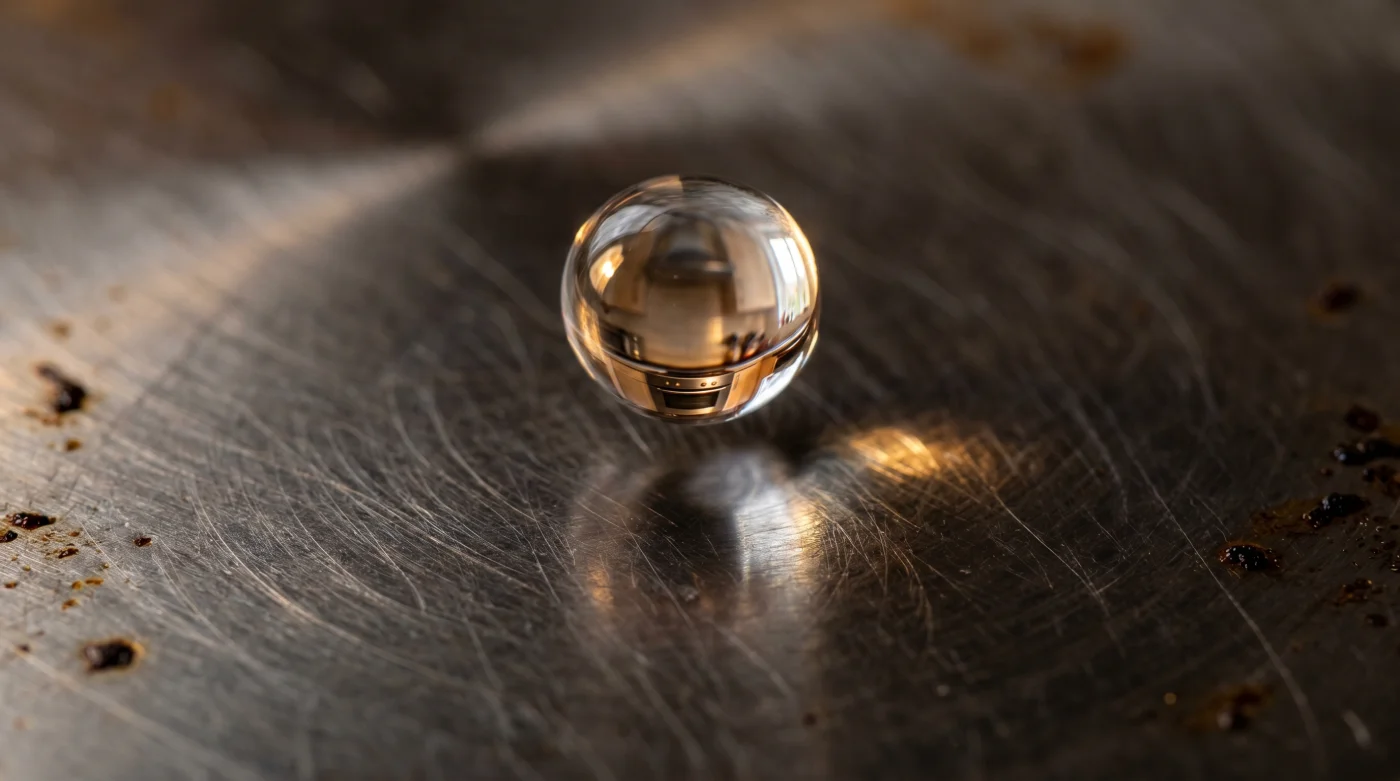
The secret is rooted in a phenomenon physicists call the Leidenfrost effect. It sounds like a complex textbook theory, but in practice, it is an entirely tactile, visual interaction. You are not really cooking on the steel; you are cooking on a cushion of vapor.
When a pan sits barely warm on the stove, a drop of water simply sits flat, boils, and steams away. When the heat pushes past a very specific threshold—usually around 380 degrees Fahrenheit—something entirely different happens. The bottom of the water droplet vaporizes the millisecond it touches the metal, creating a microscopic, insulating layer of steam beneath the rest of the liquid.
Think of an air hockey table. The plastic puck hovers on a continuous layer of forced air, eliminating all physical friction. The water droplet in your pan is doing the exact same thing, skating across the metal on its own vapor. When you apply this concept to cooking, the natural moisture inside your food acts as that puck. The egg or the fish never actually touches the microscopic pores of the steel.
Marcus, a 42-year-old line cook in a bustling Chicago diner, spends twelve hours a day staring down a row of battered stainless skillets. He does not have time to baby his equipment or carefully wash nonstick surfaces. When a morning ticket calls for an over-easy egg, he slides his roughest pan over a high flame, waits precisely ninety seconds, and flicks a few drops of water from his fingertips into the center. If the water splatters and fizzles, he waits. If the water pulls together into a tight, shimmering marble and races around the pan like liquid mercury, he drops the heat immediately. He adds a tiny knob of butter, drops in the egg, and watches it slide effortlessly over the metal. He treats the temperature, not the pan, as his true cooking surface.
Tailoring the Technique to Your Meal
Not every meal requires the exact same approach. Once you understand the baseline thermal trick, you have to adapt the temperature to what you are trying to achieve on the plate.
- Hyaluronic Acid Serums Accelerate Dehydration In Dry Indoor Climates
- Smart TV Soundbars Distort Dialogue When Connected Via Bluetooth
- Ceramic Brake Pads Actually Increase Stopping Distance During Winter
- Colorado Inter Miami Ticketing Platforms Just Froze Resale Transfers
- TVMax En Vivo Broadcasters Suddenly Restrict Mobile App Streaming
- OLED TV Screens Prevent Burn In Using This Fast Tweak
- Ceramic Car Coatings Cost Thousands Unless You Use This Formula
- Burr Coffee Grinders Extract Sweeter Roasts Using This Prohibited Trick
- Robot Vacuum Cleaners Double Suction Power With This Tape Hack
- Niacinamide Serums Trigger Extreme Breakouts When Layered With Tap Water
For the Breakfast Purist: Eggs are notoriously unforgiving because they cook rapidly and dry out fast. To keep them tender, you need to hit the mercury-ball stage to seal the pores of the metal, but then you must immediately turn the burner down to low. The stored thermal energy in the thick base of the skillet maintains the vapor barrier while the gentle ambient heat slowly sets the whites without turning them tough or rubbery.
For the Sear Chaser: Fish skin and thick cuts of steak require a bit of controlled aggression. You want that shattering, golden crust. Here, you wait for the perfect water bead, quickly wipe it out with a dry paper towel, and add a thin layer of high-smoke-point oil. You do not drop the heat down. You lay the protein down firmly and let the intense heat create a localized vapor shield while simultaneously caramelizing the exterior surface.
For the Busy Parent: Pancakes and quick weeknight sautés demand consistency over high heat. If you preheat the pan and wait for the bead test before adding your fat and batter, you skip the frustrating sticking that usually ruins the first pancake of the batch. The batter hits the hot, oiled metal and puffs up instantly, riding smoothly on its own steam rather than gluing itself to the floor of the skillet.
The Mindful Application
Mastering this takes about three minutes of active observation. You are simply training your eyes to recognize a physical state change in the metal. It requires no special tools, just a glass of water and your bare hands.
Start with a completely dry, clean pan. Do not add oil yet. Place the heavy skillet over medium heat on your stove. Wait roughly two to three minutes. Dip your fingers in water and flick a small amount right into the center of the pan.
Observe the immediate reaction. The water will tell you exactly what the metal is ready to do. If it bubbles weakly, the pan is simply too cold. If it splatters violently into a dozen angry droplets, the pores of the metal have not quite closed up yet.
The Tactical Toolkit: When the water merges into a single, cohesive bead that rolls like a glass marble, you have hit the zone. Never use high heat to preheat your stainless skillets; it rapidly warps the metal. Wipe out the water bead before adding oil, and add your fat right before the food goes in.
The Bigger Picture
When you stop seeing your kitchen tools as stubborn obstacles, cooking transforms from a daily chore into an act of intuition. You no longer fight your equipment; you collaborate with it.
Relying on synthetic coatings meant accepting a cycle of waste. You replaced your skillets every couple of years as the surface inevitably degraded, scratched, and lost its slickness. Learning to manipulate heat turns an inert piece of metal into a lifelong companion. You stop fearing delicate foods, knowing you control the physical environment in the pan.
The heavy silver skillet is no longer something you actively avoid when the morning calls for a quick omelet. It becomes the most versatile, reliable piece of equipment you own. You realize that the perfect nonstick surface was always there, waiting quietly inside the steel, requiring nothing more than a little patience and a drop of water to appear.
“A stainless steel pan doesn’t need a synthetic coating; it requires a cook who understands how to build a floor out of steam.”
| Water Behavior | Pan State | Cooking Result |
|---|---|---|
| Sits flat and boils weakly | Too cold (Under 300°F) | Proteins fuse to the metal immediately, resulting in heavy tearing. |
| Splatters into angry, tiny drops | Heating up (300°F – 350°F) | Food will stick aggressively and leave a scorched layer upon flipping. |
| Forms a single, sliding bead | Leidenfrost Zone (380°F+) | Flawless glide for delicate foods, mimicking a nonstick surface. |
Common Pan Friction Questions
Do I need to oil the pan before testing with water?
No. Always test a dry pan. Oil will splatter violently and dangerously if you add water directly to it.Can I wash the pan immediately after cooking?
Let the metal cool first. Running cold water over a highly heated stainless skillet causes permanent structural warping.Why did my butter instantly burn?
Your pan got far too hot. Drop the heat slightly after the water bead forms, wait a few seconds, and then add dairy fats.Does this work for cast iron too?
Cast iron relies more on polymerized oil seasoning, but the exact same thermal principles apply to preventing food from sticking.What if the bead breaks apart into smaller balls?
You are perfectly in the zone. As long as those smaller beads roll like mercury instead of instantly evaporating, the vapor barrier is fully active.