The scent of braised short ribs slowly fades into the Sunday evening shadows, leaving behind the quiet reality of a kitchen that needs resetting. You stand at the edge of the sink, staring down a heavy Dutch oven crusted with caramelized fond, reduced starches, and stubborn grease. It is a familiar, quiet ritual of restoration after a long meal, a chore that demands your attention before the week begins.
You reach for the iconic yellow box in the pantry. A heavy sprinkle of white powder, a splash of warm tap water, and the coarse side of a trusted yellow sponge. You feel deeply responsible, carefully treating this expensive heirloom with a generations-old home remedy rather than subjecting it to harsh, unpronounceable synthetic chemicals.
But as you rinse away the chalky white paste under the faucet, the interior surface feels distinctly different under your thumb. It is not ruined today, or even tomorrow, but it has been subtly stripped of its original, glass-like glide. You are systematically dismantling the very surface you are trying to protect. What feels like a gentle, natural scrub is actually a slow, invisible erosion of your culinary investment.
Endless industry blogs and social media influencers champion this basic pantry staple as a harmless cure-all for every imaginable kitchen disaster. Yet, the brutal laws of physics tell a much darker story. It acts like liquid sandpaper, ruthlessly dragging jagged crystalline edges across a fragile manufactured landscape, permanently scarring the barrier you rely on to cook delicate meals without sticking.
The Velvet Sandpaper Illusion
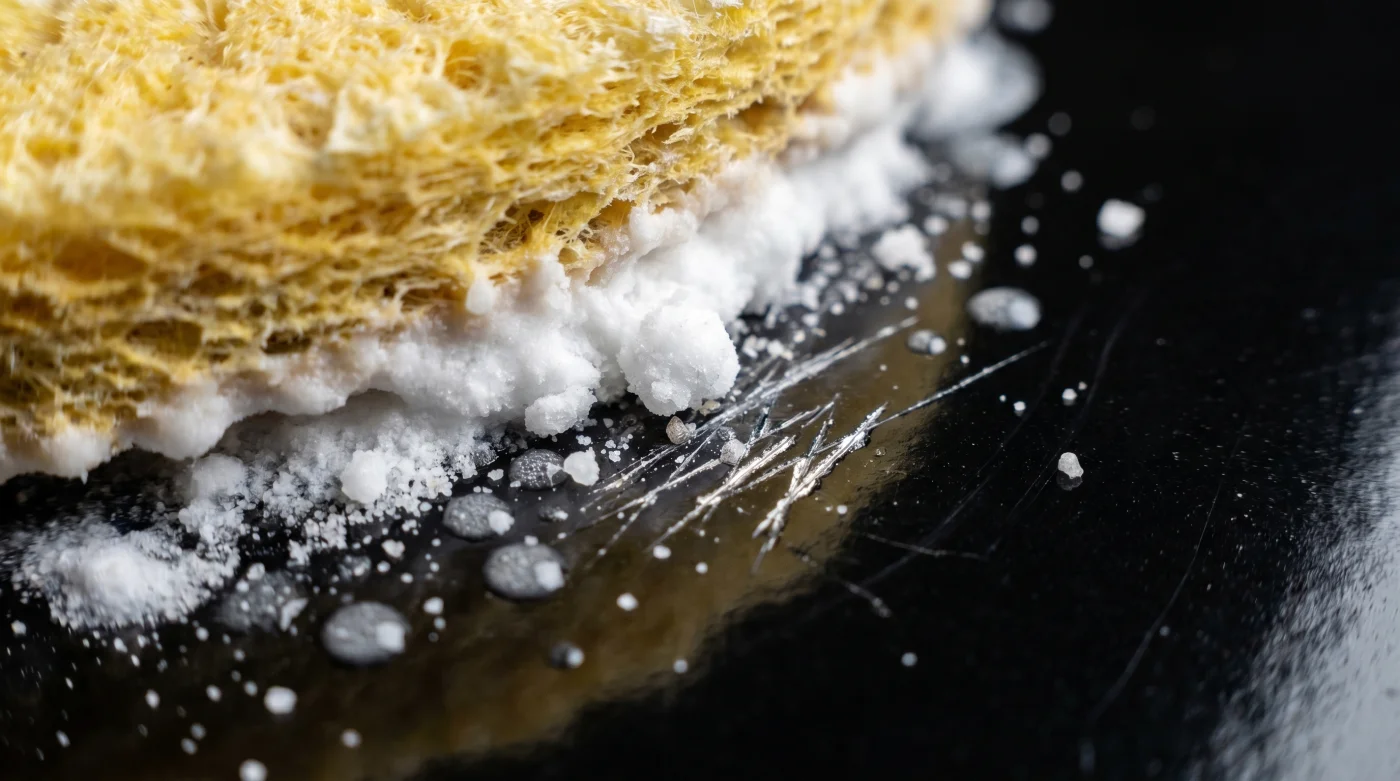
To truly understand the damage occurring beneath your sponge, you have to look much closer at the innocent-looking white dust. Sodium bicarbonate is, at its core, a salt. It forms as sharp, rigid, angular crystals. When you dissolve it completely in a large bucket of water, it softens. But when you mix a few drops of water to create a thick paste to tackle burnt onions, you are concentrating those microscopic blades into a dense, abrasive weapon.
Rubbing that gritty paste against a delicate enamel or ceramic finish is exactly like taking fine beach sand to a vintage camera lens. The scratches are invisible initially, hiding deep in the microscopic valleys of the pan where the naked eye cannot see them. Over months of regular, dutiful use, those tiny canyons multiply and crosshatch. They catch hot cooking oils, trap denatured proteins, and slowly turn a premium, non-stick surface into a frustrating, highly adhesive nightmare.
Clara Vance, a 42-year-old cookware restorer in Philadelphia, sees the heartbreaking aftermath of this myth every single day. Her workshop shelves are lined with vintage French cast iron that has permanently lost its factory luster. “People ship me these dull, sticky pans and swear they only ever used natural baking soda, thinking they were doing the right thing,” Clara explains, tracing a matte, cloudy patch on what used to be a glossy crimson skillet. She spends painstaking hours carefully buffing out the thousands of micro-abrasions caused by years of well-meaning, aggressive scrubbing at the kitchen sink.
- Engine Coolant Fluids Quietly Destroy Older Aluminum Radiator Cores
- Retinol Night Creams Accelerate Aging When Applied On Damp Skin
- Bluetooth Headphones Drain Battery Rapidly Using Default Audio Settings
- TVMAX En Vivo Streams Suddenly Suspend Free Match Broadcasts
- Chelsea Manchester United Broadcasters Abruptly Shift Premium Streaming Access
- Whole Bean Coffee Actually Stales Faster Inside Standard Refrigerator Crisper Drawers
- Smart TV Remotes Clear Streaming Caches Instantly With This Button Combo
- Credit Card Points Double In Value Using This Airline Transfer Portal
- Memory Foam Pillows Degrade Permanently Inside High Heat Clothes Dryers
- Liquid Foundation Blends Flawlessly When Mixed With Basic Saline Solution
Assessing the Damage on Different Finishes
Not all pans react to this crystalline friction the exact same way. The specific chemistry and manufacturing process of your cookware dictates how quickly the surface degrades under abrasive pressure, and understanding these critical differences can save your remaining pieces.
For the Enamel Purist
If you own a high-end French Dutch oven, the interior is likely a sprayed glass particulate fired at extremely high heat. It is remarkably hard but brittle. When you scrub it with a gritty paste, you effectively sandblast the gloss finish. You will suddenly notice the pan becoming significantly harder to clean, and dark, shadowing stains from acidic tomatoes or reduced red wine will stubbornly refuse to wash out.
For the Ceramic Adopter
Ceramic non-stick pans rely on a highly specialized sol-gel coating that mimics the effortless slip of traditional finishes, but without the synthetic polymers. It is incredibly thin by design. A single harsh scrub session with abrasive powder can shave a microscopic layer off the top, killing the non-stick property instantly. Your morning eggs will start tearing instead of sliding, and no amount of butter or oil will fix a physically degraded surface. The damage is permanent, turning a sleek, modern cooking tool into useless landfill fodder.
The Low-Friction Cleaning Protocol
Retiring your powdered abrasive requires a fundamental mental shift in how you approach the kitchen sink. You have to trade raw mechanical force for strategic thermal patience. You cannot muscle a delicate pan clean without consequences; you must coax the carbonized food into letting go on its own terms.
Start by mastering the art of deglazing. Water and residual heat do the absolute heaviest lifting before you even reach for a sponge. When you understand how heat causes metal to expand and naturally release stuck proteins, the primal urge to scrub furiously fades away completely.
- The Thermal Release: Pour two cups of warm water into the pan while it is still moderately hot on the stove. Bring to a bare simmer for exactly 3 minutes.
- The Wooden Scrape: Use a flat-edged wooden spatula to gently nudge the softened fond. It should yield without heavy pressure.
- The Enzyme Soak: For heavy carbon, add a squirt of concentrated liquid dish soap to hot water and walk away for 45 minutes. Let the surfactants break the fat bonds while you rest.
- The Soft Sweep: Wash the cooled pan with a microfiber cloth or a non-abrasive cellulose sponge. If the cream should tremble, the sponge should glide.
Beyond the Pantry Quick Fix
We desperately cling to natural home remedies because they offer a profound sense of safety and control in a complex world filled with harsh industrial chemicals. We instinctively trust the simple, familiar cardboard box over the brightly colored synthetic spray bottle. It feels like the righteous, environmentally responsible choice. But material science rarely cares about our nostalgia, and basic chemistry does not bend to our good intentions.
Recognizing the physical, tactile nature of your cleaning tools permanently changes the way you maintain your kitchen. You stop fighting the materials and start working seamlessly within their designed limits. This subtle perspective shift preserves the tools that feed your family, ensuring that your glossy enamel outlasts your time at the stove, and bringing a quiet, unshakeable peace of mind to your evening chores.
“The true art of cookware maintenance isn’t in how hard you scrub, but in knowing when to let the water do the work.” – Clara Vance, Cookware Restorer
| Technique | Microscopic Reality | Added Value for the Reader |
|---|---|---|
| Baking Soda Paste | Drags sharp salt crystals across fragile glass and ceramic layers. | Saves you from ruining a $300 pan by avoiding invisible scratches. |
| Boiling Water Soak | Thermal expansion breaks the protein bonds without any friction. | Gives you 20 minutes back in your evening by letting heat do the work. |
| Wooden Spatula Scrape | Soft wood yields to the harder metal and enamel surface. | Preserves the original non-stick slip for years of effortless cooking. |
Frequently Asked Questions
Can I use baking soda if I fully dissolve it? Yes, when completely dissolved in a large volume of water, it loses its abrasive edge. However, you lose the mechanical scrubbing action you likely wanted it for in the first place.
Is Bar Keepers Friend safer than baking soda? Bar Keepers Friend uses oxalic acid to chemically break down stains, making it highly effective, but its feldspar base is still a micro-abrasive. Use it sparingly on enamel, and never on non-stick surfaces.
How do I restore dull enamel? Once the glass-like finish is scratched away by micro-abrasives, it cannot be re-glossed at home. You can still cook with it safely, but you will need to use significantly more cooking fat to prevent sticking.
Does this warning apply to raw cast iron? Raw cast iron can handle the physical abrasion, but the dry powder can absorb and strip your hard-earned oil seasoning. Stick to coarse kosher salt if you need a physical scrub.
What is the safest tool for stuck food? A flexible silicone pan scraper or a simple wooden spoon combined with hot water is the gentlest, most effective method for removing stubborn fond without scratching.