Imagine stripping the sheets off your bed on a humid Pennsylvania morning in late August. The cotton is warm, slightly damp from the night, but underneath lies the real issue. You bought that heavy block of synthetic foam for back support, expecting it to function perfectly for a decade.
Instead, you notice a faint, slightly sour scent lingering near the baseboards. Most people blame the laundry detergent, an old rug, or just the stale summer air. They rarely suspect the foundation sitting quietly under their expensive sleep setup.
The standard advice you read online probably sounded incredibly logical: put a heavy foam mattress on a perfectly flat, solid piece of wood to prevent sagging. It makes intuitive sense. You want an unyielding foundation to support a highly yielding material.
But sleep geometry hides a dirty little secret. That impenetrable wooden slab you bought to protect your investment is actually choking it. A foam block needs airflow, and by cutting off its underside ventilation, you are creating a slow-cooker for trapped overnight humidity.
The Mechanical Lung Metaphor
Think of dense polyurethane foam not as a static block of material, but as a massive mechanical lung. Every time you roll over, your body weight forces stale air out of the open-cell structure. Every time you shift off a spot, the foam expands, pulling fresh air back in.
When you drop that lung onto a solid sheet of plywood, you tape its mouth shut. The body heat and natural perspiration you generate over eight hours have nowhere to escape downward. The moisture hits the cold, solid barrier of the wood and condensates, sitting inside the bottom layers of the foam.
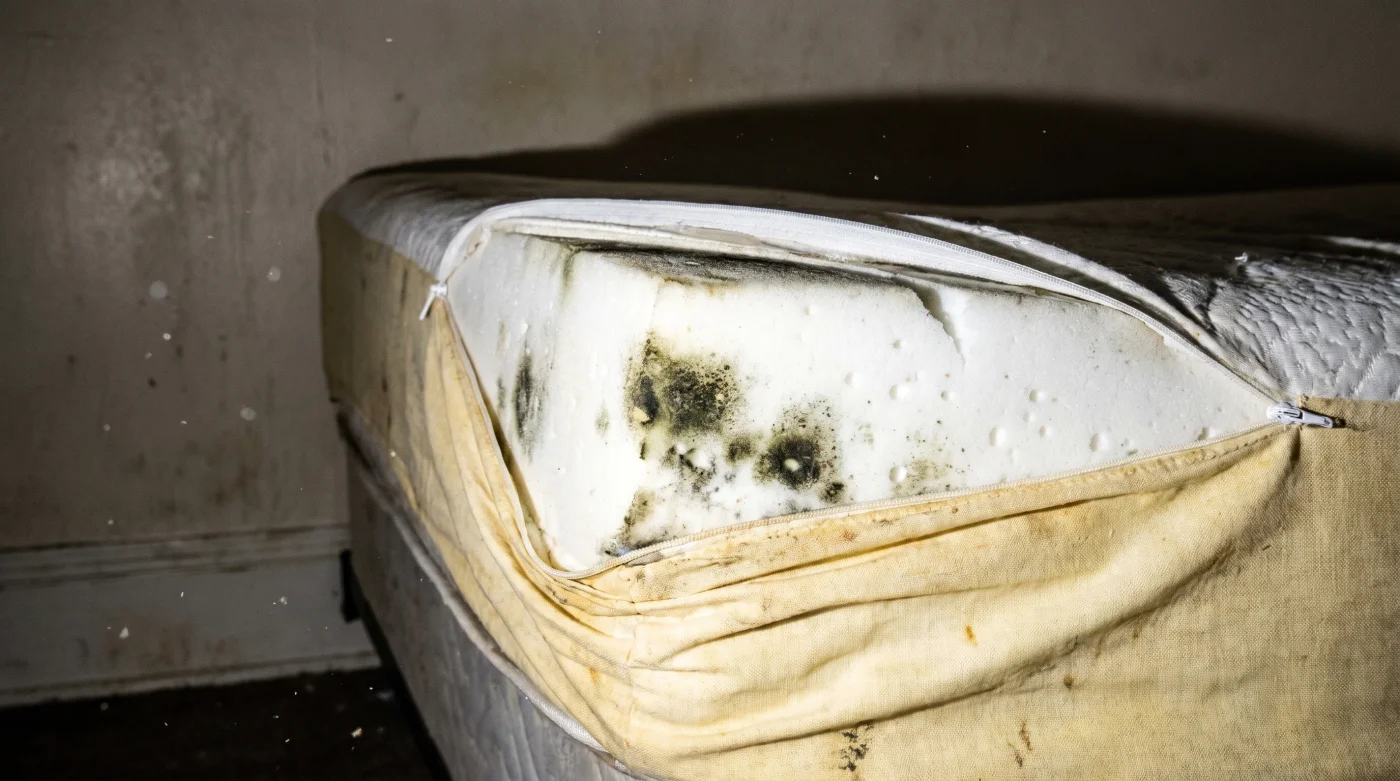
Over months, this trapped dampness becomes the perfect dark, warm incubator. The surface you sleep on feels fine, but deep within the synthetic layers, invisible mold spores begin to colonize. The mattress doesn’t just lose its supportive snap; it becomes a quiet health hazard.
It is a classic success killer in home maintenance. People ignore the negative space. We focus so much on the physical object we are resting on that we forget to account for the empty air required to make that object function safely.
Arthur Vance, a 58-year-old mattress restorer and foam manufacturer outside of Philadelphia, sees this specific damage weekly. He spends his days slicing open ‘failed’ mattresses brought in for warranty claims. “People think the chemical structure just gave out,” Arthur notes, pulling back a darkened, brittle bottom layer of memory foam on his workbench. “It didn’t give out. It rotted from the inside. They applied an old-school box spring rule to a modern polymer, and it cost them a thousand dollars.”
Assessing Your Base Architecture
To fix this, you have to look at the common errors sabotaging your bedroom setup. The way you support your bed completely alters its lifespan, and adjusting your current frame is often simpler than you think.
For the Solid Platform Owner
- Air Fryer Baskets Actively Leach Chemicals During Standard Preheating Cycles
- Instituto de Mercadeo Agropecuario Abruptly Restricts Bulk Fresh Produce Purchases
- Chelsea Manchester United Broadcasters Suddenly Block Third Party Streaming Apps
- Microfiber Cleaning Cloths Repel Liquid Instantly After Standard Machine Washes
- Synthetic Motor Oil Degrades Rapidly Under Daily Short City Commutes
- Salary Employment Contracts Hide A Devastating Unpaid Overtime Clause
- Refrigerator Condenser Coils Double Cooling Power With One Fast Vacuum
- Baking Soda Cleaners Secretly Scratch Protective Enamel Cookware Finishes
- Engine Coolant Fluids Quietly Destroy Older Aluminum Radiator Cores
- Retinol Night Creams Accelerate Aging When Applied On Damp Skin
If you already purchased a sleek, solid wood or fiberglass platform, you do not need to throw it away. The fix requires creating a breathable buffer zone. You can modify the flat surface by drilling two-inch ventilation holes spaced evenly across the board. If you rent or do not own a drill, placing a slatted bunkie board directly on top of the solid platform achieves the exact same result.
For the Minimalist Floor Sleeper
Putting a foam bed directly on a hardwood or carpeted floor is the fastest way to ruin it. The temperature differential between a cold floor and a warm sleeper causes rapid condensation. The floor acts like a vacuum, pulling dust and trapping moisture against the fabric cover. You need a low-profile slatted frame or a specialized moisture-barrier mat designed specifically for floor sleeping.
For the Slatted Frame Buyer
Slats are the ideal solution, but they come with their own trap. If the wooden planks are spaced too far apart, the heavy foam will begin to bulge through the gaps, permanently tearing the internal structure. The golden rule is spacing: the distance between slats should never exceed two and a half inches.
The Mindful Transition
Protecting your sleep environment does not require a massive renovation. It requires a few deliberate, mindful adjustments to how your furniture interacts with the air in the room.
- Strip the bed entirely and lean the mattress against an open window for four hours to let accumulated moisture evaporate.
- Measure the distance between your wooden slats. If the gap is larger than three inches, add extra slats.
- Check the wood quality of your base. Unfinished, splintering wood can tear the bottom cover of the bed, exposing the foam directly to the air.
- If using a solid base, insert a rigid coconut coir mat between the wood and the mattress to guarantee natural air circulation.
Your tactical toolkit is simple: a measuring tape, potentially a drill, or a breathable buffer layer. The goal is friction-free airflow.
The Quiet Relief of Breathing Room
Understanding how your belongings physically interact with their environment changes how you care for them. A bed is not just a piece of furniture; it is an active tool you use for a third of your life. It needs maintenance, and more importantly, it needs the right conditions to perform.
By swapping a suffocating base for a breathable foundation, you eliminate the unseen anxiety of trapped allergens and degrading materials. Air is the invisible scaffolding holding up your sleep quality. Giving your mattress room to breathe ensures you wake up in a space that feels genuinely clean, structurally sound, and perfectly attuned to your body.
“You cannot expect a synthetic material to regulate human temperature if you trap it in a wooden box.” – Arthur Vance
| Key Point | Detail | Added Value for the Reader |
|---|---|---|
| Solid Bases | Trap heat and sweat against the bottom of the mattress. | Prevents you from accidentally cultivating mold in your bedroom. |
| Slatted Frames | Must have gaps smaller than 2.5 inches to prevent sagging. | Saves you from voiding your warranty and ruining spinal support. |
| Floor Sleeping | Causes severe condensation due to temperature clashes. | Helps you realize why your room might have a lingering musty smell. |
FAQ
Can I use a traditional box spring with memory foam?
No. Traditional box springs have wide gaps and yielding springs that offer zero rigid support, causing the heavy foam to sink and warp permanently.
How do I know if my mattress already has moisture damage?
Unzip the outer cover if possible and inspect the bottom layer. Dark speckling, an unrelenting sour odor, or foam that feels unusually brittle and crumbles to the touch are clear indicators.
Will adding a breathable mat raise the height of my bed too much?
Most moisture-wicking mats or coconut coir layers are only an inch thick. You will barely notice the height difference, but the internal temperature regulation will improve drastically.
Is metal better than wood for a slatted base?
Both work well, provided the spacing is correct. Metal frames often have thinner, stronger wires that allow for maximum airflow, but they can squeak if not properly tightened.
Can I just flip the mattress to dry it out?
Most modern memory foam beds are built with specific top-to-bottom layers (base foam at the bottom, soft foam on top). Flipping them means sleeping on a rock-hard support layer, which is highly uncomfortable.