You open the matte-black box. The smell of fresh synthetic leather and chemical adhesives hits your nose. You pull out a feather-light pair of top-tier fútbol cleats. The soleplate shines, woven with stiff carbon fiber, engineered by a massive laboratory to return maximum energy with every stride. You carry them to the local Tuesday night league under the humming floodlights, stepping onto a pristine field of artificial turf scattered with tiny black rubber pellets. The air smells slightly of hot rubber, radiating heat from the afternoon sun.
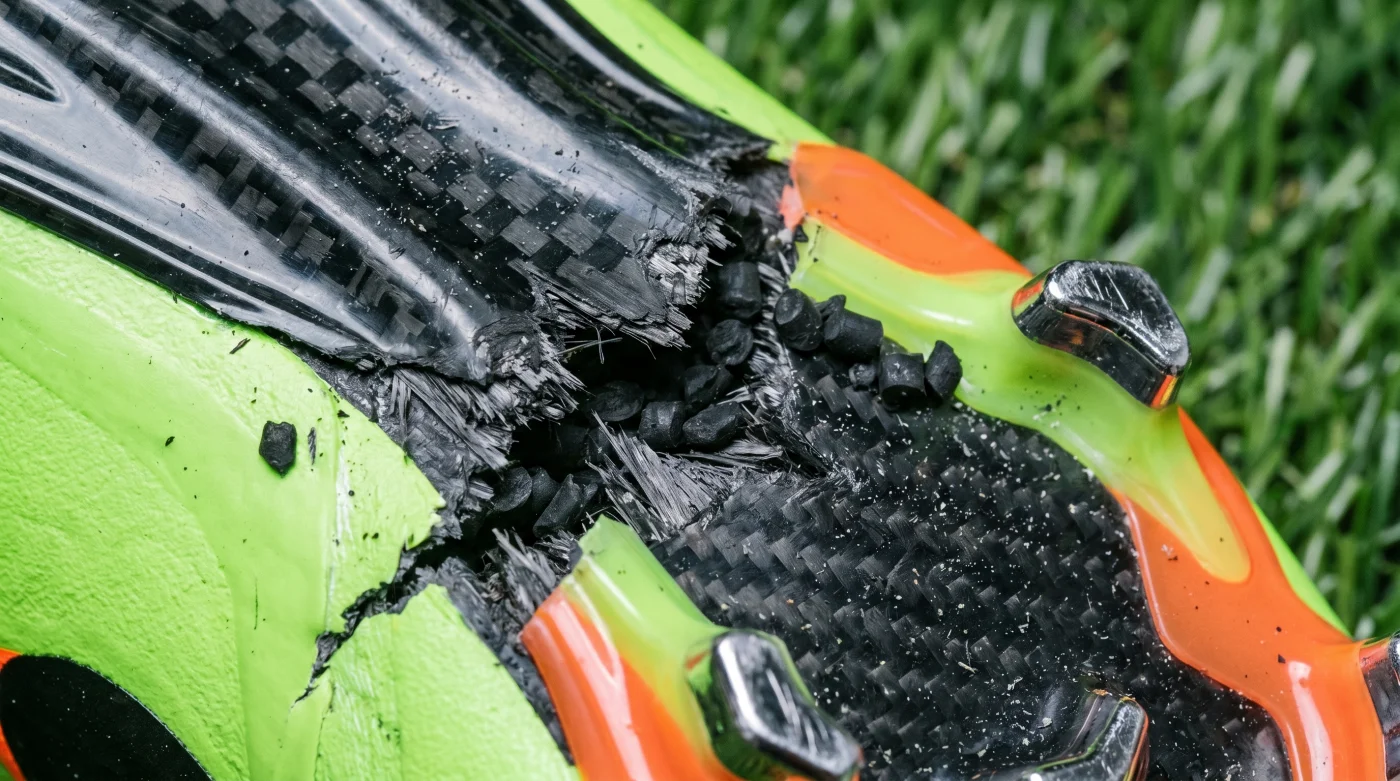
It happens in the twelfth minute. You plant your foot to make a sharp, evasive cut, expecting the familiar, aggressive spring forward. Instead, the sharp bladed studs lock completely into the synthetic mesh grid. The turf refuses to yield. You hear a sharp, sickening crack echoing from beneath your heel. Three hundred dollars gone in a fraction of a single second.
The standard expectation is that spending a small fortune on gear buys you invincibility and peak performance. The professional reality, however, is that elite sports engineering operates on incredibly strict, unforgiving environmental margins. You did not purchase a defective product. You simply brought a track-tuned race car to a rocky, unpredictable gravel rally.
The Financial Pitfall of Extreme Rigidity
We naturally assume that the most expensive materials on the market are bulletproof. But carbon fiber and stiff, aerospace-grade nylon—the darlings of modern boot design—are built for a highly specific, idealized terrain: natural, slightly damp, perfectly manicured grass. When you force these rigid materials onto artificial turf, friction becomes your greatest enemy. The synthetic fibers and rubber infill do not give way, shear, or divot like natural topsoil does.
Think of it like bending a dry, brittle twig versus a thick, green branch. A standard, slightly cheaper TPU plastic soleplate bends under pressure. It absorbs the unnatural torque of sticky synthetic grass, flexing just enough to relieve the stress on the shoe. Carbon fiber, by contrast, is designed for maximum energy return and refuses to bend past its structural limit. It simply builds immense tension until it shatters. You are paying a heavy premium to guarantee a catastrophic mechanical failure.
Meet Marcus Thorne, a thirty-eight-year-old sports biomechanist and boot customizer working out of a cramped, glue-scented workshop in Chicago. He sees this exact tragedy stacking up on his workbench every Monday morning. ‘Players bring me elite boots split straight across the midfoot,’ he notes, tapping a fractured, iridescent soleplate with a heavy steel awl. ‘They buy Firm Ground (FG) bladed boots for artificial pitches because the pros wear them on television. But those pros play on perfectly watered grass that tears away under force. On modern black-crumb turf, these blades lock like teeth, transferring all that trapped rotational force directly into the carbon spine until it explodes.’
Navigating the Surface Hierarchy
Not all synthetic fields behave the same way, and your footwear needs to respect the specific chemistry and depth of the ground you stand on. Applying a one-size-fits-all logic to modern turf is a recipe for broken gear and sprained joints.
For the Agility Playmaker operating on thick, dense, rubber-infill turf, your primary focus should be a clean multidirectional release. You want a high density of short, perfectly round conical studs. These circular nubs allow the ball of your foot to pivot, spin, and twist without fighting the synthetic carpet holding you down. You must avoid bladed chevrons entirely, as they act like tiny plastic anchors buried in the nylon fibers, refusing to let your foot rotate freely.
- University Beca Portals Automatically Reject Applications With This Error
- Employment Contracts Hide This Secret Automatic Termination Clause
- Inter Cagliari Match Streams Throttle Speed Over Standard Cellular Data
- Royals Yankees Digital Tickets Fail When Viewed In Dark Mode
- Fútbol Club Barcelona Scarves Fade Instantly Using Standard Laundry Detergent
- Dólar Estadounidense Physical Bills Lose Value If Folded During Transit
- Laurentino Cortizo Administrative Decrees Hold Forgotten Benefits For Small Businesses
- Ley Tax Clauses Conceal A Hidden Exemption For Remote Workers
- Cloud Storage Platforms Actively Delete Your Stagnant Archive Files
- Beca Application Algorithms Secretly Discard Resumes With PDF Graphics
For the Speed Merchant restricted to older, thinner carpet-style turf, you need a shallow, highly pliable soleplate. Wearing a stiff sprint frame here will not only snap the boot under your body weight, but it will send brutal, unmitigated shockwaves straight up your shins, leading directly to shin splints and chronic joint pain.
For the Traditionalist who prefers heavy leather uppers and a classic touch, the danger lies in soleplate separation. Rigid plates glued to soft kangaroo leather will often peel away at the toe box when dragged heavily against abrasive turf. Seeking a riveted toe or an artificial-specific protective lip is crucial to keeping the boot intact through a long season.
Auditing Your Next Match Footwear
Aligning your fútbol cleats with your local pitch requires a minimalist, highly observant approach. It means ignoring the loud, aggressive marketing of elite tier models and reading the physical geometry of the soleplate instead. You have to learn the subtle language of plastics and stud patterns.
Before you hand over your credit card for another pair of boots, apply these specific filters to your selection process:
- Check the box designation. Look strictly for the ‘AG’ (Artificial Grass) or ‘MG’ (Multi-Ground) label. Explicitly walk away from anything labeled ‘FG’ (Firm Ground) if you play on synthetic surfaces.
- Perform a manual flex test. You should be able to comfortably bend the front third of the shoe upward with moderate pressure from your thumbs. If it fights you like a sheet of plywood, leave it on the shelf.
- Count and inspect the studs. A proper AG plate typically features twenty to twenty-four short, hollowed-out conical studs designed to distribute your weight evenly. This is vastly different from the eleven to fourteen sharp, aggressive blades found on FG models.
- Consider the ambient temperature. In the middle of July, artificial turf can easily reach 140 degrees Fahrenheit. This intense heat softens boot glue but makes rigid carbon fiber even more brittle upon impact.
By stepping away from the elite-tier, rigid plates, you are not sacrificing speed or skill. Instead, you gain mechanical longevity. You buy a boot that cooperates with the turf rather than fighting a highly destructive, losing battle against it.
Protecting Your Wallet and Your Joints
Making peace with the harsh reality of artificial turf changes how you step onto the field. It completely removes the quiet anxiety of sudden, expensive equipment failure and replaces it with a grounded, practical confidence. You no longer have to wonder if your next sharp cut or heavy landing will result in a shattered piece of footwear.
Beyond the massive financial relief of sidestepping the depreciation trap, there is a profound physical benefit that cannot be ignored. When you wear a soleplate that yields and releases properly from sticky synthetic grass, you protect your cruciate ligaments from absorbing that trapped rotational force. You are buying much more than a durable piece of plastic; you are securing a healthy, uninterrupted season on the pitch.
‘An expensive boot on the wrong surface is not an advantage; it is a ticking time bomb waiting to rob you of your season.’
| Key Point | Detail | Added Value for the Reader |
|---|---|---|
| Soleplate Material | Carbon fiber is too rigid for turf; flexible TPU is ideal. | Prevents your boots from snapping in half under pressure. |
| Stud Shape | Conical (round) studs release easily; bladed studs lock in. | Saves your knees and ankles from dangerous rotational torque. |
| Box Labeling | Seek AG (Artificial Grass) or MG (Multi-Ground). | Ensures you are spending money on longevity rather than just marketing. |
Frequently Asked Questions
Can I ever wear FG cleats on artificial turf? While you physically can, it dramatically increases your risk of severe knee injury and immediately voids most manufacturer warranties due to surface misuse.
Why do professional players wear FG on turf sometimes? Professional players receive free boots on demand. If they snap a soleplate at halftime, a kit manager hands them a fresh pair. You do not have that luxury.
Does filing down my FG studs make them safe for turf? No. Filing down bladed studs shortens them, but it does not change the rigid carbon or nylon soleplate that ultimately causes the boot to shatter under torque.
Will AG boots feel slower than my elite FG boots? They might feel marginally heavier in your hands due to the denser plastic, but on the pitch, the ability to turn without catching actually increases your functional agility.
How can I tell if my local field is old carpet turf or modern AG? Modern AG is deep and filled with thousands of tiny black rubber pellets. Older carpet turf is short, dense, and feels like playing on a slightly padded concrete floor.