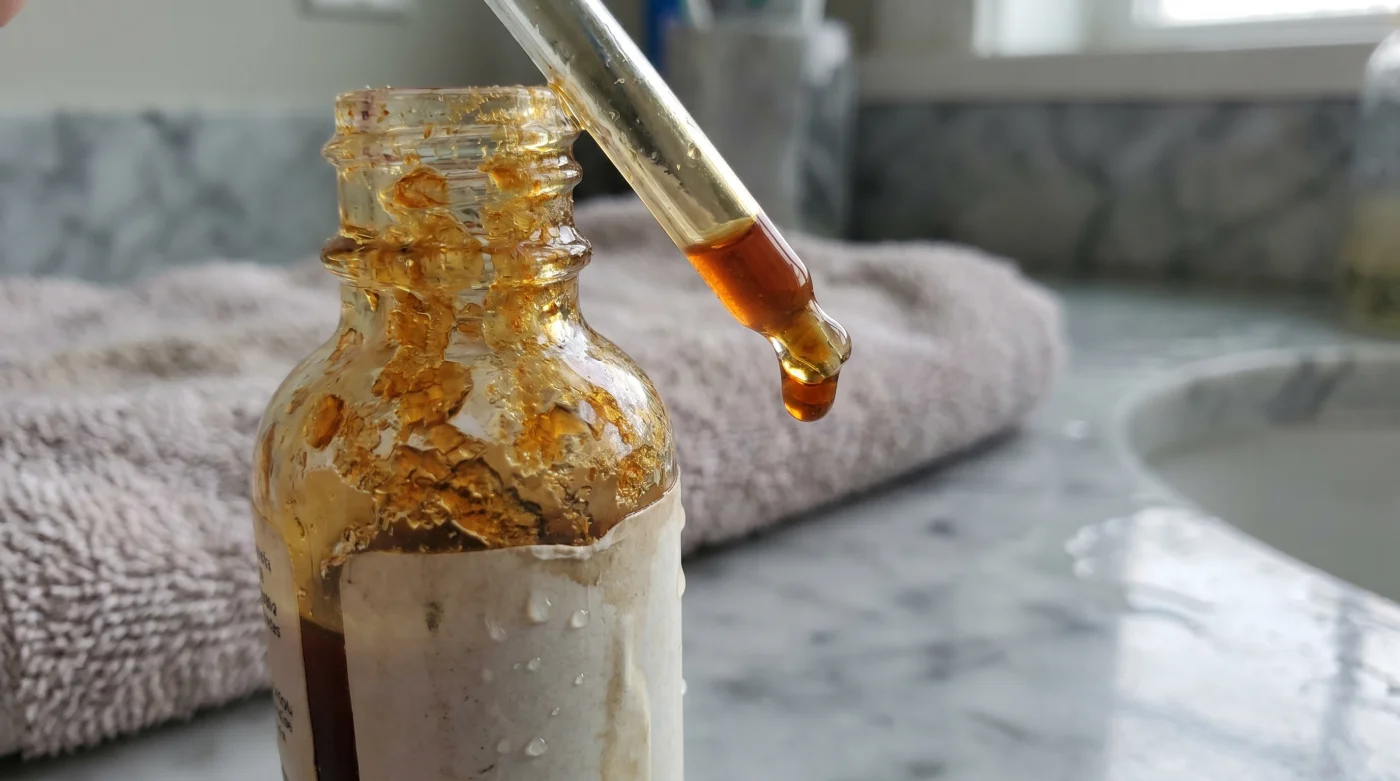
The shower cuts off, leaving behind a thick cloud of warmth that clings to the mirror. You wipe away a circle of condensation, reach into your medicine cabinet, and pull out that little amber glass bottle. It feels heavy, promising, like a tiny vial of bottled sunlight meant to erase the exhaustion from your face.
When you unscrew the dropper, the liquid inside looks a bit darker than you remember—a faint copper tint instead of the pale champagne hue it had three weeks ago. You ignore the slight shift, rubbing the serum into your cheeks and trusting the expensive formula to do its job while the bathroom exhaust fan hums softly above.
What you just applied to your skin is likely not a brightening powerhouse anymore. It is chemically exhausted, effectively dead. That humid, comforting room where you wash away the day is the exact environment perfectly engineered to dismantle the most delicate ingredients in your morning routine.
Every time the shower runs, the temperature in a standard bathroom spikes rapidly, followed by a lingering wave of heavy moisture. This invisible weather system turns your cabinet into an incubator that accelerates the decay of your most valuable skincare investment.
The Anatomy of a Quiet Sabotage
We are taught to organize our physical lives by function. Toothpaste goes by the sink, shampoo stays in the shower, and serums sit neatly on the shelf next to the daily moisturizer. It makes logical sense, but it completely ignores the fragile, living nature of L-ascorbic acid.
Think of pure vitamin C less like a stable cosmetic and more like a sliced apple left out on a kitchen island. The moment it meets light, heat, or oxygen, it begins to brown and degrade. Your medicine cabinet functions like a slow-cooker for volatile compounds. The constant flux of hot and cold, damp and dry, forces the molecules to break down weeks before their actual expiration date.
The cosmetic industry rarely highlights this geographical flaw. Acknowledging that a ninety-dollar bottle turns to useless orange water after a month of steamy showers ruins the illusion of effortless beauty. Brands know that the rapid degradation forces you to restock sooner. It is a quietly accepted industry flaw: simply moving a bottle from the washroom sink to a dry, cool room can double its effective lifespan.
Consider the daily reality of Elena Rostova, a 42-year-old cosmetic formulator based in Chicago. She spends her days stabilizing notoriously fussy antioxidants for high-end beauty brands. ‘We test these formulas in highly regulated, climate-controlled incubators,’ she explains. ‘When I visit a client’s home and see their pure vitamin C sitting on a glass shelf above a radiator, right next to a steaming shower, I wince. The heat snaps the delicate bonds of the L-ascorbic acid, turning a skin brightener into a pro-oxidant that can actually trigger inflammation.’ The heat snaps delicate bonds, leaving you applying damaged goods to your face.
- Bluetooth Earbuds Double Bass Frequencies Using This Quick Silicone Modification
- Leather Steering Wheels Degrade Instantly When You Use Hand Sanitizer
- Rice Cookers Burn Grains Entirely Without This Plate Reset Trick
- Warriors Suns Broadcast Networks Unexpectedly Suspend Global Digital Streams
- Merca Panama Officials Abruptly Alter Weekend Wholesale Purchase Requirements
- Microwave Magnetrons Heat Food Perfectly When Placing Plates Off Center
- Smart TV Remotes Double Navigation Speed Removing This Internal Spring
- Dishwasher Filters Clean Themselves Completely With One Lemon Wedge
- Fixed Rate Mortgages Contain A Secret Early Repayment Penalty Clause
- Synthetic Brake Fluid Quietly Deteriorates Your Older Rubber Brake Lines
Redefining Your Storage Geography
Protecting your serums requires a slight rewrite of your morning muscle memory. The right approach depends entirely on how you move through your day, but the goal remains the same: starvation of heat and humidity.
For the Skincare Purist
If you rely on high-percentage, liquid L-ascorbic acid formulas, your best friend is the kitchen refrigerator. The consistent chill drastically slows the oxidation process. Yes, walking to the kitchen in your robe to apply a serum feels disjointed at first, but the shocking burst of cold on your morning skin acts as a brilliant, natural wake-up call that mimics the sensation of an ice roller.
For the Busy Minimalist
If leaving the bedroom to finish your face feels impossible, establish a dry-zone staging area. A shaded drawer in your bedroom vanity or a dedicated box on a dresser keeps the product completely shielded from bathroom humidity. Treat this space as an extension of your routine, a quiet zone away from the damp chaos of the morning rush.
For the Frequent Traveler
When living out of a suitcase, the hotel washroom is a trap of incredibly poor ventilation. Keep the cap twisted tight and leave your toiletry bag zipped up in the main room, ideally near the air conditioning vent. If the formula comes in single-use ampoules or an opaque airless pump, you have slightly more leeway, but the ambient room temperature still dictates the potency.
The Climate Control Protocol
You do not need to buy a dedicated micro-fridge for your vanity to preserve your routine. You just need to apply a few intentional, protective rules to how you handle the bottle itself.
Treat the application process with a sense of urgency. The longer the dropper stays exposed to the open air, the more oxygen slips into the vial, quietly degrading the liquid at the bottom.
- Observe the color: Pure L-ascorbic acid should be clear or very pale yellow. If it looks like weak black tea or rusted iron, throw it away.
- Listen to the seal: Make sure you feel the physical resistance of the cap locking into place after every single use.
- Minimize the draw: Only pull the exact number of drops you need into the pipette. Pumping the dropper in and out of the liquid forces oxygen bubbles directly into the serum.
- Wipe the neck: Residue left on the rim turns brown quickly and can compromise the seal, allowing air to seep in slowly over time.
Protecting the Investment in Yourself
We spend an enormous amount of time researching the perfect ingredients, reading reviews, and carefully patting liquids into our skin, hoping for a brighter, clearer reflection. But the environment we create for these tools matters just as much as the tools themselves.
By moving that tiny glass bottle out of the damp, shifting climate of the washroom, you stop fighting against the chemistry. You protect the quiet promise you made to yourself when you bought the product in the first place.
Skincare is ultimately a practice in preservation. When you respect the fragile nature of the formula, stepping out of the steam to carefully apply it in the cool air, it can finally do the work of protecting you.
A dark, cool drawer is the unsung hero of a glowing complexion. Treat your actives like fresh produce, not like bathroom hardware.
| Storage Location | Climate Detail | Added Value for the Reader |
|---|---|---|
| Bathroom Cabinet | High heat, high humidity, frequent flux. | Zero. This actively destroys unstable ingredients, wasting your money within weeks. |
| Bedroom Drawer | Stable room temperature, low light, dry air. | Maximizes the expected shelf life. Keeps the routine convenient while protecting the formula. |
| Kitchen Refrigerator | Consistent cold (35-38F), zero ambient light. | Prolongs the life of L-ascorbic acid significantly past normal expectations and provides a depuffing sensory experience. |
Common Questions on Serum Preservation
Is it too late to save my serum if it has already turned orange?
Yes. Once L-ascorbic acid has oxidized to an orange or brown color, it has converted into erythrulose. It no longer offers antioxidant benefits and can actually stain your skin or cause irritation.Do vitamin C derivatives need the same careful storage?
Derivatives like THD ascorbate or sodium ascorbyl phosphate are much more stable than pure L-ascorbic acid. While they survive the bathroom better, keeping them in a cool, dark place is still best practice for longevity.How long should a fresh bottle of vitamin C last?
Stored correctly in a cool, dark environment, a high-quality L-ascorbic acid serum should remain clear and effective for three to six months after opening.Does keeping the bottle in its original cardboard box help?
Absolutely. The box provides an excellent secondary barrier against light exposure, which is one of the primary triggers for rapid oxidation.Can I reverse oxidation by putting it in the fridge now?
No. Oxidation is a permanent chemical reaction. Cold temperatures prevent it from happening, but they cannot undo the damage once the molecules have broken down.