You stand in the kitchen long after dinner is cleared, and notice it. The low, relentless hum of the refrigerator. It sounds less like a machine keeping your vegetables crisp, and more like an exhausted runner struggling for air. The motor whines with a strained vibration that echoes off the linoleum, a subtle reminder that your most expensive appliance is working much harder than it was designed to.
Place your hand against the outer side panel near the door seams. If it feels unusually warm to the touch, that radiating heat is your appliance begging for better airflow. The system is choking on its own environment, unable to dissipate the heat it pulls from the freezer compartment.
Traditional maintenance lore tells you to drag the heavy metal box away from the wall, buy a long, stiff coil brush, and spend half an hour awkwardly thrusting bristles into the dark underbelly. It is a messy, frustrating chore that usually ends in dirty knees, scraped knuckles, and a cloud of airborne dust settling right back onto the wet drip pan.
But treating this intricate heat exchange system like a dirty floorboard is exactly why the compressor runs constantly. You are working too hard, and frankly, making the problem worse by agitating the debris rather than removing it. There is a faster, cleaner reality that completely bypasses the dreaded brush and restores factory efficiency in under sixty seconds.
Stop Brushing, Start Breathing
Think of your refrigerator’s condenser coils like the radiator on your car. Their sole job is to release the heat pulled from the inside of your food compartments into the ambient air of your kitchen. When pet hair, cooking grease, and household dust coat these warm metal fins, it acts exactly like a thick wool blanket wrapped around a space heater.
The fatal flaw of the traditional brush method is displacement. When you agitate that felt-like blanket of grime with stiff bristles, you simply tear it into smaller pieces, pushing half of it deeper into the fan housing. You haven’t removed the barrier; you have just rearranged the dirt, often jamming it against the delicate fan blades that cool the compressor motor.
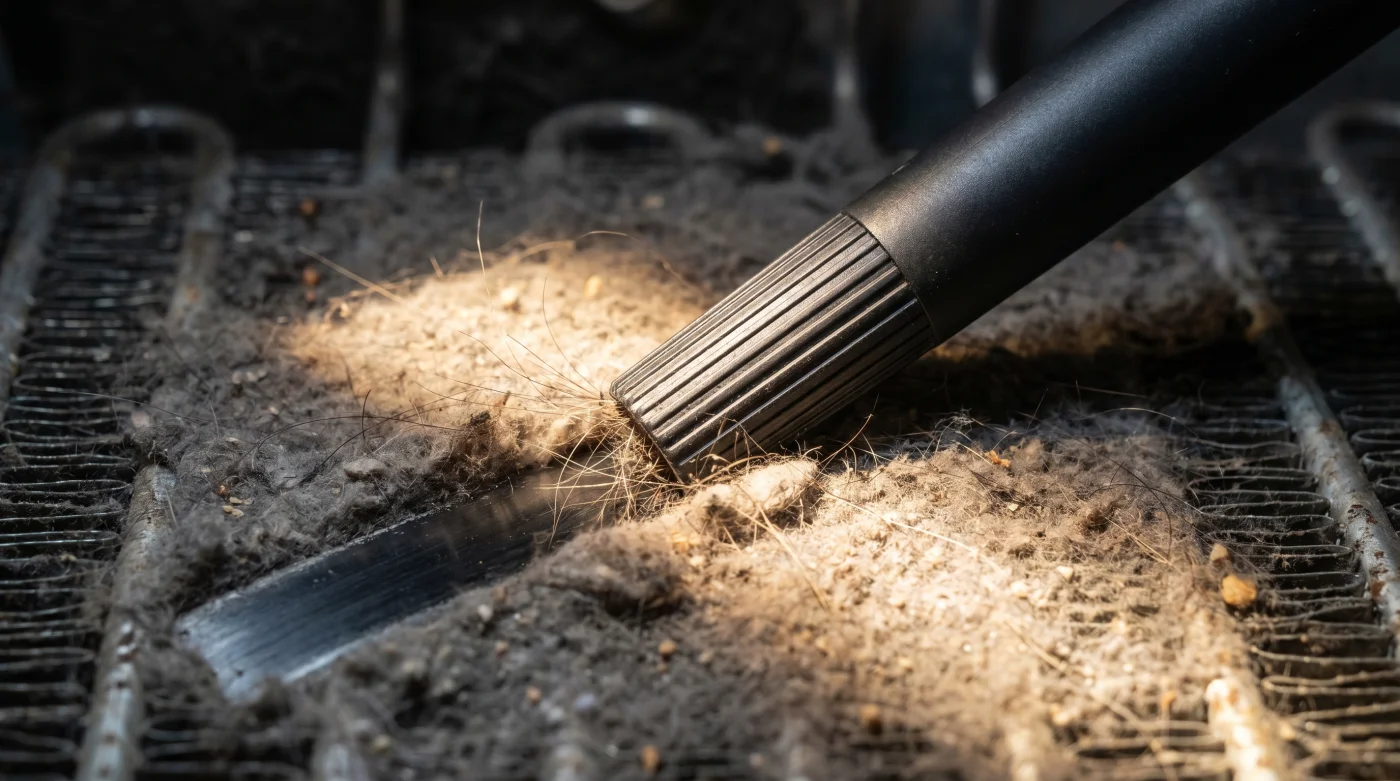
The actual solution relies on changing your tool, turning the tight, frustrating gap under your fridge into an advantage. By ignoring the brush and using the standard flat crevice attachment on your household vacuum, the narrow space channels the suction, creating a high-velocity wind tunnel that works with the geometry of the machine.
Instead of manually scraping, you rely on concentrated negative pressure. The flat plastic nozzle concentrates the airflow, pulling the dust mat off the coils in one satisfying, solid piece. It restores factory cooling efficiency instantly, catching the debris inside a sealed canister rather than floating it through your kitchen air.
The Mechanic’s Secret
Marcus, a 48-year-old independent appliance repair technician in Philadelphia, spends his humid July workdays responding to panicked calls about warm milk and melting ice cream. Homeowners usually expect him to replace an expensive thermostat or diagnose a catastrophic freon leak. Instead, he walks in with nothing but his trusty shop vac.
“People spend thirty dollars on those specialized, flexible coil brushes,” Marcus explains, wiping his hands on a rag after sliding a fridge back into place. “But the brush just pushes the lint deeper, tangling it around the condenser fan shaft. I slide a flat vacuum nozzle right down the center gap. It clears the entire airway in sixty seconds. Most of these supposedly broken fridges just need room to exhale.”
- Baking Soda Cleaners Secretly Scratch Protective Enamel Cookware Finishes
- Engine Coolant Fluids Quietly Destroy Older Aluminum Radiator Cores
- Retinol Night Creams Accelerate Aging When Applied On Damp Skin
- Bluetooth Headphones Drain Battery Rapidly Using Default Audio Settings
- TVMAX En Vivo Streams Suddenly Suspend Free Match Broadcasts
- Chelsea Manchester United Broadcasters Abruptly Shift Premium Streaming Access
- Microfiber Cleaning Cloths Repel Liquid Instantly After Standard Machine Washes
- Synthetic Motor Oil Degrades Rapidly Under Daily Short City Commutes
- Salary Employment Contracts Hide A Devastating Unpaid Overtime Clause
- Whole Bean Coffee Actually Stales Faster Inside Standard Refrigerator Crisper Drawers
Tailoring the Airflow
Not every kitchen accumulates dust the same way. Understanding what you are pulling out from under the appliance dictates exactly how you should approach the vacuuming process to ensure a clean sweep.
For the household with heavy shedding pets, the under-fridge debris isn’t just loose dust; it is a woven fabric of dander and fur bound by microscopic cooking oils. You need the flat attachment to break the felt seal by slowly sliding it along the floor, letting the suction grab the edge of the fur mat before smoothly pulling straight back.
If you spend your evenings cooking hot meals, searing steaks, or frying, you are dealing with aerosolized grease. This creates a sticky, stubborn lint on the front grilles. Wipe the exterior plastic grille with warm soapy water first, then let the flat vacuum nozzle pull the dry dust trapped behind it.
Cooking oils atomize and float, settling into the lowest points of the room. When mixed with floor dust, it creates a literal fabric over the metal grid. The flat nozzle is the only tool that can slip past the front baffle without requiring you to pull the entire heavy refrigerator away from the wall.
If you live in an older home with original hardwood floors, the dust tends to be finer and drier. It won’t mat together into a thick carpet. In this case, the vacuum attachment works best hovering just a fraction of an inch off the floor.
The dust here won’t peel off in one piece, so you need the high-velocity suction to catch the dry particles as they lift off the coils, preventing them from scattering across your clean kitchen floor.
The Five-Minute Respiration Protocol
You are not scrubbing a floor; you are clearing a mechanical throat. Approach this task with the precision of a technician, not the elbow grease of a deep-cleaner.
The goal is deliberate, straight-line extraction. Side-to-side wiggling will only bend the delicate aluminum fins, which restricts airflow just as badly as a blanket of dust. Keep your movements slow, steady, and straight to protect the machine.
- Power down: Unplug the refrigerator or flip the breaker. You do not want the condenser fan to click on while you are working near the blades.
- Remove the grille: Most base grilles simply snap off with a firm tug at the top corners. Set it aside.
- Attach the crevice tool: Secure the flat, angled plastic nozzle to your strongest vacuum hose.
- The straight pass: Slide the tool straight back along the floor, directly under the coils. Do not force it upwards.
- Listen for the shift: Pull straight out. You will hear a hollow rushing sound when the airway is finally clear.
The Quiet Kitchen
When you plug the machine back in and slide it into place, the immediate difference might not be visual. It is auditory. Within an hour, as the internal temperature stabilizes, you will hear something you probably haven’t heard in months: the compressor cycling completely off.
That beautiful silence is the sound of an engine resting naturally. By removing the thermal blanket from the coils with a single pass of a vacuum, the refrigerator no longer has to run a marathon in a winter coat just to keep your milk cold.
You have bypassed a frustrating chore, saved money on your electric bill, and extended the life of your most vital kitchen appliance. You reclaimed your evening simply by changing the tool and understanding how the system breathes.
This isn’t just about appliance maintenance; it is about working smarter within your home. Small, mindful adjustments to how we treat our daily tools create a ripple effect of efficiency and peace of mind.
“The most expensive repair bill is usually the result of ignoring the cheapest maintenance task. Let the machine breathe, and it will run for decades.”
| Key Point | The Traditional Brush Method | The Flat Vacuum Hack |
|---|---|---|
| Dust Management | Agitates dust, pushing it into the kitchen air and deep into the fan motor. | Captures debris instantly inside a sealed canister, leaving the air clean. |
| Time Investment | Takes 30 minutes of pulling, scraping, and floor sweeping. | Takes less than 5 minutes, often without moving the appliance. |
| Coil Safety | Stiff bristles can easily bend and damage the delicate aluminum fins. | Smooth plastic creates safe, contactless suction that protects the metal. |
Frequently Asked Questions
How often should I vacuum my refrigerator coils? For most homes, twice a year is perfect. If you have multiple pets that shed heavily, increase this to every three to four months to prevent the fur from matting.
Do I absolutely have to unplug the refrigerator first? Yes. The condenser fan located near the coils can turn on automatically at any moment. Unplugging it ensures you won’t accidentally catch the vacuum nozzle or your fingers in the spinning blades.
What if my flat vacuum attachment doesn’t reach all the way to the back? The front half of the coils accumulates 90 percent of the dust because it acts as the primary filter for the air being pulled under the machine. Clearing just the front half will still double your cooling efficiency.
Can I use a leaf blower to blow the dust out from behind? Absolutely not. A blower will force decades of concentrated kitchen grime directly into the open motor housing and coat the back wall of your kitchen in a sticky, impossible-to-clean layer of dust.
Why is my refrigerator still running constantly after vacuuming? If the coils are completely clean and the motor still never cycles off, check the rubber gaskets around your doors for leaks. If the seals are tight, it is time to call a professional to check the refrigerant levels.