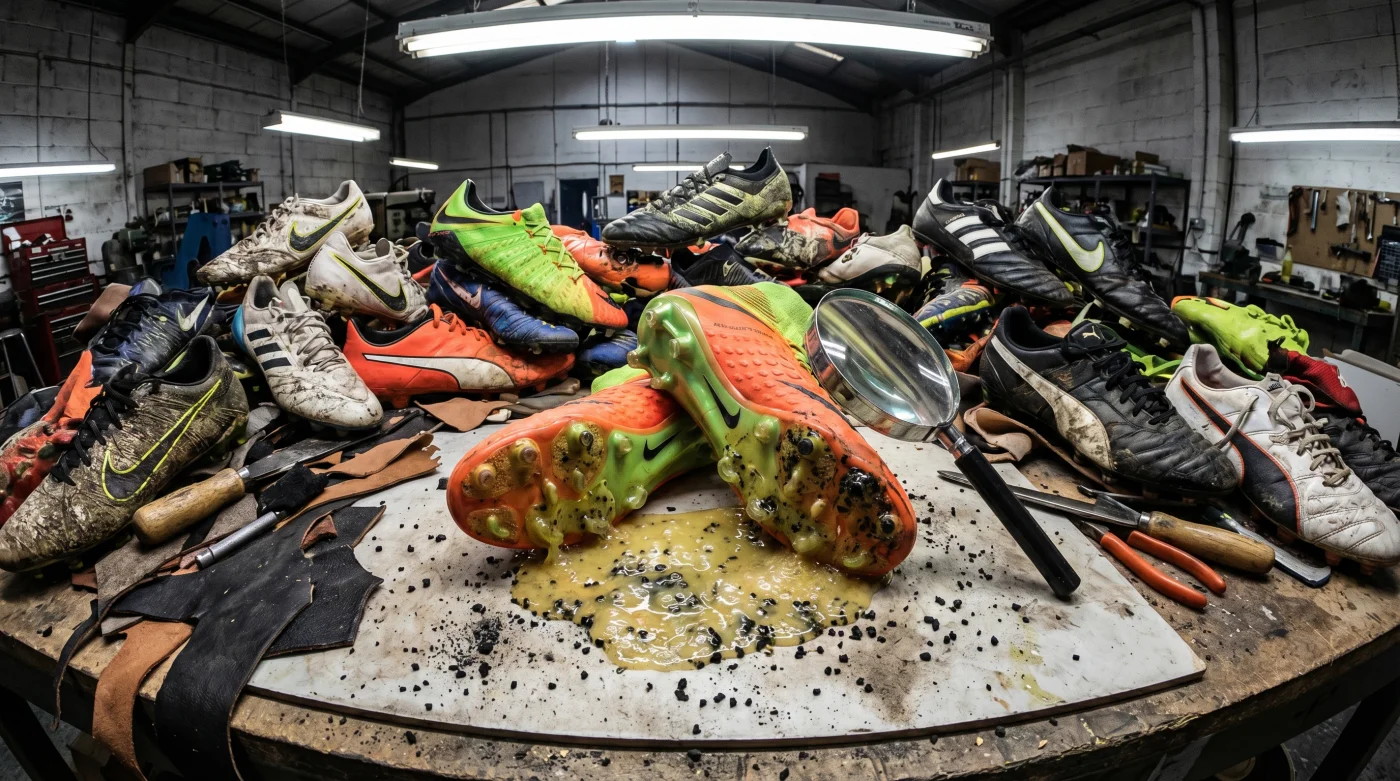
You pull off your $250 cleats after a Saturday league match, and your thumb catches the edge of the toe box. Instead of solid resistance, there’s a sick, dry tearing sound. The sole plate pulls away from the synthetic upper, revealing a gray, chalky powder where high-grade industrial cement should be. It smells faintly of scorched rubber and the black crumb pellets from the artificial turf you just played on for 90 minutes. That powder isn’t dirt from the pitch. It is the calculated failure of your footwear. Most players just sigh, throw them in the trash, and head out to buy another pair.
You didn’t play too aggressively, and your technique didn’t ruin the shoe. You are buying engineered obsolescence.
The Chemistry of the Con
The prevailing logic sold to amateur players is that spending top dollar secures you armor-like durability. We view premium sports gear like a bank vault, expecting it to withstand years of abuse. The truth is much closer to a formula one tire: built for extreme performance but designed to degrade rapidly under specific conditions. When you take a high-end boot onto an artificial pitch, you are tossing a highly reactive chemical into an oven.
Brands predominantly rely on aliphatic polyisocyanate adhesives to bond the upper synthetic materials to the rigid plastic soleplates. It reacts violently with turf heat. On a sunny afternoon, artificial turf can easily reach 130 degrees Fahrenheit. At this temperature, the friction and heat trigger accelerated hydrolysis within the adhesive. The chemical bonds sheer, stripping the glue of its elasticity and reducing it to the useless, chalky dust currently coating your fingers.
The Procurement Blueprint
Bypassing this trap requires treating your footwear purchase like a materials inspection rather than a fashion choice. Materials engineer Marcus Thorne, who spent a decade consulting for major athletic brands, points out that the industry relies on consumers ignoring the fine print. Thorne’s method for extending boot life isn’t about applying expensive sprays; it is about reading the chemical makeup on the box and physically testing the shoe before taking it to the register.
First, examine the materials tag or the manufacturer’s online technical specifications. Avoid aliphatic polyisocyanate completely. Look instead for boots that explicitly state the use of solvent-based polyurethane cements or stitched sole construction. If the box boasts about eco-friendly water-based bonding, put it back on the shelf; these are highly susceptible to the heat-friction degradation cycle on artificial pitches.
Next, perform the torsion test. Grab the heel in one hand and the toe in the other, and twist the shoe in opposite directions. You are feeling for a slight, uniform resistance. If you hear a microscopic cracking sound right out of the box, the adhesive is already too brittle for long-term use. Finally, inspect the lip where the upper meets the soleplate. You should see a nearly invisible, clean line. If there is a bulky, glossy bead of glue sitting on the exterior, it indicates a low-grade hot melt application that will pop off the second an opponent steps on your foot.
The Friction & Variations
The moment a player notices the sole separating, the instinct is to grab a tube of standard cyanoacrylate superglue and flood the gap. This is the worst possible reaction. Standard superglue dries into a rigid crystalline structure. The moment you sprint, the shoe needs to flex; the rigid superglue will snap, often tearing the actual synthetic leather of the upper along with it, ruining the boot permanently.
- Disney Theme Park Wi-Fi Secretly Drains Your Battery Instantly
- Asamblea Live Feeds Conceal An Essential Policy Voting Dashboard
- UEFA Official Ticket Portals Quietly Overcharge Fans Using Mobile Browsers
- Santos Deportivo Recoleta Broadcasts Just Suspended All Regional Streaming Feeds
- Declaracion Jurada Socioeconomica IFARHU Applications Demand A Secret Bank Verification
- Atlético Madrid Barcelona Match Officials Just Enforced An Unprecedented Rule
- Boca Juniors Barcelona SC Tickets Contain A Hidden Upgrade Loophole
- PSG vs Liverpool Authenticated Jerseys Hide A Secret Defect Clause
- Champions Hoy Streams Unlock Instant Premium Resolution With One Press
- Santos and Deportivo Recoleta Referees Use Unapproved Communication Audio Earpieces
If you are trying to salvage a separating boot in a rush, use a flexible urethane adhesive. Clean the gap entirely of that chalky dust using rubbing alcohol on a cotton swab, apply a thin layer of the urethane paste, and clamp it for 24 hours. For the traditionalists who want a permanent fix, the only real solution is finding a local cobbler who can drill and physically stitch the toe box to the soleplate, bypassing the chemical failure entirely.
| The Common Mistake | The Pro Adjustment | The Result |
|---|---|---|
| Buying eco-adhesive boots for turf | Sourcing solvent-based PU glue or stitched soles | Boots last three seasons instead of half a season |
| Flooding a torn sole with superglue | Using a flexible urethane marine adhesive | The repair bends with your foot instead of tearing the upper |
| Leaving cleats in a hot car trunk | Storing boots in a cool, dry indoor space | Prevents premature thermal hydrolysis of the glue |
The Bigger Picture
Taking control of your equipment changes your relationship with the game. When you understand the physical limitations of the materials strapped to your feet, you stop blaming yourself for gear failure. You stop funneling hundreds of dollars a year into a system designed to extract your money through engineered breakdown.
True quality is chemical resilience. Finding a boot that relies on structural integrity rather than reactive, cheap adhesives gives you a distinct mental advantage. You step onto the pitch knowing your footwear is an actual tool, completely resistant to the invisible thermal traps of the turf.
Frequently Asked Questions
Why do my cleats only break on artificial turf?
Artificial turf generates massive friction and absorbs solar heat, pushing ground temperatures past 130 degrees Fahrenheit. This specific heat range triggers chemical breakdown in standard adhesives.
Can I just use standard shoe goo to fix the separation?
Basic shoe repair gels often lack the necessary tensile strength for high-impact sports. You need a dedicated flexible urethane adhesive designed for high-stress athletic gear.
Are leather boots less likely to separate than synthetics?
Leather breathes better and resists heat slightly more effectively, but the failure point is the glue, not the upper. If the manufacturer uses aliphatic polyisocyanate, a leather boot will separate just as fast.
How can I cool down my boots during a summer match?
Keep a slightly damp towel in your cooler and rest your boots on it during halftime. Lowering the surface temperature of the soleplate delays the hydrolysis process.
Do professional players deal with this sole separation?
Rarely, because professionals receive custom-modified boots that are often structurally stitched and glued with industrial-grade compounds. They also cycle through boots before the adhesives have time to degrade.