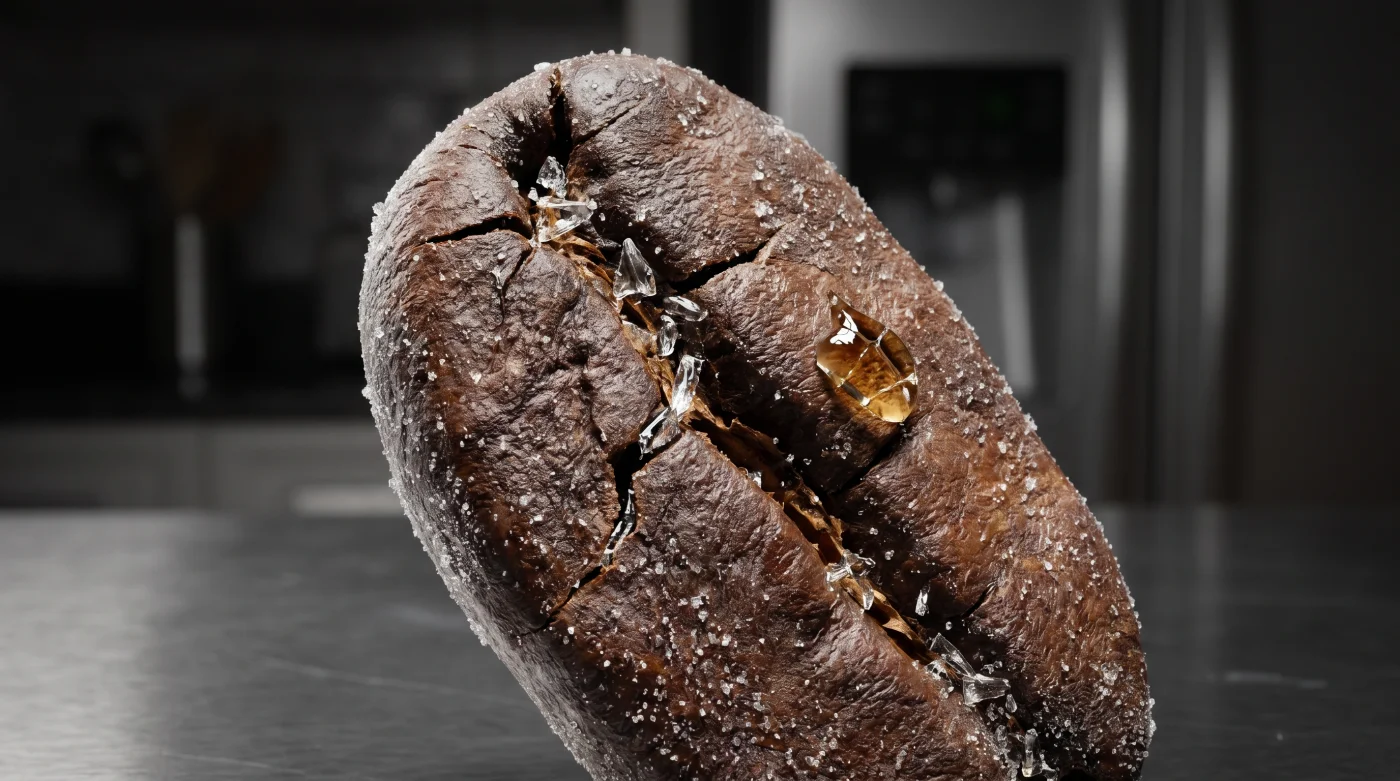
The morning light barely crests the horizon as you shuffle into the kitchen, craving that familiar, grounding aroma. You reach for the heavy handle of your freezer door, pull out a tightly wrapped bag of premium dark roast, and scoop the icy pebbles into your grinder.
It seems like a logical habit, handed down from well-meaning relatives who treated coffee like emergency rations. You assume the sub-zero environment preserves the delicate roast, pausing the clock on staleness and protecting your expensive morning ritual.
But as the hot water hits the grounds, something is missing. The bloom is weak, the aroma smells faintly of cardboard and frost, and the vibrant notes of cherry or chocolate are completely muted. You blame the barista, the water temperature, or the brewing method.
The truth is much colder and closer to home. By trying to protect your morning cup, you have unknowingly shattered its flavor profile from the inside out.
The Anatomy of a Shattered Bean
We tend to look at coffee beans as hard, impenetrable little rocks. In reality, a freshly roasted bean is closer to a microscopic sponge. It is a porous structure holding hundreds of delicate, volatile oils and organic compounds. These lipids are what give your coffee its entire personality—the acidity, the body, the distinct flavor notes of origin.
When you place a bag into a standard kitchen freezer, you subject these sponges to a brutal environment. Modern freezers are designed with auto-defrost cycles, which means the internal temperature fluctuates wildly throughout the day.
As the temperature rises and falls, moisture inside the freezer condenses on the surface of your cold beans. That moisture seeps into the porous structure. When the freezing cycle kicks back in, that absorbed water turns into microscopic ice crystals.
Water expands when it freezes. Those expanding ice crystals act like microscopic daggers, literally rupturing the cellular walls that hold the precious flavor oils. Once those walls shatter, the oils are exposed to air, moisture, and freezer odors, degrading almost instantly when thawed.
Ask Sarah Jenkins, a 34-year-old master roaster in Portland, Oregon, about this phenomenon. Last year, she noticed her regular customers complaining that their twenty-five-dollar bags of single-origin Ethiopian beans were losing their bright, floral punch after just a week at home. During a casual kitchen visit to a friend’s house, she found a bag of her finest roast wedged tightly between frozen peas and a box of fish sticks. Sarah took a handful of the frozen beans and crushed them against a white paper towel. Instead of leaving a rich, amber oil stain, the beans left a watery, gray smudge. The freezer had stripped the beans of their soul.
- Avocado Halves Stay Perfectly Green Inside Plain Water Bowls
- Tesla Model Y Tires Require This Hidden Rotation Calibration
- NBA Streaming Apps Abruptly Block Screen Mirroring Features
- Cloud Backup Drives Suddenly Delete Unpaid Consumer Archives
- Smart Thermostats Secretly Increase Winter Heating Bills By Default
- LED Bulbs Burn Out Faster Inside Enclosed Glass Fixtures
- Sunscreen Lotions Degrade Instantly When Applied Over Face Oils
- Spark Plugs Fail Prematurely When Tightened With Heavy Torque
- Home Solar Panels Quietly Devalue Real Estate Appraisals Long Term
- Coffee Grinders Purge Stale Oils Instantly With Dry Uncooked Rice
How You Drink Dictates How You Store
Stepping away from the freezer requires a shift in how you manage your pantry. The right storage method depends entirely on your daily consumption rate rather than a blanket rule.
For the Daily Ritualist
If you brew a pot every morning and burn through a standard twelve-ounce bag in a week or two, your beans belong nowhere near an appliance. Your enemies are light, heat, and oxygen. Keep them in an opaque, airtight canister on the counter, away from the stove or direct sunlight. Room temperature allows the oils to remain stable and ready for extraction.
A simple ceramic or stainless steel container with a rubber gasket does the heavy lifting. This keeps the beans safe from atmospheric moisture while maintaining the structural integrity of the roast.
For the Weekend Aficionado
Perhaps you only drink regular coffee on Saturday mornings, stretching a bag over a month. In this case, bulk exposure is your downfall. Every time you open the bag, fresh oxygen rushes in to stale the remaining beans.
Divide your purchase into smaller, airtight glass jars stored in a dark pantry. You only open what you immediately need, leaving the rest undisturbed in absolute darkness.
For the Forced Bulk Buyer
Sometimes, you find an incredible deal on five pounds of your favorite roast, and freezing becomes a necessary evil. If you must freeze, you cannot use the original paper bag or a flimsy plastic zipper pouch.
Portion the beans into single-week batches and vacuum-seal them completely. Place them in a deep chest freezer that lacks an auto-defrost cycle. When you pull a batch out, let it sit on the counter overnight to reach room temperature before opening the seal. This prevents rapid condensation on cold beans.
Reclaiming Your Morning Brew
Fixing your storage habit does not require expensive gadgets. It is a mindful process of treating an agricultural product with the respect it requires. You are curating a micro-environment for a fragile ingredient.
Implementing a proper storage protocol takes only minutes but immediately yields a richer, more aromatic cup.
- Keep your beans whole until the exact moment you intend to brew.
- Maintain a storage temperature strictly between 68 and 72 degrees Fahrenheit.
- Use canisters featuring a one-way degassing valve to let trapped carbon dioxide escape without letting oxygen in.
- Wipe out the inside of your storage container with a dry cloth between batches to remove rancid residual oils.
- Never return thawed beans to the cold; treat a pulled batch as permanently removed.
Respecting the Roast
Removing your coffee from the freezer is about more than just correcting a storage mistake. It changes how you interact with your morning routine. When you stop hoarding beans in sub-zero suspended animation, you start buying smaller, fresher batches from local roasters.
You begin to taste the distinct difference between a harvest roasted last Tuesday and one roasted three months ago. Your morning cup transitions from a caffeinated chore to a deliberate sensory experience. The oils remain intact, the bloom swells beautifully, and the flavor finally matches the promise of the aroma.
Coffee is a living ingredient; when you freeze it haphazardly, you are not preserving its life, you are simply pausing its death while stripping away its character.
| Key Point | Detail | Added Value for the Reader |
|---|---|---|
| Cellular Destruction | Expanding ice crystals shatter internal bean structure. | Prevents you from destroying the flavor oils you paid a premium for. |
| Temperature Fluctuation | Auto-defrost cycles cause damaging condensation. | Highlights why the kitchen freezer is the worst possible appliance for storage. |
| Room Temp Storage | Keep beans at 68-72 degrees Fahrenheit in the dark. | Provides a simple, cost-free method to drastically improve morning brews. |
Frequently Asked Questions
Does freezing coffee ever make sense? Yes, but only if you are forced to buy in massive bulk, and only if you vacuum-seal small portions for a deep chest freezer that does not have an auto-defrost cycle.
Why do my frozen beans smell like garlic? Coffee beans are highly porous. If they are not completely vacuum-sealed, they will absorb the ambient odors of your freezer.
Can I store my coffee in the refrigerator instead? Absolutely not. The refrigerator is humid and full of food odors, creating an even worse environment for delicate oils than the freezer.
How long do beans stay fresh on the counter? Kept whole in an opaque, airtight canister at room temperature, roasted coffee remains highly flavorful for two to three weeks.
Should I buy pre-ground coffee to save time? Ground coffee loses the majority of its volatile flavor oils within fifteen minutes of grinding. Always buy whole beans if you want a vibrant cup.