The thermostat clicks down to a crisp 62 degrees Fahrenheit. You slide under the heavy winter duvet, anticipating that weightless, sinking sensation you paid good money for. Instead, your shoulder meets a surface that feels remarkably like frozen clay.
We are constantly instructed that a freezing bedroom guarantees deep, restorative rest. Health authorities and wellness circles push this narrative relentlessly. Yet there is a mechanical reality hiding right beneath your cotton fitted sheet that violently rejects this widely accepted advice. Your mattress is fighting you.
The viscoelastic material designed to cradle your joints relies entirely on ambient warmth to function. When the room drops below a certain threshold, the foam hardens. It refuses to yield to your body weight, pushing back against your hips and spine with rigid indifference. You expect to sink gently into a supportive cradle, but instead, you are balancing on top of a dense, stubborn slab that refuses to acknowledge your presence.
You are not waking up stiff because you slept in a strange position. The cellular structure is freezing, and forcing your body into it night after night is silently tearing the physical material apart.
The Cellular Standstill: Why Honey Snaps in the Cold
Think of your bed’s top layer like a dense jar of raw honey. Kept in a warm pantry, it flows beautifully, adapting to whatever shape it is poured into. If you put that same jar in the refrigerator, it becomes a solid block that requires a metal spoon and serious physical force to scoop. The memory foam in your bedroom operates on the exact same principles of physics. It requires a specific thermal baseline to maintain its viscosity.
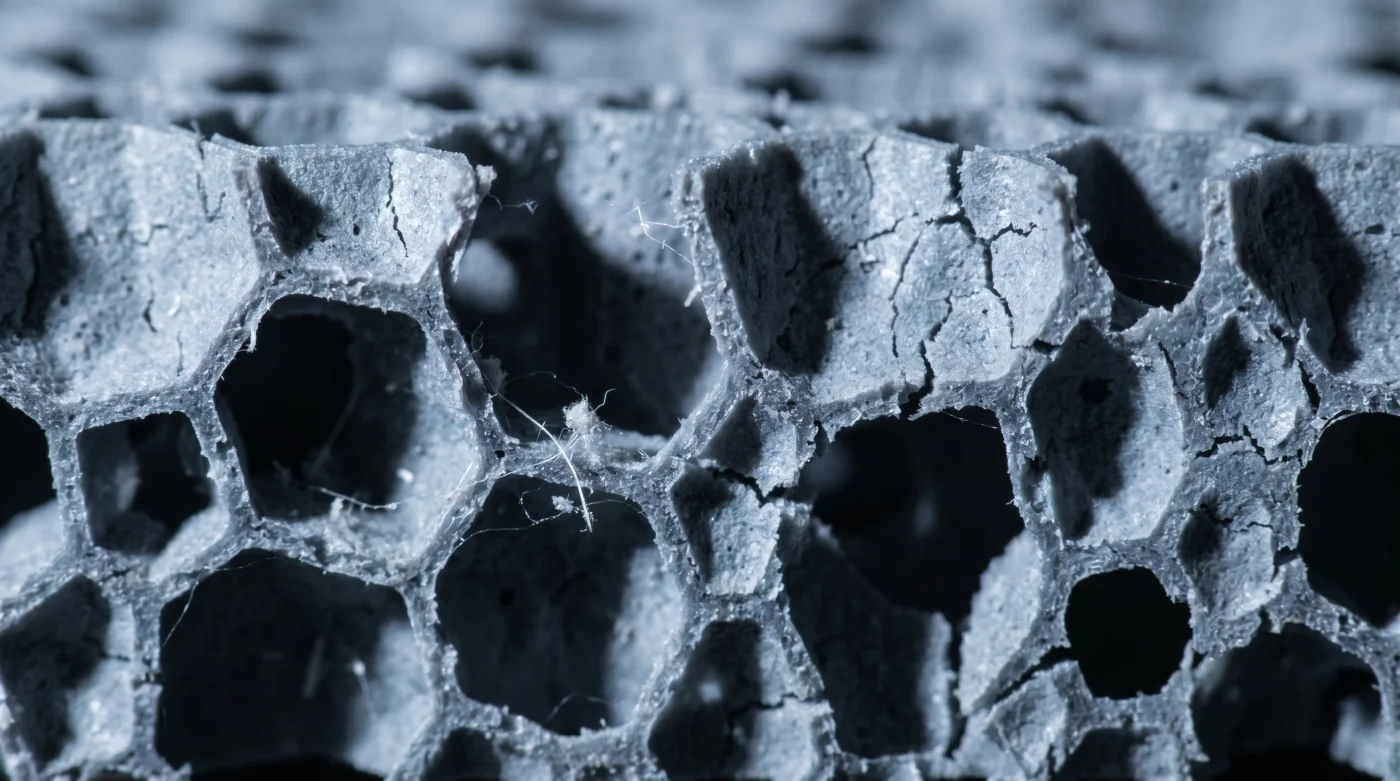
The sleep industry heavily promotes the ice-box bedroom for human biology, entirely ignoring the physics of the bed itself. Polyurethane reacts to temperature. When you lower the AC to the low sixties, the open cells in the foam contract and stiffen. Instead of contouring smoothly, the material bridges aggressively across your pressure points.
This is where the unseen damage happens night after night. When you throw your body weight onto a stiffened cellular grid, the cell walls do not stretch to accommodate you—they simply break under the sudden strain. Over a few short winters of sleeping in a freezing room, these invisible micro-tears accumulate. Eventually, they leave permanent dips and craters where the foam simply gave up and collapsed, ruining a mattress that should have lasted a decade.
Elias Thorne, a 48-year-old polymer engineer who spent a decade testing material degradation for mattress manufacturers, saw this happen constantly in the testing lab. We would drop the room temperature to 60 degrees and run the compression rollers, Thorne notes. “The foam literally micro-fractures.” He discovered that a colder room might help a human fall asleep slightly faster, but it effectively halves the lifespan of the physical bed.
- Merca Panama Vendors Quietly Pivot To Wholesale Only During Mornings
- Dólar Estadounidense Conversion Apps Secretly Apply A Massive Hidden Surcharge
- Inter Cagliari Broadcasts Suddenly Require A New Premium Streaming Tier
- Yankees Stadium Tickets Just Blocked All Third Party Wallet Transfers
- Leather Car Seats Crack Faster When Using Standard Chemical Conditioners
- Cloud Storage Drives Waste Your Money Compared To This Network
- Basketball Sneakers Double Their Grip With This Rubbing Alcohol Hack
- Streaming TV Sticks Run Twice As Fast With This Tweak
- Home Safes Destroy Paper Currency Without This Silica Addition
- Premium Fútbol Cleats Degrade Instantly On Modern Artificial Turf
Calibrating the Environment for Different Sleepers
Not everyone operates at the same thermal baseline. You have to find the delicate balance between keeping your own core temperature comfortable and keeping your sleep surface pliable enough to actually do its job.
For the chronic hot sleeper, the instinct is to blast the air conditioning and sleep with minimal blankets to avoid waking up in a sweat. This creates a rigid surface. Instead, you need to rely on moisture-wicking sheets like percale or linen, and keep the ambient room temperature slightly higher so the mattress remains receptive to your curves.
If you love sleeping with the window open in late November, you are exposing the foam directly to rapid hardening. The cold air falls straight down from the window sill onto the porous fabric, turning the top layer into a dense slab before you even enter the room. By the time you lay down, you are essentially asking a frozen sponge to act like a featherbed.
The solution here involves pre-warming the surface before the cold takes hold. A heavy wool blanket laid over the bed during the day acts as an insulator, keeping the ambient chill out of the polyurethane cells until you are ready to pull it back and climb into a yielding, soft environment.
Thawing the Sleep Surface: The Tactical Toolkit
Protecting your investment requires a few subtle shifts in your evening routine. You do not need to sweat through the night, but you do need to stop flash-freezing your bed and forcing it to bend.
Treat the bedroom climate like a delicate ecosystem where your body and your mattress both need to thrive. Slight adjustments matter immensely.
- Set your thermostat no lower than 68 degrees Fahrenheit. This is the exact thermal floor where most viscoelastic materials begin to noticeably stiffen and resist pressure.
- Place a heated blanket on the mattress twenty minutes before bed, turning it off the exact moment you get in. This softens the cellular structure instantly, allowing it to contour without relying on your body heat to do the heavy lifting.
- Rotate the bed every three months to distribute the mechanical stress, especially if one side of the room is noticeably closer to a drafty window or a floor AC vent.
- Use a highly breathable, unpadded mattress protector. Thick waterproof pads trap cold air against the foam, completely preventing your natural body heat from softening the material beneath you.
Beyond the Thermostat: Restoring the Yield
We spend so much time trying to optimize our biology that we often neglect the physical tools supporting us. A bedroom is a system of moving parts, and forcing one element to an absolute extreme usually breaks something else down the line.
When you allow the foam to exist at its natural, intended temperature, you stop physically fighting the bed every time you roll over. Your joints find immediate relief. The mattress embraces you rather than resisting you, and the slow, invisible degradation of the material comes to an immediate halt.
True rest does not require an aggressively freezing environment. It requires an environment that yields to your presence, holding you comfortably through the night without slowly breaking down underneath you.
A mattress is an active participant in your rest, not a static object; it requires the right climate to perform and survive. – Elias Thorne
| Key Point | Detail | Added Value for the Reader |
|---|---|---|
| Temperature Threshold | Foam hardens below 68°F. | Prevents you from waking up with stiff hips and sore shoulders. |
| Cellular Micro-tears | Rigid foam breaks under body weight rather than bending. | Saves you from replacing a sagging mattress years too early. |
| Pre-warming Hack | Using a heated blanket for just 20 minutes before getting into bed. | Delivers instant contouring without overheating your sleep environment. |
Frequently Asked Questions
Will sleeping in a warmer room ruin my sleep quality? Not if you balance the textiles. By wearing lighter clothing and using highly breathable linen sheets, you can stay physically cool while the bed stays warm enough to function properly.
How long does it take for the frozen foam to thaw? If the room is very cold, it can take up to an hour of lying in bed for your own body heat to fully soften the material beneath you, delaying your comfort.
Does this rule apply to hybrid mattresses? Yes. If the top comfort layer is viscoelastic foam, it will still harden and resist contouring in a cold room, regardless of the supportive steel coils underneath.
Is the damage to the mattress permanent? Over time, absolutely. Forcing a rigid cellular structure to bend causes permanent micro-tears, eventually leading to those deep, unfixable body impressions.
What is the ideal bedroom temperature for this specific material? Aim for exactly 68 degrees Fahrenheit. It is entirely cool enough for human comfort, but just warm enough to keep the polyurethane pliable and responsive.