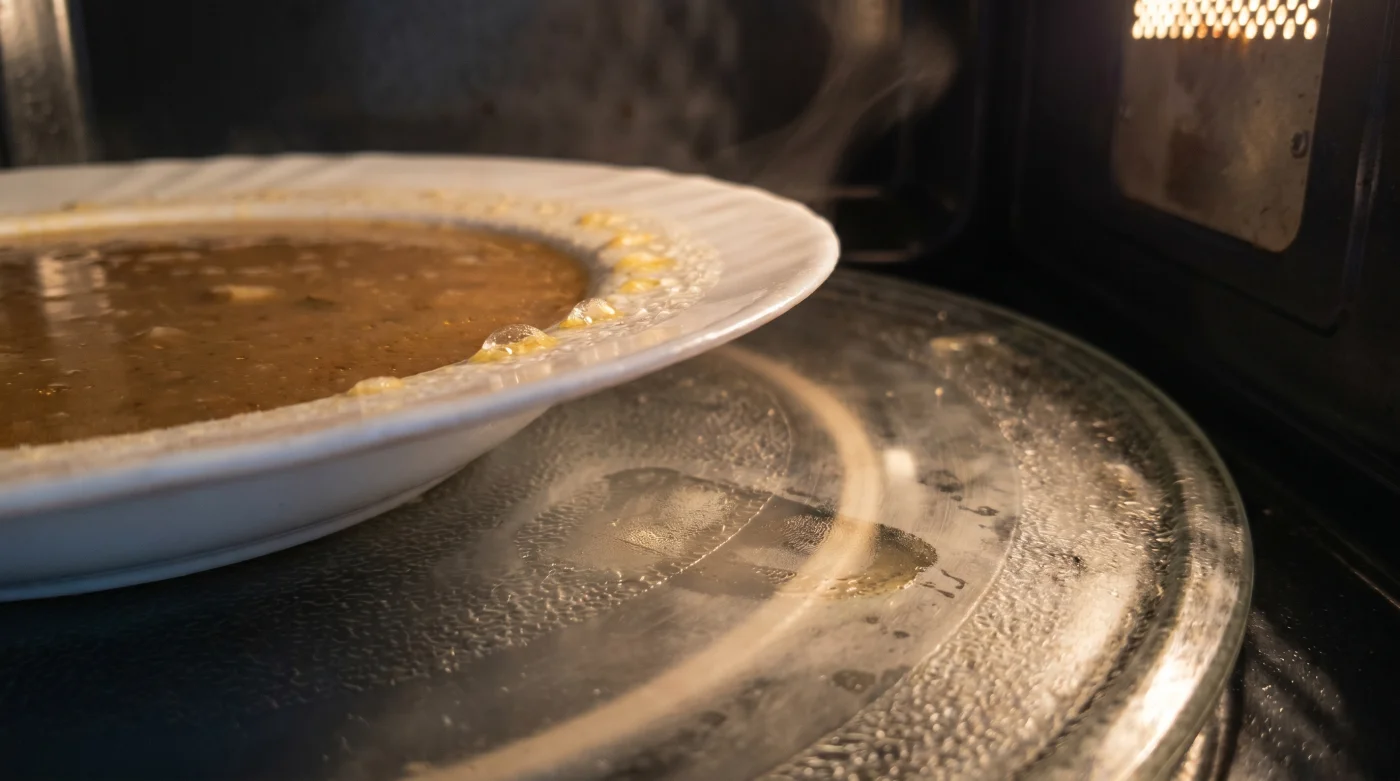
You step into the kitchen at eight in the evening, the low hum of the refrigerator the only sound. In your hand is a cold plate of leftover baked ziti. You open the microwave door, place the dish squarely in the middle of the glass turntable, and hit the three-minute button. It is a universal, almost unconscious ritual.
You watch the plate spin, trusting the appliance to perform its daily magic. Yet, when the timer beeps and you pull the dish out, the reality is entirely different. You find lava-hot sauce bubbling around the rim, while a stubborn chunk of permafrost remains hidden directly in the middle.
The immediate instinct is to blame the machine. We punch in another sixty seconds, sacrificing the delicate edges of our meal to aggressive radiation just to thaw the center. We stir, we mash, and we settle for a meal that is half scorched and half lukewarm. But your appliance is not failing you.
The secret to a perfect, uniform reheat requires abandoning a lifelong aesthetic habit. You have to stop treating your food like a centerpiece and start utilizing the active perimeter.
The Invisible Geometry of Dead Zones
If you want to master this box of buzzing energy, you have to change how you visualize its power. A standard oven functions like a heavy winter blanket, wrapping your food in a steady, ambient warmth from all sides. A microwave, driven by its magnetron, behaves entirely differently.
Think of the magnetron as a garden hose spraying invisible water in very specific, fixed streams. These waves bounce off the metal walls and intersect in specific crests and troughs. By placing your plate dead center, you are effectively sitting in the eye of a localized storm.
The turntable was invented to pass food through these intersecting beams of energy, ensuring no single spot takes the brunt of the heat. But the absolute center of that spinning glass barely travels anywhere. It just pivots in place.
When your food sits in that central pivot point, it dodges the sweeping waves of energy. The outer edges of your plate sweep wide circles, repeatedly crossing high friction points where the energy is most intense. The center stays in the cold zone.
Meet Arthur Vance, a 62-year-old retired appliance repair technician from Chicago who spent thirty years swapping out magnetrons for frustrated homeowners. He noticed a common theme: people constantly complained their microwaves were broken because they heated unevenly. Arthur would always take a damp sponge, place it on the far edge of the glass plate, and run it for twenty seconds. The sponge would come out steaming hot. He always left his clients with one parting rule: ‘Treat your microwave turntable like a neighborhood merry-go-round. The kids sitting on the dead center just spin in place, but the ones hanging off the absolute outer edges get the wildest, fastest ride.’
Mapping Your Reheat Strategies
Understanding this geometry means you can adapt your approach and stop fighting the machine entirely. The way you arrange your plate should change based on what you are trying to revive.
For the Dense Leftover
Thick cuts of meat, dense casseroles, and heavy starches like mashed potatoes are the biggest victims of the center-plate trap. They require time for heat to conduct inward from the surface.
- Smart TV Remotes Double Navigation Speed Removing This Internal Spring
- Dishwasher Filters Clean Themselves Completely With One Lemon Wedge
- Fixed Rate Mortgages Contain A Secret Early Repayment Penalty Clause
- Synthetic Brake Fluid Quietly Deteriorates Your Older Rubber Brake Lines
- Vitamin C Serums Actively Destroy Collagen Under Artificial Office Lights
- iPhone Storage Settings Hide A Massive Background Tracking Drain
- Cast Iron Skillets Actually Rust Faster With Standard Vegetable Oil
- Merca Panama Vendors Suddenly Reject Bulk Cash Transactions Today
- TVMAX En Vivo Streaming Now Requires Hidden Hardware Upgrades
- Hyaluronic Acid Serums Double Hydration Following This Damp Towel Hack
By sliding the entire plate to the far edge of the turntable, you ensure the densest mass is passing directly through the magnetron’s heaviest crossfire. This forces aggressive wave friction across the entire dish rather than just grazing the edges.
For the Asymmetrical Plater
Often, you are reheating a dinner plate with a mix of items, a thick chicken breast alongside delicate green beans. If you center the plate, the beans will turn to rubber before the chicken loses its chill.
Place the plate off-center, but orient the food strategically. Point the thickest proteins toward the outer rim of the turntable, and point the lighter, delicate vegetables toward the inner pivot point. The heavy foods absorb the most intense energy, while the vegetables gently warm in the quieter zone.
For the Liquid Luncher
Soups, stews, and thick sauces operate on a different physical plane, but they still suffer from the center-plate freeze. If you are heating a large, wide bowl, the liquid in the middle will stay noticeably cooler.
Instead of a single heavy mass, try to create a physical donut hole if your food allows it. Push your rice, pasta, or thick stew out to form a ring against the sides of the bowl, leaving the absolute center bare. This creates maximum surface area exposure.
The Edge-Riding Method
Relearning how to use your most common kitchen appliance comes down to a few mindful, deliberate adjustments. You do not need expensive accessories or complicated math. You just need to respect the physics of the box.
First, embrace the visual awkwardness of an off-center plate. It feels wrong to open the door and push your dinner bowl all the way to the right side, so close to the wall that it almost scrapes the plastic side panel. But this is where the magic happens. By forcing the plate to ride the outer track, the food travels the longest possible distance through the energy waves.
Next, drop your reliance on the high setting. Most foods, especially leftovers from the refrigerator, need time for the heat generated on the outside to physically conduct into the middle. When you run your machine at one hundred percent power, you are blasting the surface faster than the internal structure can conduct it.
Drop the power level to 50 percent, and double your cooking time. This allows the heat to gently fold into the center, like breathing through a pillow rather than shouting into a megaphone. Your food will emerge tender, evenly heated and intact.
Here is your tactical toolkit for consistent application:
- The Three-Inch Rule: Always ensure the center of your food is at least three inches away from the center of the spinning glass tray.
- The Perimeter Sweep: Place the heaviest part of your meal facing the outer wall of the microwave.
- Half-Power Patience: Set your power level to half capacity for anything thicker than a half-inch.
- The Mid-Cycle Rest: Let the food sit inside the closed microwave for 60 seconds after the beep so the trapped heat finishes the conduction process.
Reclaiming Your Culinary Margins
Mastering this small, seemingly mundane detail is not just about avoiding a cold bite of pasta. It is about understanding the systems we interact with daily rather than just blindly pushing buttons and hoping for the best.
When you know why the center of the turntable is a dead zone, you stop hovering over the door, stirring frantically, and burning your fingers on overheated ceramic rims. You gain a tiny, satisfying moment of daily control.
You step away from the endless frustration of failed expectations. You load your plate, offset it to the far edge, dial down the power, and walk away. You know exactly what the invisible waves are doing while you turn your back.
The next time you pull a meal from the refrigerator, remember the geometry of the box. Let the outer edges do the heavy lifting, and sit down to a plate that is perfectly and thoroughly revived.
‘The microwave is an instrument of precision, provided you stop treating it like a magic warming box and start respecting its geometric boundaries.’
| Key Point | Detail | Added Value for the Reader |
|---|---|---|
| Center Placement | Food pivots in place, avoiding the heavy intersecting heat waves. | Understanding exactly why the middle of your dish always stays cold. |
| Edge Placement | Food travels through intense energy zones on the outer perimeter. | Delivers consistent, hot bites without burning the delicate edges. |
| Reduced Power | Using half power slows surface heating and prevents exterior scalding. | Allows thermal conduction to warm the dense center naturally. |
Frequently Asked Questions
1. Will putting a heavy plate on the edge unbalance the spinning glass? No, modern microwaves have a central spindle and supportive roller ring specifically designed to carry asymmetrical loads smoothly without tipping.
2. Does this edge-riding trick work for heating liquids in mugs? Yes, placing your coffee mug on the outer rim forces the liquid through the heat waves much faster than leaving it in the dead center.
3. Should I still cover my food if I place it on the edge? Always cover food with a vented lid or damp paper towel to trap steam, which significantly aids in conductive surface heating.
4. Why do some newer microwaves not have turntables at all? Commercial and high-end units use a hidden, spinning antenna beneath a flat ceramic floor to scatter the waves, making plate placement less critical.
5. Does resting the food inside the machine actually matter? Yes, the resting period allows the trapped kinetic energy to finish distributing evenly throughout the dish before cold room air interrupts it.