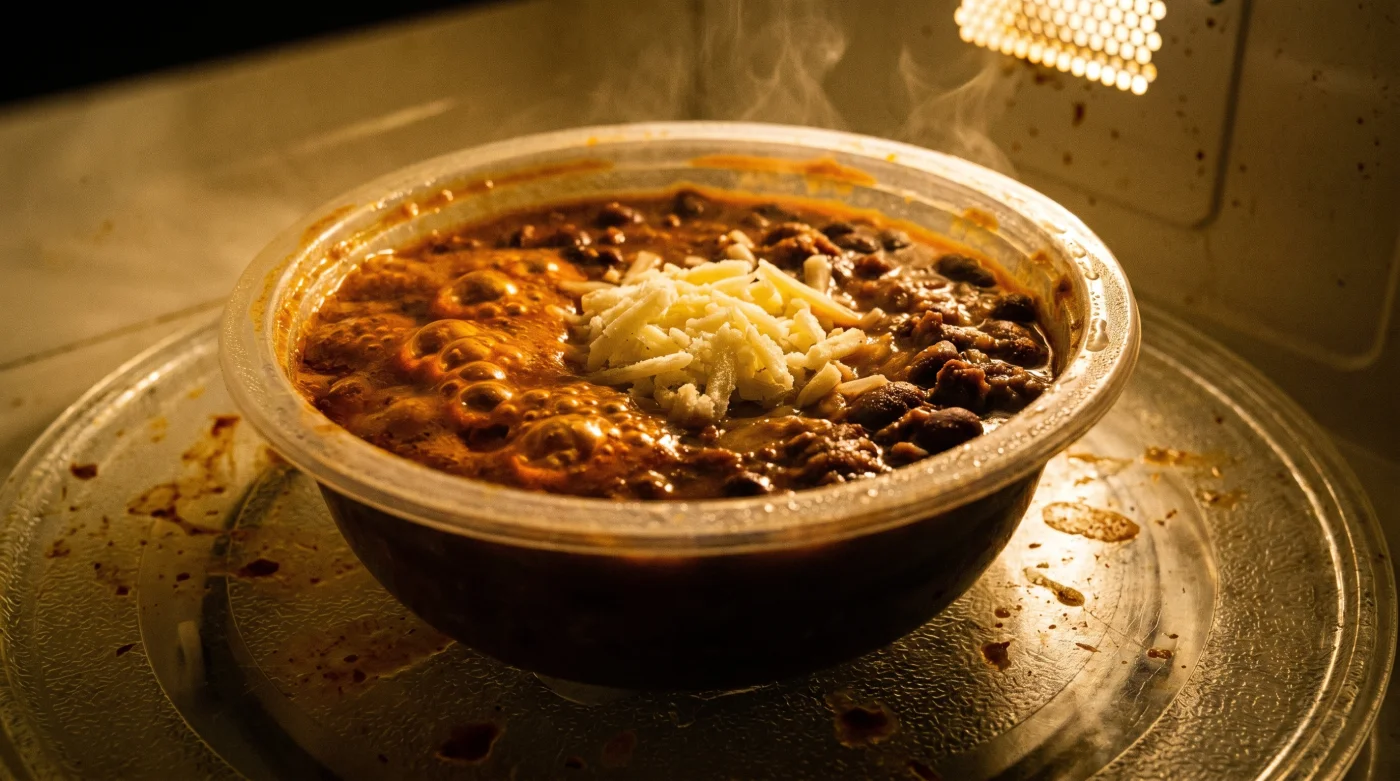
The low hum of the kitchen at midnight creates a quiet rhythm against the silence of the house. The orange glow of the digital appliance clock reads 11:43 PM, and you pull yesterday’s baked ziti from the refrigerator, the cold glass container heavy in your hands. You set the bowl exactly in the middle of the microwave glass plate. It feels correct. We are wired to appreciate symmetry, to align our plates with the dead center of the spinning circle, to press the door until it clicks shut, and walk away with a sense of order.
Three minutes pass, marked by the steady drone of the magnetron. You pull the dish out, anticipating the comforting smell of garlic and tomatoes, only to hit a wall of disappointment. The edges of the pasta are blistering hot, bubbling aggressively, while the core remains painfully frozen. You sigh, grab a heavy spoon, hack at the icy center, stir the mess into a lukewarm paste, and run the machine again.
You likely assume your appliance is failing, its lifespan draining away, or that the baseline wattage is simply too weak to penetrate dense meals. The reality is far less mechanical and much more tied to basic physics. The turntable was designed to rotate, but the energy field inside the box does not behave the way you might naturally envision.
By placing your dinner perfectly in the middle, you inadvertently keep the center of your bowl anchored in a single, unmoving spot on the rotational axis. You are fighting the fundamental laws of thermal radiation, forcing yourself into a tedious, multi-step routine of pausing, stirring, checking, and cursing under your breath.
The Standing Wave Illusion
Think of the energy inside that illuminated metal box like a yard sprinkler stuck in a rigid, unwavering pattern. There are distinct, heavy streams of water and entirely dry gaps in between. In the realm of electromagnetic energy, these are standing waves. The peaks of these waves carry intense, cooking heat, while the valleys carry almost no thermal value at all.
If you stand exactly in the middle of a rotating platform under a fixed sprinkler, the center of your head might never pass through a single water stream. Moving the dish to the outer edge drags the entire meal actively through those heavy downpours. By intentionally ignoring aesthetic symmetry, you force the densest part of your food through multiple overlapping heat zones.
Arthur, a 58-year-old commercial appliance technician based in rural Pennsylvania, spends half his week diagnosing “broken” microwaves that work perfectly fine. He often tells his frustrated clients that the spinning glass plate is a spatial cheat code most people misunderstand. When he gets called to a local diner complaining about cold spots in their oatmeal, he lays out an even layer of shredded cheese across the entire glass plate and turns it on for twenty seconds. The cheese melts in distinct puddles, mapping out the standing waves, while large patches remain entirely raw. “They center the mug of soup, it spins strictly on its own axis, and the dead spot stays dead,” Arthur explains. He advises his customers to offset the bowl so it traces a wide, sweeping circle, cutting through the invisible energy field like a snowplow clearing a driveway.
- HEPA Air Purifiers Circulate Dust Unless You Vacuum The Prefilter
- Leather Car Seats Crack Faster When Treated With Standard Conditioners
- Vitamin D Capsules Pass Through Your System Completely Unabsorbed Fasting
- Stainless Steel Pans Become Nonstick Following This Boiling Water Trick
- Memory Foam Mattresses Degrade Permanently Under Standard Electric Heating Blankets
- Dishwasher Pods Destroy Internal Plumbing When Placed Inside Dispenser Trays
- Warriors Suns Broadcast Networks Suddenly Disable Mobile Casting Permissions
- Noise Cancelling Headphones Drain Battery Double Scanning For Unused Bluetooth
- Merca Panama Vendors Abruptly Reject Electronic Payment Processing Terminals
- Electric Toothbrushes Lose Power When Kept On Constant Charging Stands
Adjustment Layers for Daily Meals
Not all meals require the same spatial awareness or heat distribution. Understanding how your specific dinner interacts with the geometry of the glass plate allows you to ditch the babysitting routine entirely, reclaiming your time.
For the leftover purist, dealing with dense casseroles, thick stews, or day-old mashed potatoes, the off-center rule is your primary defense against a ruined texture. You want to place the heaviest, thickest part of the dish closest to the outer rim. The rim travels the furthest distance during rotation, slicing through the highest number of standing wave peaks, bringing the frozen middle up to a safe 165 Fahrenheit in a fraction of the time without turning the edges to leather.
For the busy parent rapidly heating morning milk or a quick bowl of soup, liquids behave slightly differently but still suffer heavily from the dead-center trap. Rather than stopping the machine every thirty seconds to stir the bottle or agitate the bowl, push the container two inches toward the door.
This seemingly insignificant shift disrupts the stagnant thermal pocket that forms in the middle of the liquid. You will quickly notice the broth heats evenly from all sides, eliminating the scalding top layer that typically burns the roof of your mouth while the bottom stays cool.
For the batch prep enthusiast who relies on Sunday meal prep to survive the week, reheating multiple components simultaneously can be a nightmare. When heating rice, chicken, and broccoli together on a wide plate, arranging the food correctly is more vital than where the plate sits. Keep the center of the plate completely bare, pushing the food out into a wide ring.
The empty center guarantees that nothing sits in the cold axis of rotation. The food travels through the active heat zones, allowing the moisture to steam the rice rather than turning the chicken dry and rubbery.
The Asymmetrical Approach
Applying this concept requires almost zero physical effort, yet it completely rewrites a decades-old kitchen routine. You are trading a tedious chore for a tiny, highly mindful adjustment before you press the start button.
Start by visualizing the glass turntable as an analog clock face. You want to avoid placing anything directly on the center pin holding the glass. Instead, map out your placement using the outer perimeter, utilizing the full width of the appliance.
A few simple tactical adjustments will guarantee an even temperature and protect the integrity of your meal without ever reaching for a stirring spoon.
- Push the ceramic bowl until its outer edge nearly touches the microwave wall as it rotates.
- If heating multiple small items, arrange them in a wide outer ring, leaving the middle entirely bare like a donut.
- For awkwardly shaped proteins, such as chicken breasts, place the thickest portion facing outward, pointing away from the middle.
- When using a rectangular storage container, align it diagonally across the outer edge to maximize its rotational sweep without bumping the door.
- Lower the power level to 70 percent to give the standing waves time to penetrate the off-centered food gently.
Embracing the Off-Center Logic
It feels incredibly counterintuitive to leave the middle of your microwave entirely empty. As humans, we are taught to balance our surroundings, to find the steady center of gravity, and to make our physical environment visually tidy. But home appliances operate purely on physics, devoid of visual comfort.
When you deliberately slide that plate three inches to the left, you are taking control of the environment. You stop treating the appliance like an unpredictable magic box and start operating it like a precise thermal tool. The frustrating, repetitive ritual of microwaving, stirring, and waiting simply dissolves from your evening.
You gain back those little, vital fragments of time once spent standing guard in the kitchen. The food comes out steaming consistently from edge to edge, holding onto its intended flavor and texture, all because you chose functional reality over an illusion of symmetry.
“The center of the turntable is the eye of the storm; nothing moves, nothing heats. Shift the weight, and you change the weather inside the box.”
| Key Action | The Technical Shift | Daily Value Gained |
|---|---|---|
| Offsetting the primary bowl | Moves static food through active standing wave peaks | Eliminates icy centers in dense, heavy leftover meals |
| Creating a food ring | Avoids the stagnant thermal axis entirely | Heats multiple diverse items uniformly without drying |
| Outward facing proteins | Exposes thick cuts to the maximum radiation sweep | Prevents overcooked thin edges and dangerously raw cores |
Why does my food pop and explode more when off-centered? Faster, more efficient heating can trap steam inside dense foods quickly. Always vent your lids lightly or pierce vegetable skins to let the pressure escape safely.
Does this specific method work well for defrosting meat? Absolutely. Defrosting relies entirely on gentle, even exposure. Keep the frozen meat toward the extreme edge and flip it halfway through the cycle to prevent semi-cooked edges.
What if my dinner plate is simply too big to offset? If the ceramic plate covers the entire glass turntable, arrange the food itself in a wide ring on the plate, intentionally leaving the middle porcelain empty.
Will an off-center heavy glass bowl damage the rotating motor? No. Most modern turntables rest on a supportive plastic roller ring with wheels specifically designed to handle asymmetrical weight distribution without straining the central motor.
Is the center of the microwave completely useless for cooking? Not entirely. It works reasonably well for small, highly porous items like a single dinner roll or a marshmallow that requires minimal, gentle, and slow warming.