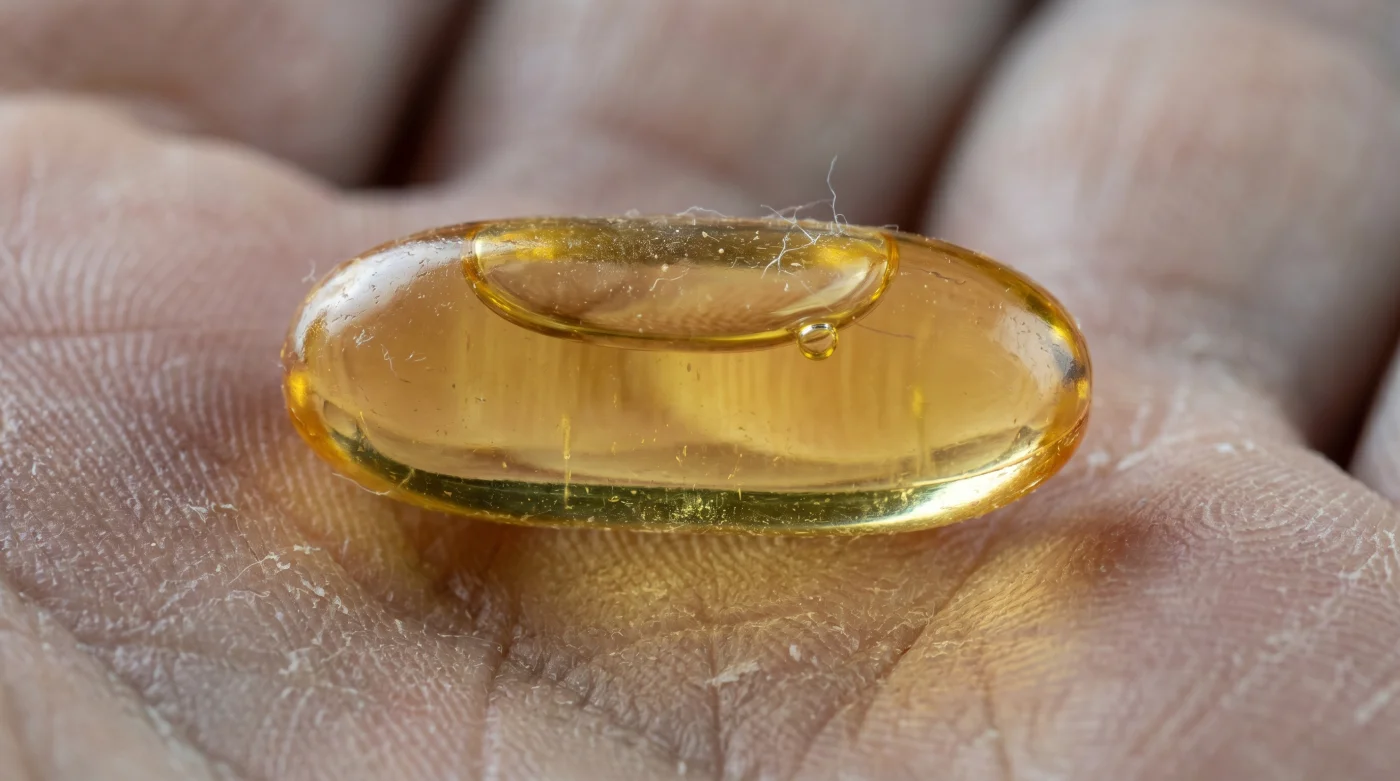
You stand at the kitchen counter before the sun has fully crested the horizon. The house is quiet, save for the rhythmic drip of the coffee maker and the soft hum of the refrigerator. You shake a single, translucent golden capsule into your palm, toss it back, and swallow it down with a glass of cold tap water.
It feels like a small victory before the day even begins. You skip breakfast to rush out the door, or perhaps to maintain a strict fasting window, confident that this tiny ritual is quietly fortifying your bones against the coming winter. But that empty stomach is quietly betraying your entire routine.
The reality of human digestion is far less forgiving than the instructions printed on the back of a supplement bottle. By dropping that pill into an empty, fasting stomach, you are essentially dropping a sealed envelope into a mailbox that has no bottom. It just falls right through the system, completely untouched by the cellular mechanisms designed to catch it.
The morning standard of taking pills with a simple glass of water is an industry-wide oversight that ignores the basic mechanics of how our bodies extract value from what we consume. Without a heavy dietary fat to act as the courier, those premium supplements are biologically useless, passing through your digestive tract entirely unabsorbed.
The Oil and Water Paradox
Think of your digestive tract as a bustling transit hub. Water-soluble vitamins like vitamin C or the B-complex are commuters who can walk right onto the train unassisted. They dissolve easily in the ambient fluids of your stomach and slip directly through the intestinal walls into your bloodstream.
Vitamin D, however, requires a very specific type of vehicle. It is entirely fat-soluble, meaning it refuses to mix with the water-based fluids in your gut. Imagine trying to clean an oily cast-iron pan with pure cold water; the water simply beads up and rolls away, unable to penetrate the grease. Your body treats vitamin D in a similar fashion when there is no dietary fat present to bind with it.
To cross the cellular barrier and actually enter your bloodstream, the vitamin must be packaged into microscopic clusters called micelles. Trying to force a fat-soluble vitamin through the intestinal wall without these micelle clusters is like trying to breathe through a wet pillow; the barrier is simply too dense for the payload to pass through. These clusters only form when your gallbladder releases bile, and your gallbladder only releases bile when it detects significant dietary fat entering the stomach.
If you consume your vitamin D capsule while fasting, or even with just a dry piece of toast, the gallbladder stays asleep. The golden capsule melts, but its valuable contents have no vehicle to carry them across the threshold. The nutrient is left stranded, eventually flushed out as expensive waste.
The Hidden Fix in the Lipid Lab
Dr. Elias Vance, a 48-year-old clinical researcher specializing in lipid metabolism, spent years watching this exact failure play out in his patients. He repeatedly saw individuals taking massive 5,000 IU doses of vitamin D daily, yet their routine blood work showed numbers barely scraping the bottom of the healthy range.
One morning, he asked a highly frustrated patient to walk him through her exact routine. She proudly explained her strict fasting protocol until noon, accompanied only by her morning vitamins and black tea. He realized the immediate failure of the industry’s delivery instructions. He prescribed a single structural change: move the pill to lunchtime and take it with a spoonful of peanut butter. Within a month, her active levels tripled.
- Stainless Steel Pans Become Nonstick Following This Boiling Water Trick
- Memory Foam Mattresses Degrade Permanently Under Standard Electric Heating Blankets
- Dishwasher Pods Destroy Internal Plumbing When Placed Inside Dispenser Trays
- Warriors Suns Broadcast Networks Suddenly Disable Mobile Casting Permissions
- Noise Cancelling Headphones Drain Battery Double Scanning For Unused Bluetooth
- Merca Panama Vendors Abruptly Reject Electronic Payment Processing Terminals
- Microwave Glass Plates Cook Food Unevenly When Placed Dead Center
- HEPA Air Purifiers Circulate Dust Unless You Vacuum The Prefilter
- Leather Car Seats Crack Faster When Treated With Standard Conditioners
- Electric Toothbrushes Lose Power When Kept On Constant Charging Stands
Deep Segmentation: Adjusting Your Routine
You do not have to abandon your preferred morning habits, but you do need to understand the digestive system and adapt your timing to match it. The goal is to match the supplement to the chemical environment it needs to survive.
For the Intermittent Faster
If you delay your first meal until midday to maintain a fasted state, your morning habit needs a radical shift. Do not swallow the capsule alongside your morning black coffee or plain green tea. Instead, physically move the bottle to your lunchbox or your desk at work. You must wait to take it until you break your fast with a meal that contains actual, measurable fat.
For the Plant-Based Eater
If your morning consists of a simple fruit smoothie or a bowl of plain oatmeal, you are missing the necessary lipids to trigger bile production. The natural sugars and carbohydrates will not activate the gallbladder.
You need to introduce a heavy fat source into that breakfast window. A thick slice of avocado on the side, or a heavy spoonful of almond butter mixed directly into the oats, creates the exact chemical courier system your body needs to catch the vitamin.
For the Heavy Breakfast Eater
If your mornings naturally involve scrambled eggs, cooking oils, bacon, or full-fat yogurt, you are entirely in the clear. The fats inherent in these traditional breakfast foods act as a perfect sweep for the capsule.
You are already providing exactly what the digestive hub requires to function. Your natural breakfast habits produce ample lipids to sweep the vitamin D directly through the intestinal wall and into your system without any additional adjustments.
Mindful Application: The Tactical Toolkit
Fixing this biological mismatch is a minimalist intervention. It requires no extra money and very little time, asking only for a slight pivot in your daily choreography.
Here is exactly how to adjust your habits: Ensure your investment actually reaches your cells by applying these specific, measurable parameters to your daily routine.
- Identify your fattiest meal: Shift your dosage time to align with whichever meal contains the highest fat content, whether that happens to be breakfast, lunch, or dinner. The time of day matters far less than the contents of the stomach.
- The 10-Gram Rule: Aim for a meal or snack containing at least 10 to 15 grams of dietary fat to ensure adequate bile production. This is roughly equivalent to a tablespoon of olive oil or a handful of almonds.
- Standalone Pairings: If you prefer to take the supplement outside of a full meal, pair the pill with a dense, fat-heavy snack like walnuts, a thick slice of cheddar cheese, or half an avocado.
- Temperature Protocol: Keep the capsules themselves out of direct sunlight and away from heat sources like the stove. Ambient heat can silently degrade the fragile oil inside the capsule before you even place it in your mouth.
The Biology of Peace of Mind
When you stop fighting your body’s natural chemistry, a daily chore transforms into a quiet collaboration. You are no longer just going through the motions, hoping blindly for a physiological result that never actually arrives.
By making this single, tactical adjustment to your consumption timing, you stop wasting your resources. You guarantee that the deliberate care you put into your morning routine actually translates into the physical resilience and bone density you are seeking.
It is a profound shift from blind compliance to deliberate, mechanical nourishment. Understanding how your internal system actually operates gives you the power to use it properly.
This subtle calibration brings your daily habits into absolute harmony with your biology. You finally receive the benefits you have been paying for all along, allowing you to move through the darker months with genuine, quiet confidence in your body’s defenses.
“The digestive system does not read the label on the bottle; it only responds to the chemical environment you provide.” — Dr. Elias Vance, Clinical Lipidologist
| Key Point | Detail | Added Value for You |
|---|---|---|
| Fat Solubility | Vitamin D requires lipids for intestinal absorption | Stops you from flushing away expensive supplements |
| Fasting Conflicts | Empty stomachs halt the necessary bile production | Helps you logically redesign your morning routine |
| The 10-Gram Rule | Optimal fat threshold required for proper digestion | Gives you an exact, measurable daily dietary target |
Frequently Asked Questions
Can I take Vitamin D with just a glass of whole milk? Yes, the fat content in a standard glass of whole milk is typically sufficient to trigger the necessary digestive bile response.
Does it matter if I take it at night instead of the morning? The time of day matters far less than the presence of heavy dietary fat. Take it with your heaviest meal, whenever that occurs.
What if I take a dry powder capsule versus an oil-filled gel cap? Both forms biologically require dietary fat for your body to absorb the active nutrient across the dense intestinal wall.
Can I just take it alongside a daily fish oil supplement? While fish oil contains beneficial fats, the actual volume in a single pill is often too small to stimulate enough bile. Pair it with actual food.
How long after a meal can I take the supplement? Aim to take it directly during the meal or within thirty minutes after eating, while active digestion and bile release is still occurring.