The glow of the router sitting on your bookshelf is almost mocking. You sit on the couch, staring at the spinning buffer wheel on your television screen, wondering why your premium gigabit internet plan feels like dial-up the moment you walk into the back bedroom. The silence of the house is punctuated only by the frustrated tapping of your fingers against your phone screen as a crucial video call stutters into pixelated oblivion. You are paying for speed, but what you are actually getting is a fragmented web of invisible dead zones.
We have been conditioned to solve digital problems with our wallets. Buying expensive mesh nodes feels like the only logical response when your connection drops through the floorboards. You browse online retailers, adding heavily marketed plastic towers to your cart, accepting the frustrating reality that modern hardware is designed to require constant, expensive supplementation. The tech industry thrives on the assumption that you will blindly purchase a repeater rather than question how the original device actually works.
But look closely at that standard plastic box with its little black antennas. Unless it sits dead center in the middle of your living space, suspended from the ceiling like a chandelier, it is currently broadcasting half of its invisible energy directly into the drywall behind it. You are literally paying your internet service provider every month to deliver high-speed broadband access to the brick exterior of your house, the insulation in your walls, and perhaps a very lucky squirrel in the side yard.
By treating radio waves less like magic and more like physical elements, you bypass the expensive upgrades entirely. A simple physical manipulation changes the entire layout of your digital home, capturing wasted energy and sending it exactly where it is needed most. You do not need an engineering degree or a soldering iron; you simply need to understand that a wireless signal behaves exactly like light, and light can always be reflected.
Shaping the Invisible Light
Think of your router’s antenna as a bare lightbulb dangling from a wire in the center of an empty room. It throws illumination in a complete 360-degree sphere, indiscriminately lighting up the walls, the ceiling, and the floor with equal intensity. When that bulb sits against an outside wall or is shoved into a corner desk, half of the light it produces spills uselessly into the neighbor’s yard or gets absorbed by heavy masonry.
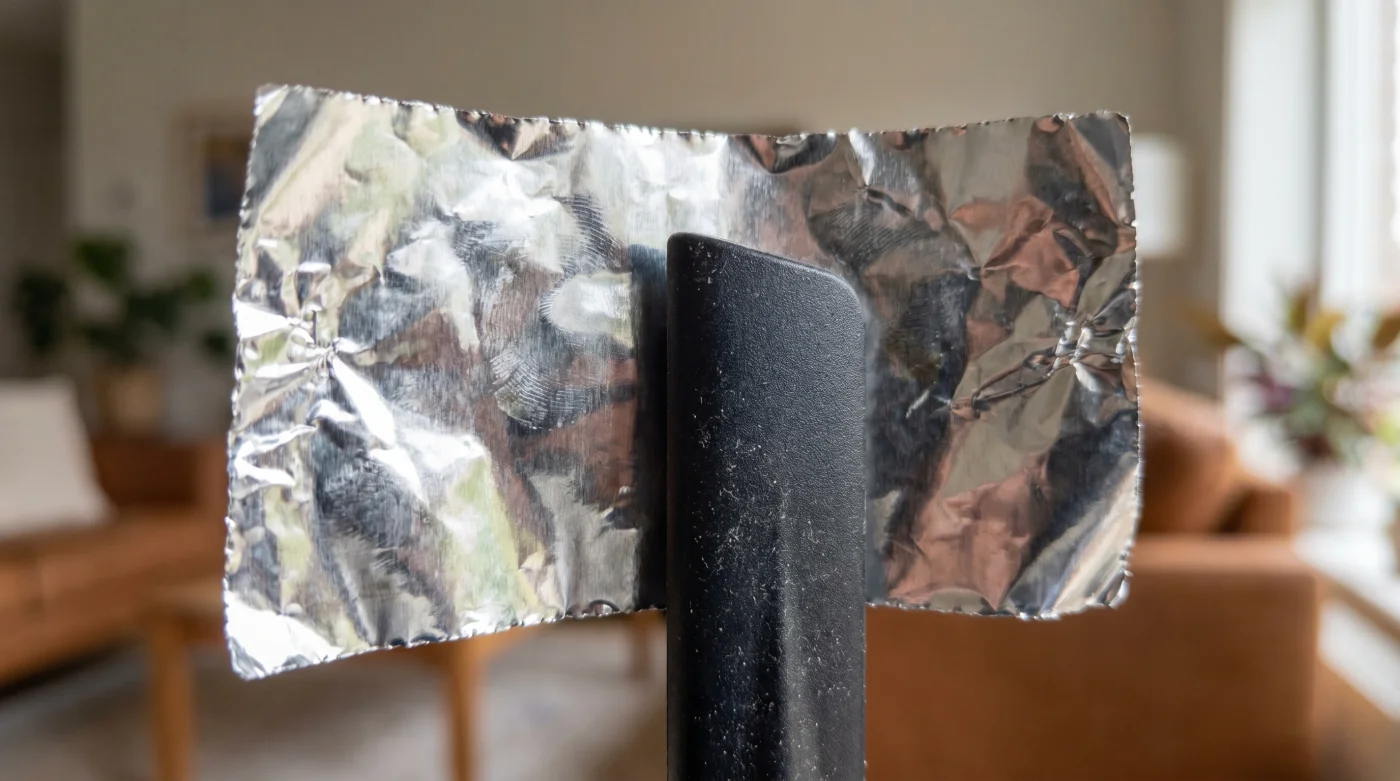
The industry wants you to fix a dim room by purchasing five more lightbulbs and placing them everywhere, linking them together in a complex and expensive mesh. But you do not need more light; you just need a lampshade. By placing a parabolic curve of standard kitchen aluminum foil behind that antenna, you immediately capture the wasted rearward radiation and bounce it forward into your home. You instantly turn a bare, inefficient bulb into a highly focused flashlight beam.
Marcus Thorne, a 58-year-old commercial network architect from Chicago, has spent decades wiring vast server farms and corporate high-rises. When his own pre-war apartment suffered from severe brick-wall interference, he did not run hundreds of feet of Ethernet cable or purchase premium repeaters. He simply cut a thick piece of baking foil, curved it over a rolling pin to make it perfectly smooth, and slipped it behind his primary antenna. Within three minutes, the signal in his distant office jumped from one bar to maximum capacity. He calls it reclaiming the lost half, a trick older engineers use when budgets run dry.
Adjusting the Beam for Your Space
Not every house requires the exact same physical modification. The way you shape, mold, and position your metallic barrier directly determines the new shape of your digital environment. By understanding your specific architectural hurdles, you can tailor this tactile hack to solve your exact frustration.
- Auto Insurance Policies Quietly Void Coverage For Unreported Minor Scratches
- Dishwasher Heating Elements Permanently Warp Modern Plastic Tupperware During Drying
- Hyaluronic Acid Actively Dehydrates Facial Skin In Low Humidity Climates
- iPhone Battery Settings Hide A Diagnostics Mode That Restores Capacity
- Baking Soda Actually Darkens Roasted Vegetables Instead Of Crisping Them
- Synthetic Motor Oil Actively Destroys Older Vehicle Engine Valve Seals
- Manchester United Tickets Now Mandate An Unprecedented Biometric Verification Scan
- Tottenham Brighton Streams Suddenly Block Mobile Screen Casting Worldwide
- Noise Canceling Microphones Distort Your Voice Over Standard Bluetooth Connections
- Washing Machine Drums Breed Black Mold Behind The Rubber Seal
For the Exterior Wall Setup
If your modem lives in the far corner of the house simply because that is where the cable company originally drilled the hole, fold a tall, wide curve of foil. Place it directly behind the router, facing inward toward the center of your floor plan. You instantly stop heating up the exterior vinyl siding with radio waves and flood your interior living space instead, effectively pushing the signal back into the house where it belongs.
For the Vertical Strategist
Houses with difficult second floors often struggle because omnidirectional antennas broadcast outward like a flat donut, not upward like a perfect sphere. Tilt your foil reflector at a sharp forty-five-degree angle from below, essentially creating a miniature satellite dish pointing directly at the ceiling above. The thick floor joists will still offer some resistance, but the sheer volume of newly directed energy will easily punch through to the upstairs bedrooms.
For the Dedicated Streamer
Sometimes you only care about one specific piece of hardware, like the smart television in the den that keeps dropping the evening movie. Form a much tighter, narrower curve around a single antenna to create a highly directional, concentrated beam. You are essentially pointing a laser of bandwidth straight through the interior walls directly to that specific receiver, sacrificing broad coverage for an intense, unbreakable connection right where you sit.
The Minimalist Application
Building this reflector requires a touch of precision, not just crumpling a sandwich wrapper over the plastic casing. You want to treat the metallic surface with deliberate care, ensuring it forms a smooth, continuous curve to bounce the waves accurately. Wrinkles, creases, and jagged edges will scatter the radio waves randomly, defeating the entire purpose of the modification.
Gathering your tactical toolkit takes only moments and involves items you already own. You will need heavy-duty aluminum foil to hold a rigid shape, a rolling pin or smooth wine bottle to mold a perfect curve, a piece of stiff cardstock or an empty cereal box for structural backing, and a few pieces of clear tape to hold it all together.
The physical construction process takes less time than waiting on hold for your internet provider to complain about slower speeds. Follow these quiet steps to manually reshape the invisible infrastructure of your home network without spending a single dollar or downloading another frustrating setup app.
- Cut a clean rectangle of foil roughly six inches tall and nine inches wide, keeping the edges as straight as possible.
- Glue or tape the shiny side of the foil completely flat against your cardstock backing to prevent any micro-wrinkles that might scatter the signal.
- Wrap the reinforced foil firmly around your rolling pin to create a smooth, perfect parabolic curve.
- Stand the curved structure directly behind the router antenna, ensuring the black plastic stalk sits exactly in the center of the curve, about one to two inches away from the metal.
- Rotate the open side of the metallic curve directly toward your most stubborn dead zone.
Reclaiming Your Environment
There is a profound, quiet satisfaction in solving a modern technological frustration with a common scrap of kitchen material. It strips away the helplessness we often feel when a screen freezes, a signal drops, or a device demands an expensive upgrade. You realize the invisible infrastructure swirling around you responds beautifully to physical logic, bending to your will without a monthly subscription fee or a complex software update.
You walk into that previously dead back room and watch the connection bars snap immediately to full strength. The air feels different when you understand how to control the tools that usually control you. You have not just improved your daily internet speed; you have bypassed an entire industry designed to sell you solutions, and finally mastered the physical space you live in.
A fifty-cent piece of kitchen metal can completely outsmart a three-hundred-dollar hardware marketing campaign, provided you simply understand how invisible radio waves bounce. – Marcus Thorne, Network Architect
| Key Point | Detail | Added Value for the Reader |
|---|---|---|
| Mesh Node Systems | Requires purchasing multiple repeater towers. | Burns cash to push a weak signal slightly further into the home. |
| The Foil Deflector | Uses 50 cents of standard kitchen aluminum and cardstock. | Recycles wasted rearward signal and instantly doubles forward range. |
| Setup Time | Takes 30+ minutes of app syncing and password resets. | Takes 3 minutes of quiet folding, requiring zero technical skill. |
Frequently Asked Questions
Will putting metal near my router damage the internal hardware?
Not at all. You are simply creating a passive wall that bounces the outgoing radio waves in a new direction. It is exactly like putting a mirror behind a candle; the candle does not burn any hotter.Does it matter if I use the shiny side or the dull side of the foil?
While both sides will reflect radio frequency effectively, the shiny side tends to be slightly smoother microscopically. Face the shiny side toward the antenna for the absolute cleanest bounce.How far away from the antenna should the foil sit?
Aim for a gap of about one to two inches. This places the antenna near the focal point of the parabolic curve, creating a strong, parallel beam rather than scattering the energy.Can I use an empty soda can instead of kitchen foil?
Yes. Cutting an empty aluminum can vertically and fanning it open creates an excellent, pre-curved parabolic reflector. However, the sharp metal edges require much more caution when handling.Will this hack improve my internet speed if my provider is slow?
This modification prevents signal loss through walls and distance, meaning you get exactly the speed you pay for in every room. It cannot magically give you more bandwidth than your monthly plan allows.