You slide the sleek white tower out of its cardboard shell, peeling away the protective film with a satisfying snap. The plastic smells new and clinical. You set it in the corner of your bedroom, press the glowing power button, and listen as a quiet, reassuring hum fills the space. The air already feels lighter, purely by the power of suggestion. You throw away the packaging, confident that your seasonal allergies are finally under control.
It feels like an immediate upgrade to your personal environment. You are taking intentional control of the invisible world—the drifting dust mites, the pet dander from the dog’s bed, and the lingering cooking smells that stubbornly settle into your upholstery. But as you push that heavy, motorized base flush against the drywall to hide the thick power cord, you unknowingly commit a fatal error. You have just turned a powerful, engineered filtration system into a remarkably expensive white noise machine.
The problem lies in a fundamental misunderstanding of how room-scale air circulation actually functions. Most modern air purifiers are designed with restrictive rear or side intake panels. They rely on a strong internal fan to pull dirty air through the back, force it through a dense thicket of pleated fiberglass, and push the clean air out the top or front. It is a system built entirely on the principle of unhindered airflow.
When you press that rear intake flush against a baseboard, you instantly choke the motor. The machine can only draw air from a localized, tiny three-inch pocket of space directly behind it. This means the powerful fan is endlessly filtering the exact same dust in a tightly confined loop, while the vast majority of the room remains completely stagnant. The clean air shoots up, hits the ceiling, and never pulls the distant dirty air toward the filter.
The Perspective Shift: The Suffocation of Good Intentions
Think of your home’s air not as empty space, but as a slow-moving body of water. To clean a murky pond, you cannot just filter the shallow water lapping against the edge; you need to create a strong, continuous current that pulls water from the deep center. An air purifier must create a convection loop, drawing stale air across the room and replacing it with purified air.
The aesthetic marketing of home appliances has done us a massive disservice. Glossy interior design magazines and sleek product boxes always show these bright white units tucked neatly into tight corners, wedged tightly between bookshelves, or hidden behind mid-century armchairs. This industry standard teaches you to visually treat an active lung like a static piece of furniture, prioritizing a clean aesthetic over the basic laws of physics.
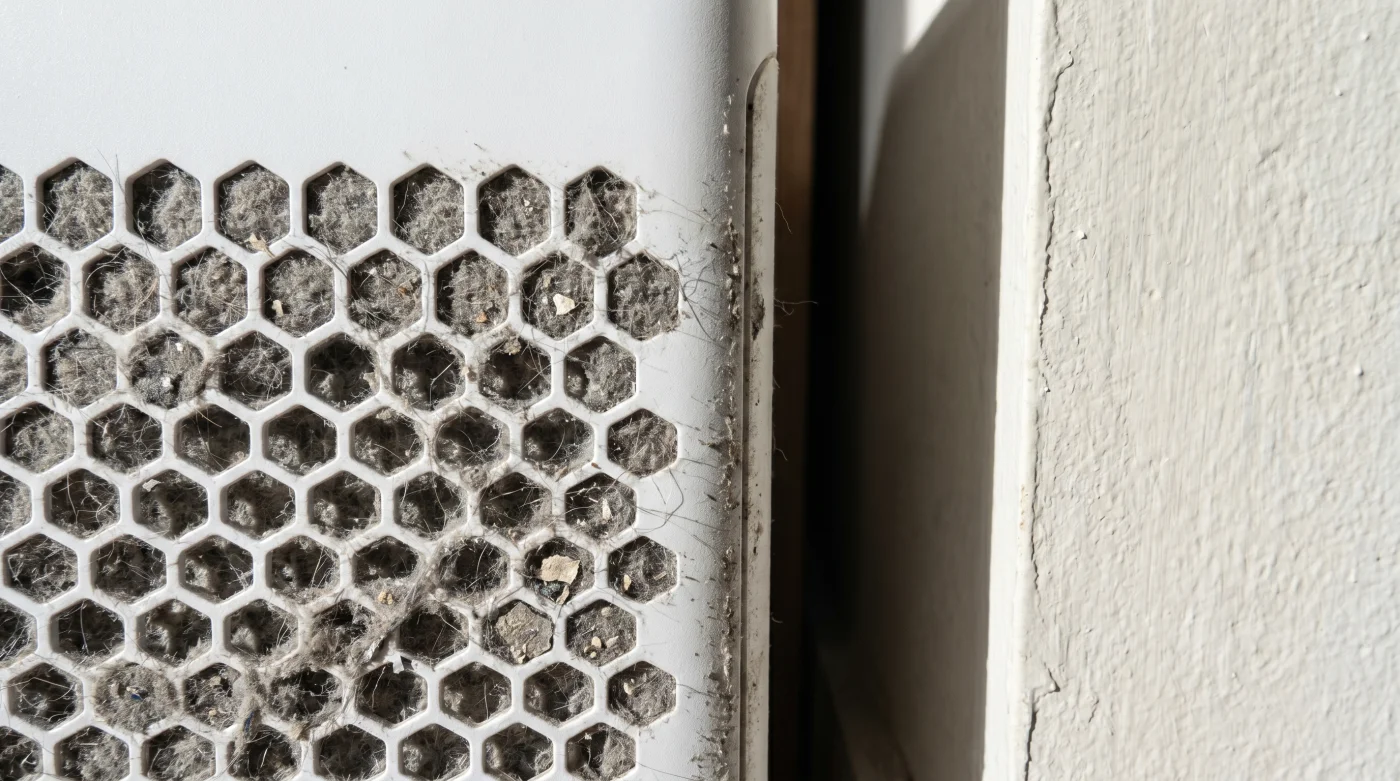
Placing a rear-intake fan flush against a barrier is exactly like trying to run a marathon while breathing through a tightly pressed pillow. The fan speeds up to compensate for the lack of air, the motor strains against the resistance, and the HEPA filter collects a thick layer of grey fuzz strictly on one side. You look at that small patch of dust and assume the machine is working brilliantly, giving you a completely false sense of security.
The true mechanism of clean indoor air requires both massive volume and steady velocity. If the intake cannot grab the room’s broader atmospheric pressure, the microscopic particles hovering above your bed or settling onto your living room rug never actually makes it into the filtration chamber. You are effectively paying for electricity to clean the wall.
Expert Context: The Invisible Current
Consider Marcus Vance, a 48-year-old indoor air quality technician based in the humid valleys of Pennsylvania. Armed with a harmless chemical smoke pen, Marcus spends his days visualizing invisible airflow in residential homes. He routinely watches frustrated homeowners invest in high-end, medical-grade purifiers, only to measure the air quality in the center of their living rooms and find it completely unchanged from the outdoors.
Marcus points his smoking pen near the center of a client’s bedroom, and the thin white plume just drifts aimlessly toward the ceiling fan. ‘They buy these gorgeous, expensive machines and hide them like dirty laundry,’ he explains, grabbing the heavy unit and pulling it eighteen inches away from a heavy velvet curtain. Suddenly, the smoke snaps into a tight horizontal line, racing across the bed and plunging into the newly exposed intake. By simply moving the unit forward, he restores the entire room’s circulation in seconds.
- Vitamin C Serums Oxidize Instantly When Stored Near Bathroom Showers
- Honda CR-V Maintenance Guides Deliberately Upsell Unnecessary Chemical Transmission Flushes
- Ground Beef Browns Horribly When Cooked Directly From The Refrigerator
- Memory Foam Mattresses Degrade Rapidly When Kept In Cold Bedrooms
- Rental Lease Agreements Contain A Devastating Clause About Minor Repairs
- Merca Panama Vendors Quietly Pivot To Wholesale Only During Mornings
- Smart Thermostats Waste Electricity By Overriding Built-In Furnace Efficiency Sensors
- Wooden Cutting Boards Harbor Bacteria When Washed With Standard Soap
- Dólar Estadounidense Conversion Apps Secretly Apply A Massive Hidden Surcharge
- Inter Cagliari Broadcasts Suddenly Require A New Premium Streaming Tier
Deep Segmentation: Adjusting for Your Space
Every room in your home has a unique atmospheric footprint, defined by drafty windows, forced-air heat registers, and open doorways. You need to adjust your placement strategy based on how the room is actually lived in and where the air naturally travels, rather than where the appliance looks the most invisible. You have to work with the room, not against it.
For the bedroom minimalist, the overwhelming instinct is to hide the purifier behind a nightstand or wedge it against a laundry hamper. Instead, pull it out so the intake panel faces the open walkway at the foot of the bed. If the glowing blue LED lights bother you while you sleep, use a small piece of black electrical tape over the display rather than suffocating the machine’s intake behind a solid block of wood.
In a modern open-concept living room, a small purifier shoved into a distant corner is fighting a losing battle against a massive volume of air. Treat the unit like an end table or a deliberate architectural feature. Place it beside the sofa, ideally positioned where the air freely passes from the kitchen hallway into the main seating area, acting as a tollbooth for floating dust and smoke.
If you have a dedicated home office, do not tuck the machine under your desk by your feet where cords tangle. The heat from your computer tower and your own body creates a natural thermal updraft, sending dust straight toward your face. Keep the purifier slightly raised or at least out in the open room, ensuring the wide intake captures the floating particulates before they settle permanently onto your keyboard and monitor.
Mindful Application: The Eighteen-Inch Rule
Fixing this structural flaw does not require a redesign of your home or a massive shift in your daily routine. It simply requires a mindful, physical adjustment in how you position your environmental tools. It is about respecting the machine’s mechanical needs over your desire for an uninterrupted baseboard.
Start by identifying exactly where the dirty air enters your specific machine. Run your bare hand slowly around the back and sides while the unit operates on its highest, loudest setting. You will feel a distinct, cooling draft pulling inward against your skin. That specific surface area absolutely must face open space to function properly and move enough volume.
Follow these grounding, mechanical steps to establish a highly functional breathing zone for your purifier:
- Create a strict eighteen-inch perimeter between the intake vents and any solid drywall, heavy drapery, or large furniture.
- Position the outflow grille (usually located on the top) so the clean air can arc smoothly into the center of the room, encouraging a circular convection current.
- Keep the unit far away from ultrasonic humidifiers; pulling dense, heavy moisture directly into a pleated HEPA filter causes the delicate paper to warp, clog, and lose its electrostatic efficiency.
- Raise smaller units two to three feet off the ground on a sturdy stool to capture lighter, microscopic particles that naturally hover right at your breathing level.
The Tactical Toolkit for clean air is remarkably simple: Eighteen inches of unbroken clearance, a clear line of sight to the center of the room’s foot traffic, and a weekly wipe-down of the plastic outer grille. This simple habit prevents the internal motor from straining against its own casing, dramatically extending the operational life of the appliance by years.
The Bigger Picture: A Room That Breathes
There is a profound, quiet satisfaction in knowing your personal environment is actively and efficiently working for you. When you give your appliances the physical space they require to operate, you stop fighting an exhausting battle against the inherent physics of your home. You shift from owning a gadget to managing a system.
Over the following weeks, you will begin to notice the subtle, compounding changes. The stubborn grey dust stops accumulating quite as quickly on the dark television stand. The sharp morning sunlight filtering through the blinds no longer illuminates a wildly dancing cloud of debris. You wake up feeling clearer, sleeping a little heavier, trusting that the air you pull into your lungs is genuinely scrubbed and renewed.
Ultimately, true mechanical efficiency requires a tiny compromise with your interior design aesthetics. Let the machine stand slightly off the wall, proud of its function. Give it the physical room it needs to breathe, so that you can finally do the exact same.
‘Air doesn’t turn corners just because we want it to; you either invite the draft into the machine, or you let it settle in your lungs.’ – Marcus Vance
| Key Point | Detail | Added Value for the Reader |
|---|---|---|
| Clearance Space | Maintain 18 inches from walls and large furniture. | Maximizes motor lifespan and ensures room-wide air circulation. |
| Intake Awareness | Identify if your unit has a rear, side, or bottom intake. | Prevents accidental smothering of the fan mechanism. |
| Thermal Updrafts | Keep away from heat sources like computer towers or radiators. | Catches dust before it rides thermal currents to breathing height. |
Frequently Asked Questions
Does this rule apply to small desktop air purifiers? Yes. Even small units rely on drawing in surrounding air. If pushed against a cubicle wall or stacked books, their effective range drops to near zero.
Can I place my air purifier near an open window? It is better to place it away from the window. Placing it too close means you are constantly filtering outdoor pollen as it enters, rather than cleaning the air already trapped inside your home.
How do I know if my purifier is suffocating? Listen to the pitch of the motor. If pulling the unit away from the wall changes the hum from a strained whine to a relaxed woosh, it was previously starved for air.
What if my room is too small for an 18-inch clearance? In tight spaces, aim for at least 10 to 12 inches and keep the unit running on a higher fan speed to force broader circulation across the limited area.
Should I point the clean air vent toward my bed? While the breeze feels nice, it is more effective to point the outflow toward the center of the room to create a sweeping current that pushes dirty air back toward the intake.