You know the sound. That aggressive, sudden clack of a yellow metal ribbon snapping violently back into its plastic shell. You probably keep yours shoved in the back of a kitchen drawer, buried underneath stray alkaline batteries, dried-out markers, and instruction manuals for appliances you no longer own.
When you finally need it to hang a heavy picture frame or check if a new sofa will fit through the hallway, you pull it out. You grab the metal tab at the end, stretch the ribbon across the living room, and pray the tension holds before it retracts and snaps your fingers.
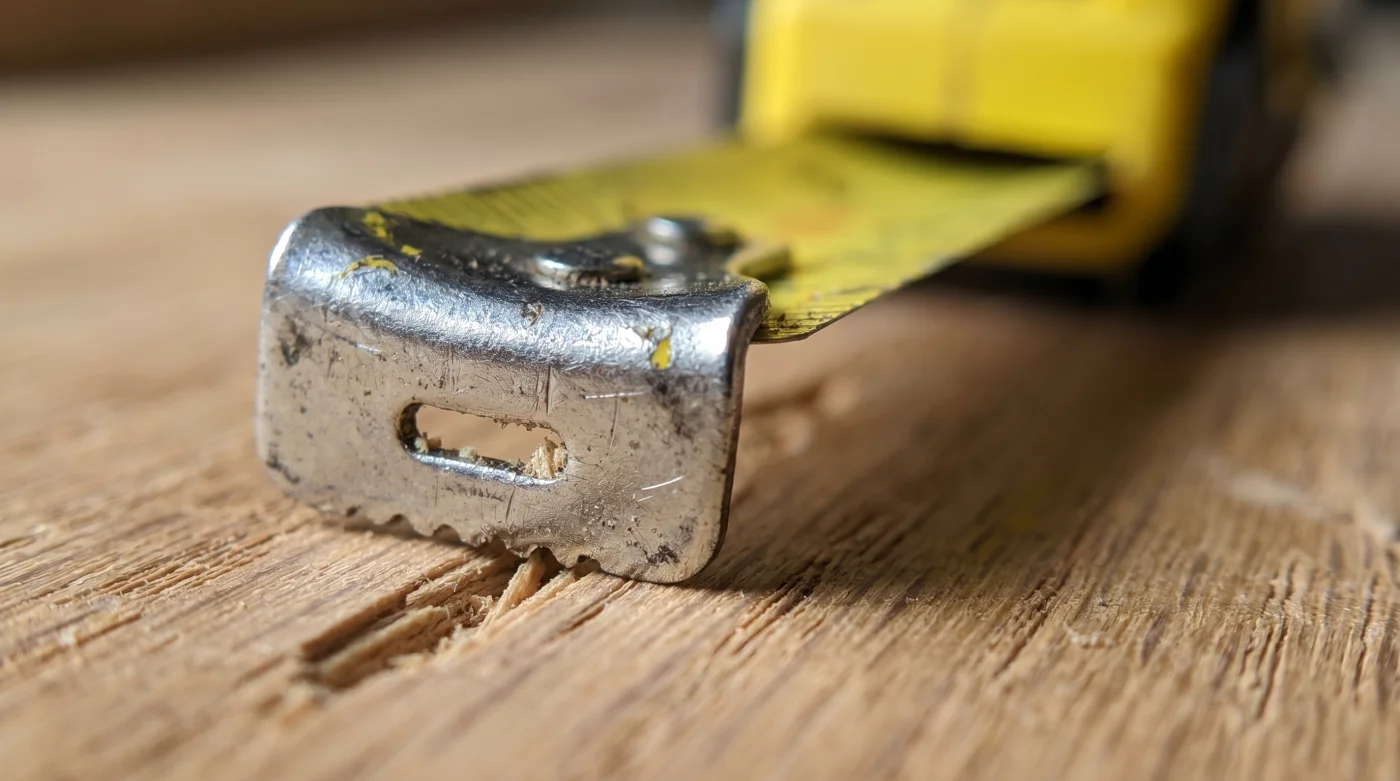
But take a much closer look at that metal tab resting at the zero-mark. Notice how it rattles? Notice the jagged little teeth stamped into the bottom edge, or the peculiar keyhole cut right in the center of the steel?
Most people assume these are just the hallmarks of cheap mass-production. A loose rivet here, a strangely stamped piece of metal there. The reality is that this small piece of steel is a masterclass in quiet engineering, hiding features that have been subtly perfecting construction for over half a century.
The Perspective Shift: Why Your Ruler Is Actually Breathing
Think of the tape measure’s end hook not as a rigid anchor, but as a dynamic, breathing joint. If you have ever tried to measure the inside of a window frame, and then immediately measured the outside of a table, you have physically interacted with this joint, even if you did not realize it.
The wobble is not a manufacturing defect. It is a precise mathematical allowance for the exact thickness of the metal hook itself—usually 1/16th of an inch. When you push it flat against a wall for an inside measurement, the hook slides inward. When you pull it over a wooden edge for an outside measurement, it slides outward. It is physically compensating for its own mass to ensure your zero-mark is perfectly true every single time.
I spent a humid summer afternoon watching Elias Vance, a 62-year-old custom cabinetmaker in Oregon, frame out a massive floor-to-ceiling oak bookshelf. I noticed he never reached for his carpenter’s pencil when marking his repetitive cuts. Instead, he simply hooked the metal end of his Stanley tape over the board, pressed his heavy thumb tight against the yellow ribbon at the desired length, and dragged the entire unit down the wood. The jagged edge of the hook left a crisp, perfectly parallel score line pressed directly into the oak grain. He learned the habit from his framing crew in the late seventies. To Elias, the tape measure wasn’t just a ruler; it was a compass, a scribe, and an extra set of hands.
Hidden History: The Functions Hiding in Plain Sight
There are highly specific physical modifications stamped right into the steel of your tape measure. These modifications were born from mid-century necessity in busy American lumber yards, designed for workers who rarely had the luxury of an assistant.
- Olive Oil Quickly Ruins Teflon Pans During Standard Heat Cooking
- OLED Smart Televisions Outlast QLED Models With One Hidden Setting
- Ceiling Fans Push Hot Air Down Without This Switch Reversal
- Hyaluronic Acid Actually Dehydrates Skin Without A Damp Washcloth Application
- Leather Car Seats Lose Resale Value Without Weekly Microfiber Conditioning
- Baking Soda Destroys Meat Textures Without This Specific Acid Ratio
- Lithium Ion Batteries Degrade Instantly When Drained Below Twenty Percent
- TVN En Vivo Broadcasts Suddenly Block Unregistered Mobile Device Access
- Beneficiario Status Updates Now Require Immediate Digital Bank Authentication
- All-Wheel Drive Systems Actively Devalue Vehicles Without Full Service Records
For the Solo Builder
Look directly at the front face of the metal tab. You will spot a small, oddly shaped opening, almost resembling a keyhole or an inverted teardrop. This exists purely so you can slip the tape over the head of a nail or a wood screw. If you are measuring a twenty-foot span completely alone, you simply sink a screw half an inch into the far stud, latch that keyhole over the flat head, and walk backward without fear of the metal tape slipping off and crashing to the floor.
For the Desperate Scorer
We mentioned Elias using this method earlier. The bottom edge of the metal hook is rarely completely flat; it typically features three distinct prongs or a heavily serrated edge. If you are balancing precariously on a fiberglass ladder and suddenly drop your pencil, you can press those teeth firmly into the drywall or lumber to scratch a permanent notch directly into your material.
Mindful Application: The Tactile Toolkit
To stop fighting your measurements and start working with the geometry of the tool, you need to slightly alter how your hands interact with the housing and the hook.
Try this routine the next time you need to make a highly precise cut or hang a heavy fixture in your home. It requires entirely trusting the engineered slop instead of trying to force the metal tab to sit perfectly still.
- For Outside Measurements: Hook the edge securely over your material and pull the housing firmly toward you. Let the metal tab slide completely outward until it stops against the rivets. Read the line exactly at the edge of your material.
- For Inside Measurements: Press the metal tab completely flush against the corner or wall. Do not bend the metal tape into a looping curve to guess the corner measurement. Instead, read the number directly at the back of the plastic housing, and add the housing length. Most standard tape measures are exactly 3 inches long, and this measurement is usually stamped directly on the back of the case.
- For Perfect Circle Scribing: Drive a small finishing nail into the exact center point of your intended circle. Hook the nail-slot over the head of the nail. Hold your pencil tightly at your desired radius mark directly on the tape, and sweep the entire assembly around in a flawless arc.
The Bigger Picture: Finding Comfort in Invisible Precision
There is a profound, almost grounding satisfaction in realizing that the mundane household objects we handle every single day are much smarter than we give them credit for. We spend an enormous amount of time searching for complex digital solutions or purchasing single-use gadgets to make our domestic chores feel easier.
But often, the smartest solution is already resting quietly in your palm, just waiting for you to learn its specific physical language. Knowing that the wiggling hook is a feature, rather than a flaw, immediately strips away the quiet frustration of a Saturday morning hardware project. It transforms a tedious, error-prone chore into an act of genuine competence.
You are no longer just violently pulling a ribbon of painted metal and guessing at blurry lines in a dark hallway. You are actively utilizing a piece of industrial history, honoring the intent of the draftsmen who knew you would be standing on a chair, completely alone in a room, just trying to hang a heavy mirror dead-center on a plaster wall.
A good hand tool doesn’t just do the heavy lifting for you; it quietly teaches you how the work should actually be done.
| The Hidden Feature | The Physical Detail | Added Value for You |
|---|---|---|
| The Intentional Wiggle | 1/16th inch slide on the rivets. | Guarantees perfect accuracy for both inside and outside measurements. |
| The Anchor Keyhole | Slotted hole on the front face. | Hooks over nail heads for solo measurements across wide, empty rooms. |
| The Serrated Bottom | Jagged metal edge on the hook. | Acts as an instant scoring tool when you lose your pencil on a ladder. |
Tape Measure Truths
Why does the metal end move so much?
It slides exactly the thickness of the metal itself so both your inside and outside measurements start at a mathematically true zero.Can I tighten the rivets if the hook feels too loose?
Absolutely not. Hammering or squeezing those rivets will permanently ruin the tool’s calibration and throw off all your inside measurements.What are the black diamonds printed on the tape?
Those mark exactly 19.2 inches. It is a specialized spacing measurement used by framers to layout engineered floor joists to maximize sheet-good efficiency.Why is there a measurement printed on the plastic casing?
That is the exact length of the housing. You add that number to your tape measurement when pressing the tape measure inside a window frame or doorway, eliminating the need to bend the metal ribbon.How do I stop the tape from snapping my fingers?
Instead of letting the locking mechanism slam the tape back, press your index finger gently against the bottom of the exposed tape as it retracts to act as a manual, friction-based brake.