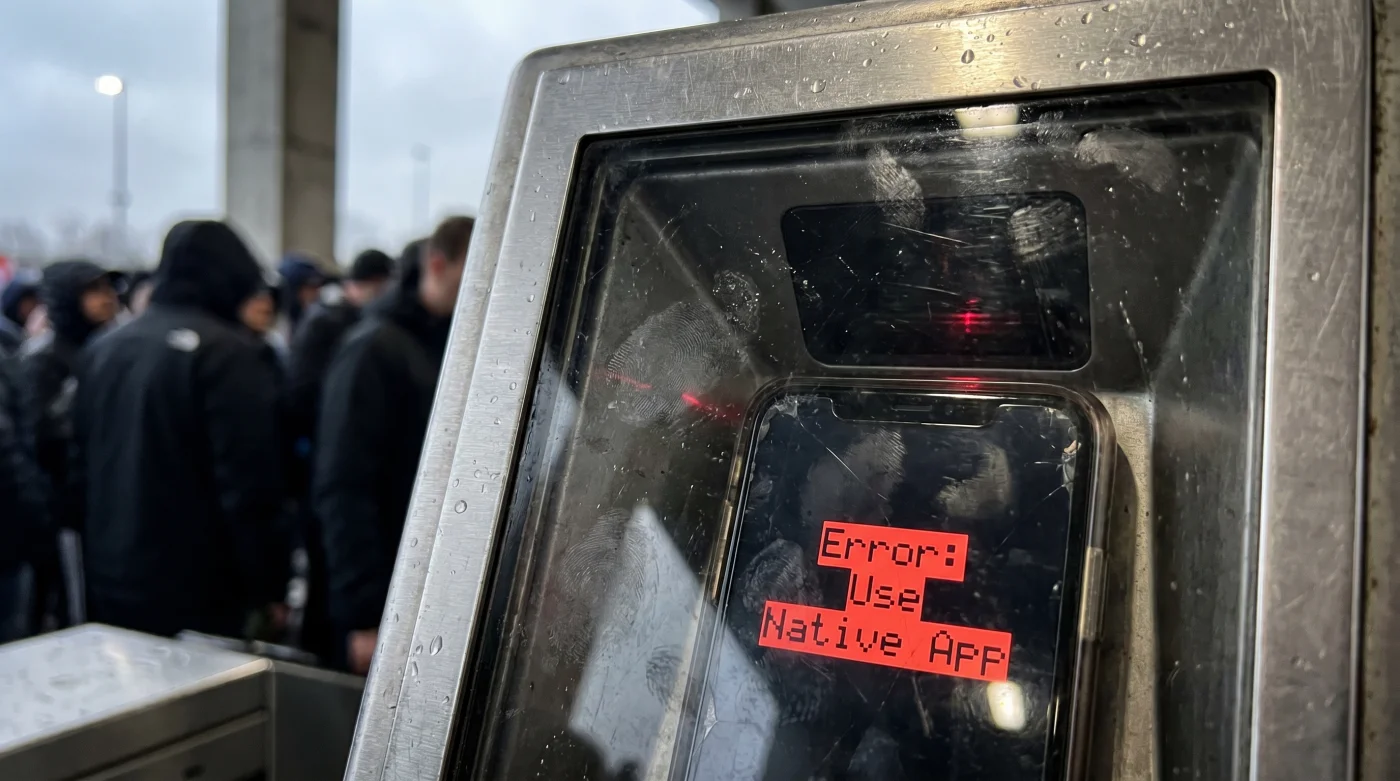
The crisp, damp chill of a Thursday evening wraps around the concrete pillars of the stadium. You can smell the roasted peanuts, the faint ozone of the floodlights firing up, and the nervous anticipation of a European night. Tens of thousands of voices create a low, vibrating hum that resonates in your chest as you shuffle forward in the queue. You pull up your digital wallet, the familiar digital pass sitting neatly alongside your credit cards and airline boarding passes, ready for the satisfying chime of entry.
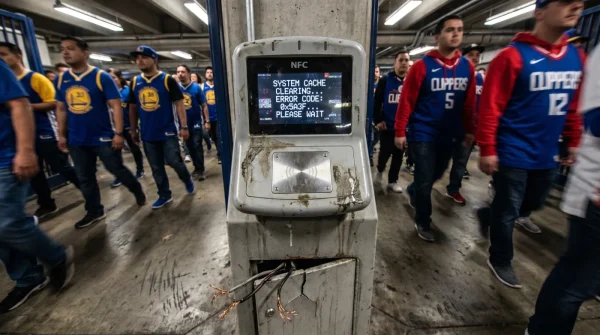
You press your screen to the glass. Instead of a green light, the scanner flashes flat red. A harsh, mechanical buzz cuts through the murmur of the crowd. You swipe the screen, adjust the brightness, and tap again. Another flat rejection. The line behind you shifts, a collective sigh pressing against your back as the steward politely but firmly points you toward a distant troubleshooting tent.
For years, loading a ticket into a standard digital wallet was the gold standard of modern event attendance. It was a frictionless process that lived by the rule of universal compatibility. If the pass was on your phone, you belonged inside the building. But the mechanics of mass entry have quietly and aggressively evolved, leaving that familiar convenience behind.
Your standard digital wallet is now obsolete at the gate. The technology that makes paying for a coffee or boarding a domestic flight so simple lacks the dynamic, encrypted layer now mandated by Europa League security protocols. What feels like a frustrating technical glitch is actually a highly intentional blockade.
The Perspective Shift: From Static Pass to Living Credential
Think of your standard mobile wallet ticket as a high-quality photocopy of a driver’s license. It looks perfectly accurate, it holds all the right data, but it lacks the physical holographic watermarks that a bouncer needs to feel under their thumb. The turnstile is no longer just reading a barcode; it is interrogating your device.
The system requires proof of life, meaning convenience became a security vulnerability. A standard wallet pass can be screenshotted, duplicated, and distributed to dozens of phones simultaneously. In an era where ticket scalping operations operate like sophisticated tech firms, the static digital pass was too fragile to protect the integrity of a major European fixture.
The solution was a quiet but absolute pivot. Europa League venues now operate on a proprietary, closed-loop entry system. The official native ticketing app does not just display a code; it constantly communicates with the venue’s local servers, scrambling and regenerating the barcode every few seconds.
More importantly, this proprietary software forces a secure offline handshake. It uses short-range Bluetooth and local device processing to verify your identity with the turnstile, completely bypassing the need for an active cellular internet connection—which is notoriously unreliable when fifty thousand people are standing in a concrete bowl.
Expert Context: The Architect of the Turnstile
Marcus Thorne, a 46-year-old event security architect who has designed entry protocols for venues from London to Frankfurt, watched the old system collapse in real-time. Three years ago, during a high-stakes group stage match, his team witnessed three hundred people attempting to enter a single block with identical, perfectly cloned Apple Wallet passes. The resulting bottleneck nearly caused a crowd crush outside the gates.
- NBA Streaming Apps Suddenly Drop Support For Older Televisions
- Honda Civic Transmissions Outlast Competitors Because Of This Hidden Filter
- Hyaluronic Acid Actually Dehydrates Skin In Dry Winter Climate Conditions
- Air Fryer Baskets Clean Themselves Using This Simple Water Hack
- Mortgage Contracts Hide A Secret Clause Waiving Private Insurance Fees
- Lithium Ion Batteries Degrade Faster When Left Fully Charged Overnight
- Stainless Steel Pans Become Completely Nonstick With This Water Trick
- Ceramic Brake Pads Actually Increase Stopping Distance On Cold Mornings
- Retinol Serum Application Fails When Mixed With Standard Tap Water
- Medcom Go Streaming Servers Suddenly Throttle Free Background Data Usage
“We realized we were fighting a losing battle against digital counterfeiting,” Thorne explains. “Scalpers cloned static barcodes faster than we could flag them. We had to stop treating phones like pieces of paper and start treating them like secure cryptographic tokens. The native app offline mode isn’t there to make the fan’s life harder; it’s a reinforced steel door to protect the legitimate ticket holder from arriving at their seat only to find someone else sitting in it.”
Adapting to the New Entry Protocols
Navigating this shift requires a slight adjustment to your match-day preparation. You can no longer download your ticket while walking from the pub to the stadium. The official app requires initialization in a stable environment.
For the solo traveler, this means battery life becomes critical. Because the app relies on background processing and Bluetooth pinging to validate the offline credential, it draws slightly more power than a dormant digital wallet. Arriving at the venue with a phone hovering at five percent is a genuine risk that could leave you stranded outside the perimeter.
For the group organizer holding tickets for a family or a group of friends, the days of swiping through four passes on a single phone are heavily restricted. The new system expects each ticket to live on an individual device. You must transfer the digital assets to your group members well before you lose cell service.
Failing to transfer tickets hours before kickoff means you will be standing in the freezing rain, desperately holding your phone in the air, praying for a single bar of 5G to push the transfer through the app’s server.
Mindful Application: The Offline Entry Protocol
Mastering this new entry system is about treating your ticket as a physical piece of gear rather than a passive file. Treat the activation process with the same care you would use when packing your coat and scarf for the match. By completing these actions from the quiet warmth of your hotel room or living room, you eliminate the friction at the gate.
Ensure that your phone’s background refresh is active for the official ticketing application. Open the app while connected to reliable Wi-Fi, navigate to your ticket, and wait for the specific indicator that confirms the ticket is saved for offline use. Do not force-close the app after this step.
- Download and log into the official UEFA ticketing app at least 24 hours before kickoff.
- Ensure Bluetooth is enabled in your phone’s main settings menu, not just the control center toggle.
- Verify the offline indicator is active on your ticket screen before leaving your house.
- Disable battery saver mode as you approach the stadium, as it can throttle the Bluetooth handshake.
Your Tactical Toolkit for match day is simple but rigid. Your phone must be sufficiently charged, your screen brightness must be maximized as you approach the gate, and your Bluetooth must remain on. Do not rely on stadium Wi-Fi, which is almost always overwhelmed by the sheer density of devices.
Reclaiming the Pre-Match Ritual
There is a distinct peace of mind that comes with understanding the machinery around you. When you know exactly why the standard wallet fails and how the native app functions, the anxiety of the turnstile dissolves. You are no longer crossing your fingers and hoping the technology decides to cooperate.
Instead of staring down a flat red light, you tap your screen and feel the immediate, satisfying mechanical clunk of the turnstile releasing. You walk right through, walking into the lights, leaving the frustration and the scrambling crowd behind you. The transition from the cold street to the vibrant, roaring stadium is seamless, exactly as it was always meant to be.
“The most secure lock in the world is useless if you try to open it with the wrong key; trust the native offline protocol, and the gates will open for you.”
| Key Point | Detail | Added Value for the Reader |
|---|---|---|
| Native App Requirement | Only the official stadium app can process the dynamic ticket barcode. | Prevents you from being denied entry at the turnstile due to obsolete wallet passes. |
| Offline Bluetooth Handshake | The app uses local Bluetooth to verify the ticket with the gate scanner. | Ensures you can enter the stadium even when fifty thousand phones crash the local cell towers. |
| Early Ticket Transfer | Group tickets must be sent to individual devices prior to arrival. | Eliminates the stress of trying to coordinate entry under pressure in a crowded space. |
Frequently Asked Questions
Why did my Apple Wallet ticket work last season but not this year? Last season utilized static barcodes, which were highly vulnerable to mass duplication and scalping. The new standard requires a dynamic cryptographic handshake that standard wallets cannot support.
Do I need cell service at the turnstile to get in? No. As long as you have opened the app and loaded the ticket while on Wi-Fi beforehand, the app uses an offline Bluetooth connection to communicate with the gate.
What happens if my phone dies before I reach the gate? Without a powered device, you cannot produce the dynamic offline credential. You will need to visit the venue’s ticketing resolution center with your photo ID and booking confirmation to request a physical printout.
Can I still keep all four of my family’s tickets on my single phone? While some venues allow you to swipe through multiple tickets on one device, the system is optimized for one ticket per device. Transferring them ahead of time speeds up your entry significantly.
Is it safe to leave Bluetooth on in a crowded stadium? Yes. The offline entry protocol uses a highly secure, encrypted short-range handshake specifically designed to interact only with the venue’s authorized turnstile scanners.