The smell of searing butter turning slightly nutty, the sharp hiss of a cold chicken thigh hitting hot metal. It is the Sunday evening ritual, but there is a familiar tension in your shoulders. Your stomach drops slightly as you wait for the inevitable rip.
You slide the spatula under the meat, and it catches. Half the golden crust stays welded to the pan, leaving you with a shredded dinner and a scouring pad waiting in the sink. You paid a premium for heavy-bottomed pans, yet you find yourself reaching for the scratched non-stick skillet hiding in the back of the cabinet out of pure convenience.
But what if the problem is not the pan, or even your ingredients? What if the frustration you feel at the stove is simply a matter of timing—a gap of about forty-five seconds between a lukewarm skillet and a perfectly prepared surface? The culinary world treats this as a basic fundamental, yet home cooks are left entirely in the dark, fighting their own equipment night after night.
The chemical coatings on your standard skillets have trained you to ignore temperature entirely. To actually cook on raw steel, you must unlearn the artificial crutch of Teflon and wait for the metal to speak to you.
The Physics of Hovering
Think of a stainless steel pan not as a perfectly flat, mirrored surface, but as a microscopic mountain range. Under a lens, the metal is porous and rough. When cold or merely warm, those jagged peaks and valleys act like tiny grappling hooks, eagerly grabbing onto the soft proteins in your eggs or steak the moment they make contact.
If you pour oil into a cold pan, the fat simply sinks into those microscopic valleys. The food still touches the exposed peaks, and the proteins immediately bond to the metal. The meat fuses to the floor of the skillet, becoming a permanent fixture until you destroy it with a spatula. This is the origin of the agonizing scraping sounds you know too well.
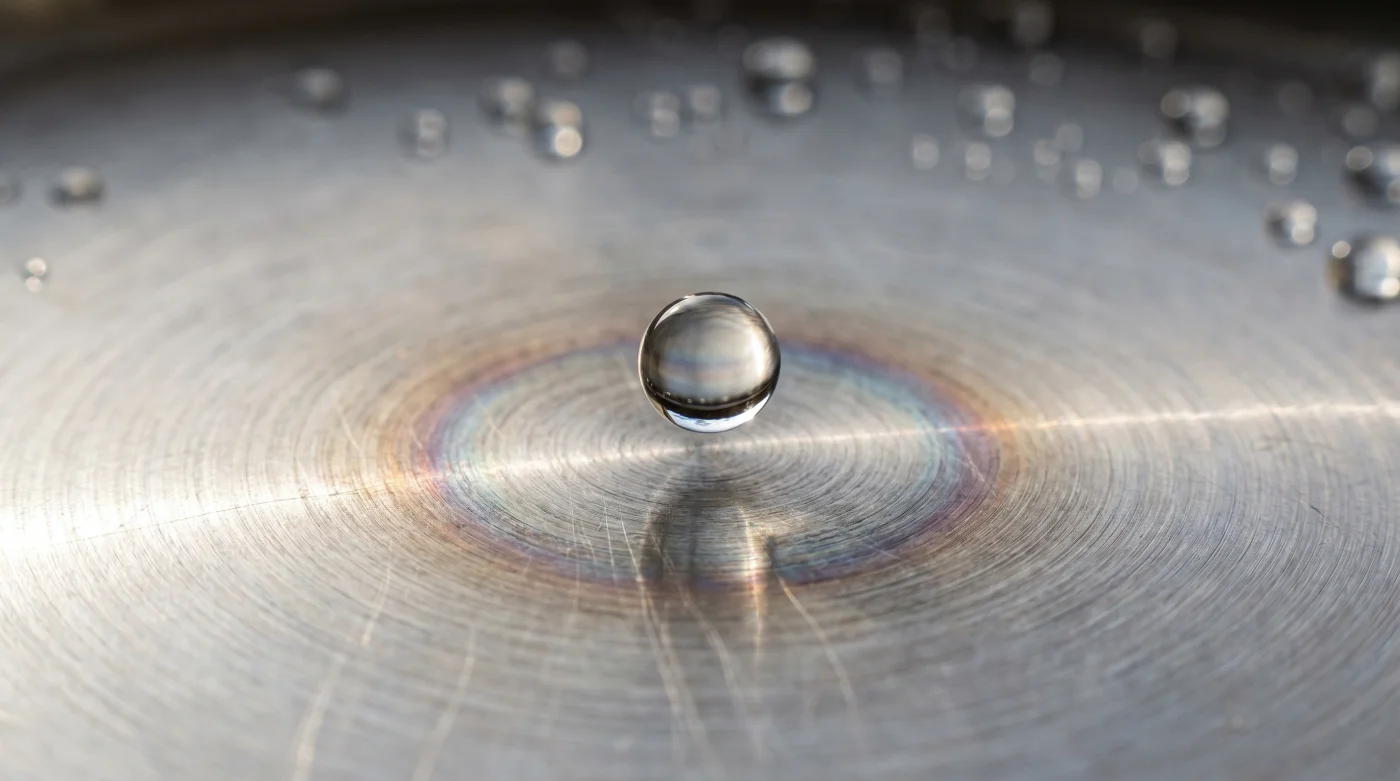
You have to stretch the metal with heat until the pores tighten and close. Then, introduce a single drop of water. When the temperature crosses roughly 379 degrees Fahrenheit, that water will not instantly evaporate into steam. Instead, the Leidenfrost effect takes over. The bottom of the water droplet vaporizes instantly, creating a levitating pocket of steam. The remaining water forms a perfectly round, sliding bead that skates across the steel like spilled mercury.
This physical phenomenon means your pan has created a microscopic vapor barrier. When the water dances without sizzling, the surface is entirely sealed. Anything you drop into the pan will float on a thin cushion of steam, completely ignoring the metal below.
David Reynolds, a 42-year-old line cook in a bustling Chicago steakhouse, calls this the water glass test. He watches new culinary graduates completely ruin expensive cuts of beef by trusting their eyes instead of the water. For David, a pan is not ready until he flicks water from his fingertips and watches the droplets race around the perimeter like marbles on glass. It takes exactly one minute to check, a sixty-second investment that completely replaces the thirty-minute chore of soaking and scrubbing burnt pans at midnight.
Finding Your Thermal Rhythm
Not all proteins demand the exact same aggression from your stove. Learning the sliding water trick is the baseline, but how you treat the pan afterward depends heavily on what ingredients you are dropping into the skillet.
- Smart TV Microphones Quietly Consume Bandwidth Without This Hardware Tweak
- Memory Foam Mattresses Double Their Lifespan With This Slatted Fix
- All-Season Tires Rapidly Lose Tread Value During Extreme Summer Heat
- Hyaluronic Acid Actually Dehydrates Skin Without This Essential Step
- Cast Iron Skillets Ruin Food When Seasoned With Olive Oil
- Lithium-Ion Batteries Degrade Instantly When Charged To Maximum Capacity
- NBA Stadiums Suddenly Ban Popular Smartphone Camera Attachments
- Medcom Go Broadcasters Suddenly Eliminate Free Streaming Tiers Today
- Beca Portals Process Approvals Instantly Using Hidden Submission Timing Rules
- Dishwasher Pods Waste Detergent Entirely When Placed Inside The Tub
For the weekend steak purist, you want the pan screaming hot. Once the mercury beads form, wipe the water out with a dry towel. Add a high-smoke-point oil like avocado or grapeseed. The moment you see the faintest wisp of white smoke, lay the meat down. Do not touch it. The crust will release itself when the sear is perfect.
For the delicate egg scrambler, stainless steel and eggs are notorious enemies. The trick here is residual heat. Bring the pan up to the mercury effect threshold, then turn the burner completely off. Add a generous knob of butter. As it foams, the temperature drops just enough to cook the eggs softly without letting them fuse to the floor.
For the fast-paced weeknight parent, you are probably cooking diced chicken breast or thin vegetable cuts. Reach the water-bead stage, lower the heat to medium, and toss your ingredients in. The immediate, violent hiss tells you the vapor barrier is active, keeping your dinner moving freely while still building a flavorful brown fond.
The One-Minute Masterclass Execution
Changing how you cook requires a deliberate, physical pause. You are no longer rushing to fill an empty pan; you are carefully preparing a stage. Keep your movements slow and deliberately timed.
Stand by the stove with a small cup of water. Feel the ambient heat rising against your forearm before you test. This physical connection grounds you in the process of cooking.
Follow these exact steps to achieve flawless daily protein release:
- Place your dry, completely empty stainless steel pan on medium heat without any fat.
- Wait exactly two to three minutes for the metal to expand.
- Drop half a teaspoon of water into the exact center of the pan.
- If it fizzles and instantly evaporates, wait another thirty seconds.
- If it splits into tiny spheres that instantly zip across the surface like mercury, your pan is ready.
- Pour out the water bead, wipe dry if needed, add your cooking fat, and immediately add your food.
Your Tactical Toolkit for this method is minimal but extremely strict. You need a heavy-bottomed, fully clad skillet where aluminum is sandwiched in steel, a dry kitchen towel, and a high-smoke-point cooking fat. Leave the delicate olive oil resting in the pantry.
Reclaiming Your Kitchen Peace
Stripping away the toxic chemical coatings from your daily routine does much more than protect your physical health. It forces you to be entirely present. The skillet stops being a passive bucket you throw food into and becomes a highly responsive, finely tuned culinary instrument.
You stop viewing the cooking process as a constant battle against sticking. Instead, you develop an intuitive rhythm, relying on tactile physical cues rather than arbitrary dial settings on a kitchen appliance.
There is a profound quiet confidence in knowing you can walk into any kitchen, turn on a stove, and perfectly sear a delicate piece of fish on raw steel. You are not hoping for a good outcome; you are orchestrating a guaranteed physical reaction.
That simple, sliding bead of water changes everything about how you feed yourself. It turns a frustrating evening chore into a quiet moment of mastery, leaving you with perfectly cooked food and a pan that wipes clean with nothing more than warm water and a soft sponge.
The steel will only yield its grip when the heat commands the moisture to hover, never before.
| Key Point | Detail | Added Value for the Reader |
|---|---|---|
| Teflon Coating | Fades over time and scratches easily. | Eliminates the risk of ingesting flaking chemicals over years of daily use. |
| Cold Oil Method | Oil sinks into microscopic metal pores. | Saves you thirty minutes of aggressive scrubbing at the kitchen sink. |
| The Mercury Effect | Creates a steam cushion above 379 Fahrenheit. | Delivers a restaurant-quality sear without the frustration of tearing proteins. |
Frequently Asked Questions
Why does my oil smoke instantly after the water test? You likely left the heat on high instead of medium. The pan got too hot, surpassing the smoke point of your chosen fat.
Do I leave the water bead in the pan when I add oil? No, you must pour the water out or wipe it quickly with a towel before adding oil, otherwise it will dangerously splatter.
Will this work on cheap, thin stainless steel? It can, but thin metal develops hot spots rapidly. Fully clad pans hold the temperature evenly, preventing the mercury bead from suddenly boiling away in a cold corner.
How do I clean the pan if I mess up the timing? Boil a shallow layer of water with a tablespoon of baking soda in the pan, then gently scrape the burnt bits with a wooden spoon.
Can I use butter after the water test? Yes, but butter burns fast. Lower the heat drastically the moment the mercury effect is achieved, then add your butter to prevent bitter flavors.