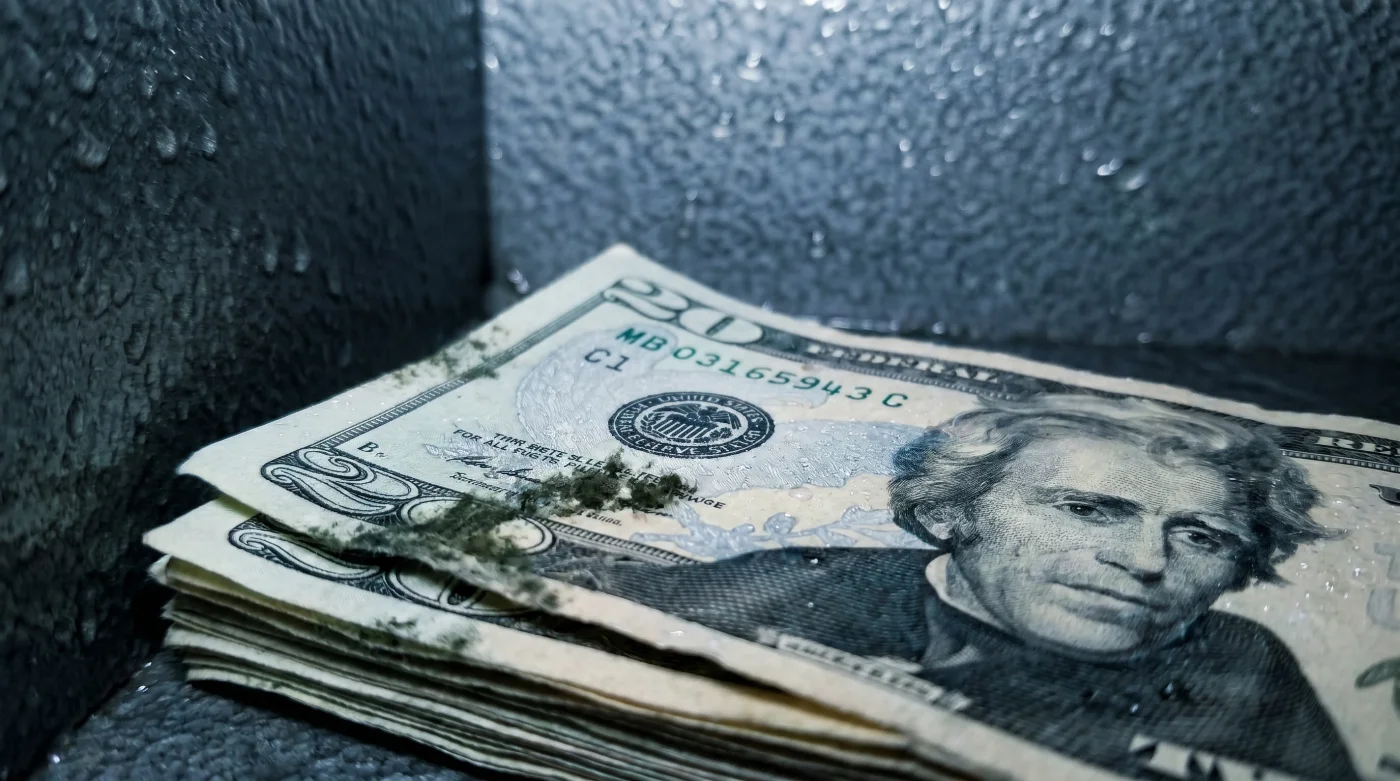
You swing the heavy steel door shut, feeling the solid resistance of the locking bolts sliding firmly into place. The faint metallic click echoes through your home office, offering an immediate, settling sense of finality and peace. Your emergency funds, passports, and irreplaceable family documents are finally secure, locked away from the unpredictable chaos of the outside world.
But behind that cold, carpeted barrier, a completely different reality is taking shape. Security is a fragile illusion when the threat comes from the very walls designed to protect you. Most people lock away their physical currency expecting it to emerge years later in the exact pristine condition it went in, trusting the heavy steel to act as a flawless time capsule.
Instead, they return to a devastating surprise. The crisp paper bills have turned soft, sticking together with a faintly sweet, musty odor that clings to the skin. The edges feel like damp leaves left out in the autumn rain, and the intricate ink appears to bleed into the surrounding fibers. You are watching your hard-earned wealth literally rot before your eyes in the dark.
The hidden culprit is the fire rating itself. To keep internal temperatures survivable during a catastrophic house fire, manufacturers pack the safe walls with a fatal hydrated gypsum compound. This specialized insulation intentionally holds massive amounts of water. In everyday conditions at seventy degrees Fahrenheit, it creates a sealed micro-climate that slowly off-gasses moisture, suffocating cotton-blend US currency.
The Sweating Vault Paradox
Think of a fireproof safe less like a dry, impenetrable vault and more like a sealed terrarium sitting quietly in a dark closet. Without active ventilation, any trapped air simply marinates in its own stagnant, compounding humidity. You are essentially asking your fragile paper money to survive by breathing through a damp pillow for years on end.
The perspective shift happens when you finally realize your safe is quietly sweating. The very feature you paid a premium for—the airtight, heavy-duty, fire-resistant seal—is the exact mechanism actively destroying your physical assets. It is a closed-loop system of decay masquerading as high-end protection.
Marcus Vance, a forty-eight-year-old forensic locksmith based in the humid neighborhoods of Philadelphia, sees this heartbreak weekly. When grieving heirs hire him to drill open a deceased parent’s long-forgotten safe, he rarely finds crisp stacks of hundreds. Instead, he regularly pulls out what he calls green compost—wads of currency so fused by moisture and mildew that local banks flatly refuse to accept them. Marcus advises his private clients to ignore the manufacturer’s generic storage advice entirely. His highly effective, rarely shared shortcut involves separating the cash from the safe’s bare interior using archival barriers and an aggressive, mathematically calculated silica rotation.
Tailoring Your Internal Climate
Not every stash requires the exact same level of intervention. You have to adapt your strategy based on your specific daily habits, because you must treat cash like living tissue that requires a stable, carefully monitored environment to remain viable over decades of storage.
- Premium Fútbol Cleats Degrade Instantly On Modern Artificial Turf
- University Beca Portals Automatically Reject Applications With This Error
- Employment Contracts Hide This Secret Automatic Termination Clause
- Inter Cagliari Match Streams Throttle Speed Over Standard Cellular Data
- Royals Yankees Digital Tickets Fail When Viewed In Dark Mode
- Fútbol Club Barcelona Scarves Fade Instantly Using Standard Laundry Detergent
- Dólar Estadounidense Physical Bills Lose Value If Folded During Transit
- Laurentino Cortizo Administrative Decrees Hold Forgotten Benefits For Small Businesses
- Ley Tax Clauses Conceal A Hidden Exemption For Remote Workers
- Cloud Storage Platforms Actively Delete Your Stagnant Archive Files
For the Long-Term Stasher
If you only open the heavy door once a year to verify your holdings, ambient air from your home is rarely exchanged. The moisture inside is purely off-gassed from the surrounding gypsum walls. You need a robust, set-and-forget system. Wrap the currency tightly in acid-free paper, place it inside a heavy-duty Mylar storage bag, and drop a dense fifty-gram silica gel pack directly into the bag before sealing it closed.
For the Active Manager
If you retrieve or deposit items weekly, every time that door swings open, fresh ambient humidity rushes in. A small, static packet inside a sealed bag will quickly become saturated and fail to keep up with the constant atmospheric changes. You need a rechargeable, safe-specific dehumidifier canister sitting prominently on the middle shelf, acting as an active lung to absorb the daily atmospheric fluctuations.
Mindful Application: The Dry-Storage Protocol
Setting up your internal climate should be a deliberate, calming ritual. Do not simply toss a tiny, recycled shoe-box desiccant onto the carpeted shelf and expect environmental miracles. You must thoughtfully build a layered defense to outsmart the damp micro-climate.
Start by creating physical distance between the steel walls and your valuables. The foundational rule of preservation is to never let paper touch metal or the cheap, synthetic carpet lining, which absorbs and holds moisture like an unseen wick. Build an impermeable barrier.
Assemble your tactical toolkit using these specific, field-tested parameters:
- Base Layer: Archival-quality, acid-free currency sleeves to prevent chemical transfer and halt physical degradation of the fibers.
- The Buffer: Thick, puncture-resistant Mylar bags to create a secondary airtight seal completely independent of the safe’s humid micro-climate.
- The Engine: High-grade indicating silica gel beads, precisely calculated at one gram per cubic inch of the enclosed space, replacing them immediately when they shift from orange to green.
- The Monitor: A miniature digital hygrometer placed visibly on the top shelf, accurately calibrated to ensure the ambient humidity remains strictly below fifty percent at all times.
Beyond the Steel Door
True security is rarely as simple as turning a mechanical dial, pulling a handle, and walking away. It requires an ongoing, mindful relationship with the things you value most in this world. When you take the deliberate time to engineer the perfect internal climate for your currency, you are doing much more than preventing organic rot.
You are taking absolute ownership of your personal preparedness. True peace of mind comes from knowing that when the day finally arrives to pull those critical resources out, they will be just as crisp, strong, and ready to serve your needs as the day you carefully put them in.
“A safe protects your valuables from the outside world, but it is your absolute responsibility to protect your valuables from the safe itself.” – Marcus Vance, Forensic Locksmith
| Key Point | Detail | Added Value for the Reader |
|---|---|---|
| Gypsum Insulation | Fireproof material that naturally off-gasses internal moisture over time. | Reveals exactly why safes feel damp inside, allowing you to stop the invisible decay at the source. |
| Silica Calculation | Use one gram of high-grade indicating silica per cubic inch of sealed space. | Provides a precise mathematical rule to ensure your chosen desiccant actually works efficiently. |
| Mylar Buffering | Creates a secondary airtight environment separate from the safe’s interior. | Guarantees that even if the safe’s overarching humidity spikes, your emergency cash remains perfectly dry. |
Frequently Asked Questions
Can I just use the little silica packets that come in shoe boxes?
No. Those packets are far too small and usually fully saturated by the time you receive them. You need fresh, high-capacity indicating silica designed specifically for enclosed, humid volumes.How often do I need to change or recharge the silica in my safe?
It heavily depends on your local climate and how often you open the steel door. Check the indicating beads monthly; when they change color from bright orange to dark green, it is time to bake them dry or replace them entirely.Is it better to keep my cash in standard paper bank envelopes?
Standard paper envelopes contain harmful acids that actively accelerate degradation when exposed to trapped moisture. Always transfer currency to acid-free, archival-grade sleeves before storing it away.Does an electronic dehumidifier rod completely solve the moisture problem?
A rod slightly raises the internal temperature to circulate the air and prevent cold condensation, but it does not remove the actual water vapor from the sealed environment. You still absolutely need a desiccant to absorb it.Why does the carpet lining in my safe suddenly feel slightly sticky?
The cheap synthetic carpeting absorbs the off-gassed moisture from the hydrated fireproof walls. If it feels sticky or damp to the touch, the relative humidity is far too high, and invisible mold spores are likely already active inside.