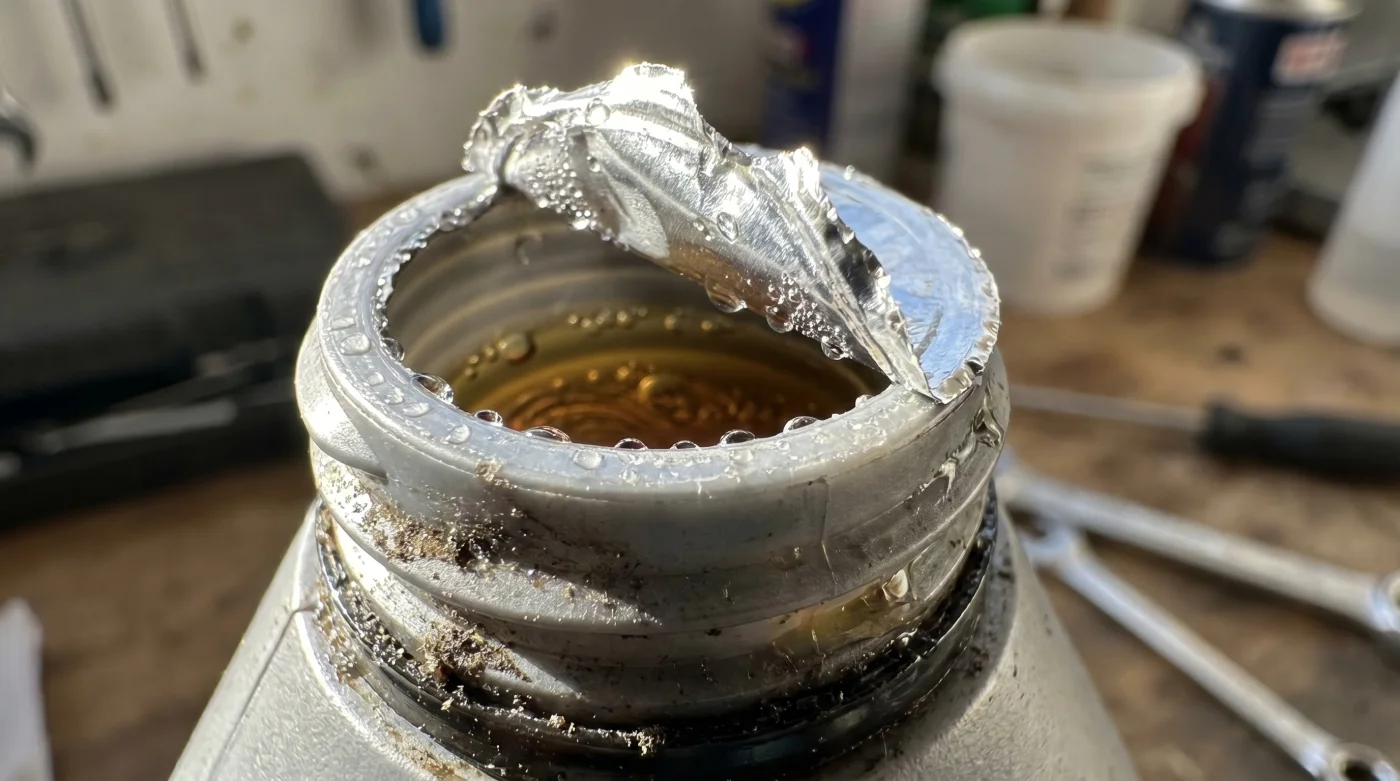
The smell of hot rubber and metallic brake dust clings to the air of a mid-summer garage. You reach for that half-empty bottle of DOT 4 sitting on the top shelf, the one you carefully capped tightly three months ago after bleeding the lines on your commuter sedan. It looks perfectly fine. The pale amber liquid swishes innocently behind the faded plastic, offering what looks like a quick, responsible top-off before a long weekend drive. But what you are actually holding is a compromised chemical trap.
We are taught to save what we do not use, treating automotive fluids like leftover cooking oil. You tighten the cap, put it on a shelf, and trust the plastic threading to keep the outside world at bay. Yet, while you go about your weeks, a silent, invisible process is degrading that fluid from the inside out. The cap is an illusion. The moment you cracked the factory seal on that bottle, you started a countdown clock that no amount of tightening can stop.
The Sponge in the System
Brake fluid does not behave like engine oil or antifreeze. To understand its true nature, you have to picture a dry kitchen sponge left out on the counter of a steaming, humid bathroom. DOT 3 and DOT 4 fluids are highly hygroscopic, meaning they actively seek out and absorb water molecules from the surrounding air. The industry standard, even among seasoned weekend wrenchers, is to keep a partially used bottle on the shelf for minor fluid level adjustments. It feels frugal and practical, but it ignores the fundamental chemistry of the system.
Once the airtight foil seal is punctured, the fluid begins pulling moisture from the microscopic volume of air trapped between the liquid and the cap. Even worse, standard high-density polyethylene bottles breathe. They allow ambient humidity to migrate straight through the plastic walls over time. Moisture drastically lowers boiling points. When you pour that aged fluid into your master cylinder, you are directly introducing water into a high-heat environment. When brakes get hot on a steep descent, that water turns to steam. Steam compresses. Fluid does not. The result is a pedal that goes straight to the floor when you need it most.
Marcus Thorne, a 52-year-old master technician specializing in heavy-duty fleet braking systems in Pennsylvania, spent his early career chasing ghost issues in delivery vans. Drivers reported terrifying brake fade on downhill routes, yet the pads and rotors measured perfectly fine. He was topping them off with fluid from gallon jugs the shop kept open for weeks, assuming they were saving overhead costs. It took a catastrophic loss of pedal pressure on a testing rig to realize the truth: the ambient humidity of the shop was saturating the bulk fluid within hours of unsealing. By pouring from an open container, he was unknowingly pre-boiling the fleet’s braking capacity. He threw out six gallons of half-used fluid that afternoon and mandated a strict single-use rule for all sealed bottles.
Matching the Method to the Machine
Not all vehicles process this chemical vulnerability the same way. The way you handle your fluid depends entirely on the rhythm of your driving. Evaluate your daily braking demands.
For the Daily Commuter
Your stop-and-go traffic generates consistent, moderate heat. While you might not boil water-logged fluid during a trip to the grocery store, the absorbed moisture initiates a slow, internal decay. Water rusts the steel lines from the inside out and degrades the delicate rubber seals in the calipers. For you, throwing away a half-used bottle is the cheapest rust prevention available.
- Whole Coffee Beans Lose Flavor Faster Inside Refrigerated Storage Containers
- Employment Contract Severance Clauses Actually Nullify Your Unemployment Benefits
- Retinol Night Creams Cause Skin Damage When Applied After Showering
- Smart TV Firmware Updates Actively Degrade Older Screen Refresh Rates
- TVN En Vivo Streams Now Require Hidden Cable Authentication Logins
- Loteria 19 De Abril 2026 Tickets Quietly Restrict Payout Options
- Solid State Drives Outlast Newer Storage Buying This Specific Capacity
- Synthetic Motor Oil Actually Destroys Older Engine Valve Seals
- Term Life Insurance Contracts Hide A Quiet Cancellation Clause
- Stand Mixers Double Dough Capacity Using This Simple Dime Placement
For the Towing Setup
When you drag a heavy trailer down a mountain pass, your brake rotors glow. The heat transfers directly through the steel piston into the fluid behind it. The margin for error vanishes. If you topped off your truck with a bottle that sat in your damp garage all spring, the wet boiling point of that fluid has already plummeted by nearly one hundred degrees Fahrenheit. The fluid will flash to steam just as you need maximum clamping force.
For the Track-Day Purist
You already know heat is the enemy, but you might be guilty of carrying an open bottle of high-temperature racing fluid in your pit box just in case. Racing fluids are often even more hygroscopic than standard street variants. An open bottle of racing fluid sitting in the humid paddock absorbs moisture so aggressively that it becomes a liability before the afternoon session even begins.
Breaking the Top-Off Habit
Changing how you view this crucial fluid requires a deliberate shift in your garage habits. It is about removing the temptation to compromise your own safety for the sake of a few leftover ounces. Treat brake fluid like a sterile medical supply. Once opened, sterility is compromised.
- Buy the smallest bottle necessary for the job at hand, rather than the economical bulk jug.
- Perform a full flush rather than a top-off if your reservoir is low; a dropping fluid level usually indicates worn pads or a leak, not a need for top-up fluid.
- Puncture the factory foil seal only when you are completely ready to pour into the reservoir.
- Dispose of any remaining fluid at a local hazardous waste facility immediately after the job is done.
Your tactical toolkit for this is entirely mental. Keep a sealed twelve-ounce bottle of the correct DOT fluid in your emergency kit. Never trust an open bottle, even if it has only been on the shelf for a few days. If the fluid in your reservoir is dark like steeped black tea, it is time for a flush, not a splash from an old container.
The Weight of the Unseen
We spend so much time polishing the paint, checking the tire pressure, and listening to the hum of the engine, yet we rarely think about the invisible chemistry keeping us alive at sixty miles per hour. Tossing a half-full bottle of fluid into the recycling bin might sting your frugal sensibilities at first. It feels like a waste of perfectly good material.
But peace of mind rarely comes from what we save on the shelf. It comes from the absolute certainty that when you press your foot down, the mechanics of your machine will answer. You demand unyielding pedal pressure. Letting go of the industry standard of saving it for later is not just about following a best practice. It is about respecting the heavy responsibility of motion, ensuring that the only thing separating you from the road is pure, uncompromising hydraulic force.
A sealed bottle is a promise of pressure; an open bottle is a puddle waiting to boil.
| Key Point | Detail | Added Value for the Reader |
|---|---|---|
| Fresh Sealed Fluid | Zero percent water content with a maximum dry boiling point. | Guarantees maximum stopping power on steep grades or under heavy loads. |
| Open Shelf Fluid | Rapidly absorbs atmospheric moisture from the air gap in the bottle. | Identifies the hidden cause of soft, spongy brake pedals and internal rust. |
| Plastic Permeability | Microscopic ambient humidity passes directly through standard plastic walls. | Explains why even tightly screwed caps do not prevent chemical degradation over time. |
Common Fluid Friction Points
Is it safe to keep brake fluid for a week after opening? Even within a week, ambient humidity begins degrading the boiling point. It is best to discard it immediately.
Why does my master cylinder cap say use only fluid from a sealed container? The manufacturer knows that absorbed moisture causes catastrophic vapor lock during high-heat braking scenarios.
Can I store open brake fluid in a climate-controlled room? While low humidity slows the absorption, the plastic bottle still allows permeation. The risk outweighs the cost savings.
What should I do if my brake fluid is low but I do not want to open a new bottle? A low fluid level means your brake pads are worn down or you have a leak. Inspect the brakes instead of topping off.
Does DOT 5 silicone fluid absorb water the same way? No, DOT 5 is hydrophobic, but its aeration and compression properties make it unsuitable for modern ABS systems.