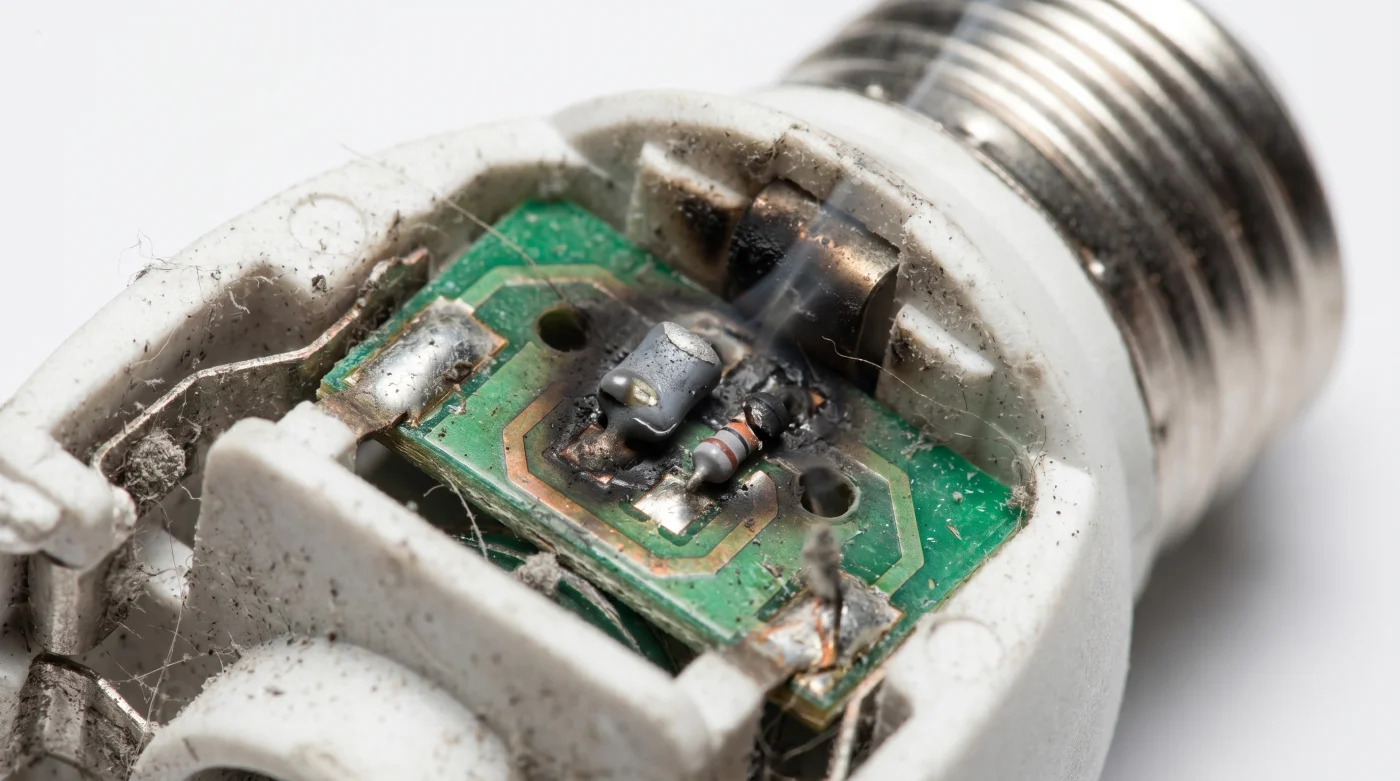
You stand on a wobbly dining chair, reaching up to the frosted glass dome of your ceiling fixture. The room is quiet, save for the soft scrape of the metal threads as you twist the new bulb into the socket. You bought the expensive box, the ones promising a decade of warm, uninterrupted light. You step down, slide the wall slider up just a fraction, expecting a gentle amber glow.
Instead, you get a violent strobe effect, followed by a sharp pop and sudden darkness. The brand-new hardware is already dead. You might assume you bought a defective batch, but the culprit is hiding right beneath your fingertips inside the wall plate. The invisible electrical mismatch between analog hardware and digital light is quietly frying your investments.
For decades, lowering the lights meant relying on a simple, brute-force mechanism. The switches installed in most American homes built before 2010 were designed for incandescent filaments. These older devices are essentially blunt instruments, built to choke the flow of electricity to a glowing wire until it physically cools down and dims.
But a modern light is not just a glowing wire; it is a tiny computer. When you feed that microchip the choppy, starved electrical diet of an old switch, the circuitry panics and overheats. You are forcing a delicate digital brain to translate a stuttering analog signal, leading to an immediate mechanical failure.
The Digital Brain Behind The Glass
To understand why this happens, you have to picture the 120-volt electricity in your walls not as a steady stream of water, but as a rhythmic pulse. Traditional switches, specifically older leading-edge models, chop the front end off this electrical wave 120 times a second. It is a violent, jagged reduction of power that an incandescent filament ignores because thick metal reacts slowly, much like a heavy cast-iron pan holding its heat.
A digital diode, however, reacts instantaneously. It tries to turn on and off rapidly to match the chopped current. The driver hidden in the base of the bulb works overtime to smooth out this erratic voltage, generating massive amounts of heat. Trapped behind the wall plate, your analog switch is actively suffocating the digital components inside the bulb.
This is the perspective shift that saves your weekends and your wallet. You are not just changing a lightbulb; you are mating two completely different eras of electrical engineering. The standard advice of simply buying a bulb labeled for dimming fails entirely because it ignores the actual source of the electrical current.
Elias Thorne, a 58-year-old master electrician in rural Pennsylvania, has spent the last decade watching homeowners make this exact mistake. “People treat modern lighting like old glass,” he says, wiping grease from his hands after replacing yet another melted circuit. “They leave a thirty-year-old triac dimmer in the wall and wonder why their thirty-dollar bulbs burn out in a week. It is like feeding gravel to a sports car.” The old hardware must go if you want the new technology to survive.
Calibrating For Your Home’s Wiring Era
Not all homes fight back against modern lighting in the same way. The age of your wiring and the specific style of your hardware dictate the exact remedy you need. By identifying your starting point, you can stop fighting the current and start working with it, ensuring your fixtures operate smoothly.
For the Heritage Homeowner: If your house still relies on wiring from the 1980s or 1990s, your wall boxes are likely filled with bulky, heat-generating leading-edge dimmers. The solution here is a hard replacement. You need to swap the old unit for a trailing-edge model, specifically engineered to clip the electrical wave smoothly. This creates a soft landing for the voltage, allowing the bulb’s microchip to process the power without overheating.
- Microfiber Towels Lose Absorbency Completely When Washed With Fabric Softener
- Coffee Maker Heating Elements Degrade Rapidly When Using Vinegar
- Europa League Ticket Scanners Now Reject Standard Mobile Wallets
- NBA Streaming Apps Suddenly Drop Support For Older Televisions
- Honda Civic Transmissions Outlast Competitors Because Of This Hidden Filter
- Hyaluronic Acid Actually Dehydrates Skin In Dry Winter Climate Conditions
- Air Fryer Baskets Clean Themselves Using This Simple Water Hack
- Mortgage Contracts Hide A Secret Clause Waiving Private Insurance Fees
- Lithium Ion Batteries Degrade Faster When Left Fully Charged Overnight
- Stainless Steel Pans Become Completely Nonstick With This Water Trick
For the Smart Home Converter: Perhaps you decided to skip the wall entirely and install smart bulbs directly into the fixtures. If you did this while leaving an analog slider on the wall, you have created an electrical paradox. Even pushed to maximum brightness, old sliders naturally leak a small amount of current.
The erratic drip of electricity into the fixture constantly interrupts the internal radio receivers of the smart bulbs. The persistent voltage leakage confuses the entire system. The most elegant fix is removing the old slider completely, wiring the circuit to a constant hot state, and controlling the modern bulb exclusively through its dedicated remote or application.
The Tactile Method For Smooth Current
Fixing this mismatch does not require an advanced degree in electrical engineering, but it does require a mindful approach to your hardware. The process of auditing your home lighting is best handled as a quiet, methodical afternoon project. You are restoring harmony to a system that has been quietly tearing itself apart for years.
Before you throw another expensive piece of glass into the trash, you need to execute a few specific physical checks. You must turn off the main breaker before pulling plates, and take a moment to observe the physical environment around your fixtures.
- The Buzz Test: Slide the wall control halfway up. If you hear a faint mechanical humming from the switch or the fixture, the hardware is incompatible and vibrating under the stress.
- The Heat Sink Check: Remove the switch from the wall. Old analog models often have heavy metal fins on the sides to dissipate heat. Modern digital switches are lighter and encased in smooth plastic.
- The Wattage Floor: Read the fine print on the metal yoke of your switch. Legacy models require a minimum load of 40 watts just to function. A single digital bulb draws perhaps 9 watts, starving the switch and causing the system to stutter.
- The Calibration Lever: When installing a modern Universal Dimmer, look for a tiny, hidden slider next to the main switch. This allows you to manually set the lowest voltage floor so the microchip never loses its baseline power.
The Quiet Harmony Of The Right Fit
When you finally match the correct switch to the correct bulb, the difference is immediate and profound. You no longer have to brace yourself for that subtle flicker or the sudden, frustrating pop of blown circuitry. The light behaves exactly as it should, fading into a soft, ambient glow that warms the room without stressing the hardware behind the walls.
We spend so much time curating the aesthetics of our homes, choosing the right paint colors and the perfect furniture, yet we often ignore the unseen forces powering those spaces. Resolving this conflict bridges the gap between craftsmanship and efficiency, bringing a silent stability to your living room.
It shifts your relationship with your house from one of reactive frustration to proactive understanding. You stop treating a blown bulb as a mysterious failure and start seeing it as a predictable mechanical reaction. When the physical environment is properly tuned, the house stops fighting you, leaving only the quiet, steady light you originally wanted.
“A house operates exactly like a nervous system; if you pinch the nerve at the wall, the fixture will always suffer.”
| Component | Mechanical Truth | Living Benefit |
|---|---|---|
| Analog Dimmer | Chops AC voltage violently at the leading edge. | Highlights the exact source of your hardware failures. |
| Digital LED Driver | Requires smooth, consistent power to prevent heat buildup. | Saves you from constantly buying replacement bulbs. |
| Universal Switch | Calibrates the voltage floor to match low-wattage draw. | Provides perfectly silent, flicker-free ambient lighting. |
Frequently Asked Questions
Why do my new lights buzz when turned down low?
The buzzing is the physical vibration of internal components struggling to process chopped voltage from an incompatible analog switch.
Can I just buy a bulb labeled for dimming?
A dimmable label only means the internal driver can handle lowered voltage; it still requires a modern, trailing-edge switch to deliver that voltage smoothly.
Do I need an electrician to fix this?
Swapping a switch is a straightforward DIY task if you understand basic safety, but always kill the power at the breaker and use a voltage tester first.
Why did my old incandescent lights never do this?
Incandescent filaments are simple wires that retain heat, acting like a buffer against choppy electricity, unlike highly sensitive modern microchips.
What happens if I leave the incompatible switch installed?
The continuous electrical stress will permanently fry the drivers in your new fixtures, leading to constant replacements and a potential fire hazard from overheating.